The purpose of the “100 Oaks Project” blog is to locate and document the 100 oldest and most historically significant live oaks in Louisiana.
I create photographic portraits of the oaks, take measurements, describe their locations (with some exceptions due to shifting landscapes and passing time), and document the histories of the trees, their sponsors, and, occasionally, their saviors.
We hope you enjoy the journey—and look forward to hearing from you. Bill & Cyndi
Note: All photographs and text (c) William Guion 2015. No part of this blog may be reproduced, distributed, or transmitted by any means, without the prior written permission of William Guion. Thank you.
I have a Google auto search set up so that each morning I receive an email containing any news story that contains the word “live oak” in its content. These days many of the stories are about people and communities working to save one or more oak trees from being removed to make way for everything from new sidewalks, to condominiums, to hotels and even storage units. These stories don’t originate from only the South, but throughout California as well.
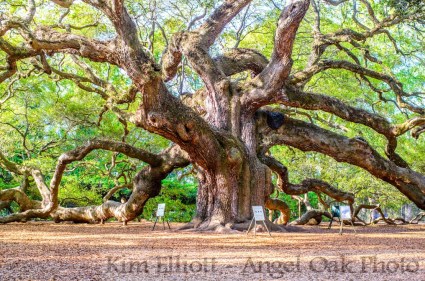
Recently, I read a story titled, the “Oldest Oaks in the World.” Oddly enough the writer listed the Angel Oak on John’s Island, South Carolina, as one of the top 10 oaks. This isn’t the first reference to the Angel Oak I’ve read recently. It comes up quite often in my daily Google auto-search. I have mixed feelings about all of the attention that it receives. It is a beautiful live oak and I don’t mean to throw “shade” toward the tree or the numerous people who work to protect it. It has a long history and at almost 25 feet in circumference, it is likely several hundred years of age. Most accurately between 300 and 400 years, NOT the wild estimates of 1000 years and more. Its massive limbs stretch long and dip to the ground creating a remarkably twisted and distinctive shape. It also has rumors of a dark past when it may have been used as a site of torture or hangings. All the ingredients for strong emotions, both love and hate.
My problems with all of the attention the Angel Oak receives are these: 1. The wild claims of its age and size. The Angel Oak is NOT one of the oldest oaks in the world. This is just hyperbole. It’s not even the oldest live oak east of the Mississippi as regularly quoted in so many articles. The Seven Sisters Oak in Mandeville, LA (also east of the Mississippi) is almost 40 feet in circumference and has been dated by arborists to actually be almost 1,000 years old—far older and larger than the Angel Oak. In fact, several Louisiana live oaks featured in my blog are larger and older than the Angel Oak (the Edna Szymoniak Oak in Hammond, LA, the Lorenzo Dow Oak in Grangeville, LA, the Jefferson College Oak in Convent, LA, the Governor’s Oak in Baton Rouge, LA, to name just a handful. All of these oaks have girths of more than 30 feet and were possibly growing before America was colonized by Europeans.
2. Too much attention. People don’t realize that all of the attention directed at the Angel Oak could quickly turn into violence toward the tree, its history, the community members, and even as a reaction to the love and care it receives. A case in point is the much-loved Treaty Oak in Austin, Texas, that in 1989 was poisoned by an individual bent on killing the estimated 600-year-old Austin landmark. Another highly publicized case of tree vandalism occurred in England when two young men cut down the iconic Sycamore Gap tree along historic Hadrian’s Wall in 2023. They were sentenced to four years in prison. There are a lot of angry people in the world today. It would be a tragedy and a heartbreak for oak tree lovers if someone took their anger out on a beautiful and beloved old oak because it was too often in the spotlight.
On a recent visit to Louisiana, I took a side road off of the Interstate Hwy. to visit the small town of Washington and the Lastrapes (or Seven Brothers) Oak. Located about a mile out of town on State Highway 182, the large old oak still stands proudly and is well-maintained by the Lastrapes family who still owns the property on which the oak grows. When I stopped to re-photograph the tree, there was a work crew doing maintenance on the fence (shown behind the tree in the photo above).
The Lastrapes Oak is the seventh tree listed in Dr. Edwin L. Stephens’ 1934 magazine article in the Louisiana Conservation Review. It is one of the original 43 member trees in the Live Oak Society and is #9 on the Live Oak Society’s registry, which contains a growing list of more than 10,000 member trees. Even my panoramic photograph hardly gives an idea of the massive size and girth of the unusual multiple trunks of this old oak. The main trunk is more than 33 feet in circumference. The largest secondary trunk is almost 30 feet around at a height of 4 feet. This beautiful old tree is one of my favorite live oaks in Louisiana and is surely a monument of a different kind.
The Seven Brothers’ name supposedly came from a story that said the tree was named for seven Lastrapes brothers who had left home to fight in the Civil War. Another variation of the story, described in Ethelyn Orso’s Louisiana Live Oak Lore, claimed that the birth of his seventh son prompted Jean Henri Lastrapes to request that seven oaks be planted; the workers arrived late in the day with the seedlings and temporarily put them in one container (or hole). The business of the days that followed in the cotton fields distracted the workers from ever completing the planting task—and thus the trees grew together, sharing the close proximity of their original planting site. For a complete story of the tree’s history, you can read my original post in this blog.
Whichever story is accurate, the tree is more appropriately referred to today as the Lastrapes Oak, after the family who has owned the property where it resides for several generations and takes pride in caring for the well-being of the historic oak. It is one of the best-maintained ancient oaks in Louisiana.
(Prints of all photos in my blog are available for purchase. For information, email bill@williamguion.com)
In Return to Heartwood – A Search for the Heart of Live Oak Country, author and photographer William Guion takes up camera and pen to document the stories and portraits of Louisiana’s oldest live oak trees before they are lost and forgotten. (www.returntoheartwood.com)
Over four decades, I’ve come to know the old oaks as sentient beings who are an essential part of the history, culture, and ecology of the Southern landscape. They are vital to what makes the South visually distinct and culturally rich. But he found the old oaks are disappearing faster than anyone realizes, from climate change, more powerful storms, depleted soil, and unchecked development.
This book is a journal of my forty-year journey through live oak country in search of these elders of the Southern landscape. It is part autobiography, part history, and part appeal to preserve the remaining old oaks before they and their stories are lost forever.
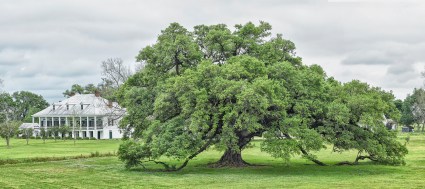
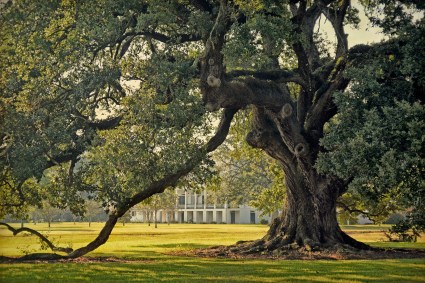
Oldest Oak at St. Joseph Plantation and plantation home in background
Just downriver from Oak Alley Plantation, is St. Joseph Plantation. According to the Live Oak Society records, St. Joseph Plantation has 16 registered live oak trees on its property, some named after family members, with the largest boasting a girth of almost 24 feet (my measurement).
The old oaks closest to the home are some of the oldest on the grounds. They are estimated to be at least as old as the plantation home (1830) and the oldest, the one standing alone upriver from the home and nearest Oak Alley (see photo above), may be 300 years old or more.
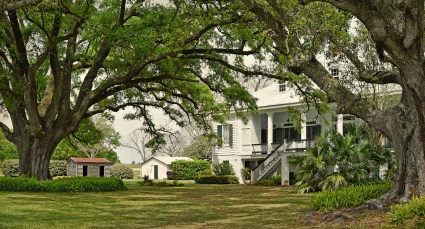
Two oaks at rear of plantation home
The oldest oak at St. Joseph Plantation is located on River Road on the upriver edge of the property, near the Oak Alley Plantation property line.
Oak profile with plantation home in background
Brief history of St. Joseph Plantation. In 1840, Dr. Cazamine Mericq purchased the plantation property from the Scioneaux family and using slave labor built the home. Shortly afterwards, he sold it to Alexis Ferry and his fiance’, Josephine Aime. The couple financed the purchase with dowry money from Josephine’s father, Gabriel Valcour Aime.
St. Joseph’s oldest oak, August morning light
Valcour Aime owned a much larger plantation next door that was called the St. James Refinery Plantation and he was generally recognized as the wealthiest man in the South at the time. Valcour’s plantation was nicknamed, “La Petite Versailles” for its extravagant gardens and manor. Valcour was married to Josephine Roman, of the wealthy Roman family. In 1836, Jacques Telesphore Roman (Josephine’s brother) purchased a working plantation from Valcour just upriver from St. Joseph Plantation that became Oak Alley Plantation.
St. Joseph’s connection to Oak Alley and Felicity Plantations. St. Joseph plantation was purchased in a post-civil War sheriff’s sale by Joseph Waguespack and the plantation has remained within the Waguespack’s extended family ever since, according to Joan Boudreaux, St. Joseph’s general manager and Waguespack’s great-great-great granddaughter.
The adjoining plantation home “Felicity,” stands downriver from St. Joseph Plantation directly above the location of Valcour’s plantation home. Felicity was built in 1850 with dowry money for Josephine’s Aime’s sister, Felicity, when she married Septime Fortier. So the three plantation homes were all connected through family members and were all on sugarcane plantation land once owned by Valcour Aime. In 1899, Joseph Waguespack purchased the 1,200 acre Felicity plantation and combined it with St. Joseph to create the St. Joseph Planting and Manufacturing Co. Ltd.
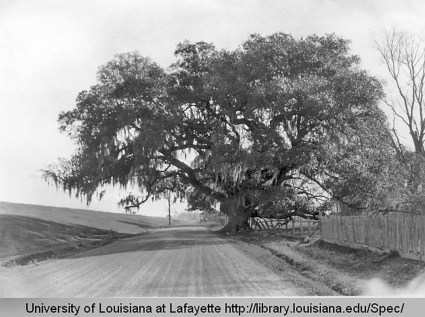
The Stonaker Oak was #18 on Dr. Edwin Stephens list of the first 43 inductee trees in the Live Oak Society in 1934. It’s an old oak with lots of stories. It was named for J.S. Stonaker who in 1934 owned the property on which the old tree was growing. The photo below was made by Dr. Stephens and is from the University of Lafayette archives, probably around 1930-1935.
Library archive of Dr. Stephens’ photo: Stonaker / St.Maurice Oak, circa 1930
Yet, for years prior to 1934, the old oak was known locally as the St. Maurice Oak. The Labatut brothers, whose family has lived next to the old oak since the early 1800s, still call the old tree the St. Maurice Oak.
Dr. Stephens’ photo: Stonaker / St.Maurice Oak, circa 1930
This has always puzzled me. So, where did the St. Maurice name come from? A topographical map of Pointe Coupee Parish shows a small Island, or “towhead,” named the St. Maurice Towhead, located directly offshore from the spot where the St. Maurice/Stonaker Oak grows. Thus, the St. Maurice Oak. But, from where did the Towhead name originate? It’s a mystery.
According to a 1932 article from the Louisiana Conservation News magazine, when the oak was measured by Stanley C. Arthur in September 1929, the tree’s girth was 22 ft. 4 in.; The canopy from north to south was 157 ft, and the east to west spread was 166 ft. 4 in. However, before the large limb was removed that hung over the road alongside the oak, its spread was 217 ft.
circa 1898 photo of St. Maurice Oak, prior to lower limb on right side being removed
In the previously mentioned Louisiana Conservation News magazine, there was a curious story about naturalist and artist, John James Audubon and the St. Maurice Oak. Audubon was hired in 1821 by Mr. and Mrs. James Pirrie, owners of Oakley Plantation, on the east bank of the river near St. Francisville, to teach their daughter Eliza to draw. It was during his time as tutor for Eliza that he became especially interested in drawing and painting birds.
According to the Audubon State Historic Site, while at Oakley “Audubon began work on at least thirty-two of his famed paintings of wild North American birds. He supposedly crossed the river frequently via the Bayou Sara ferry to hunt birds on the Pointe Coupee-side of the river. The Point Coupee ferry landing was located about a mile downriver from the St. Maurice Oak, and Audubon was a welcome guest at the Labatut home (located still just a few hundred feet upriver from the old oak). According to the Louisiana Conservation News article, Audubon “undoubtedly sheltered under the St. Maurice Oak on hot days,” and was fond of the old tree and its wide-spreading branches.
So, was the St. Maurice Oak, Audubon’s favorite live oak? It’s possible…
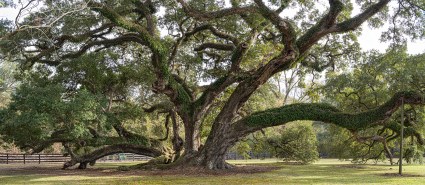
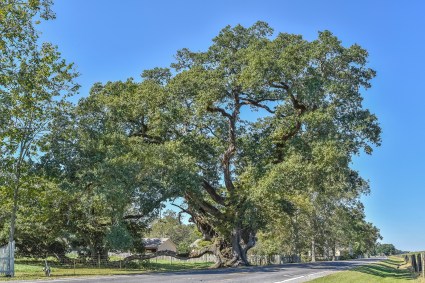
Stonaker / St. Maurice Oak, October 2015, upriver view
Stonaker / St. Maurice Oak, October 2015, downriver view with Labatut home in background
Stonaker Oak, close up view of trunk and scars of lost limbs







 100 Oaks Project