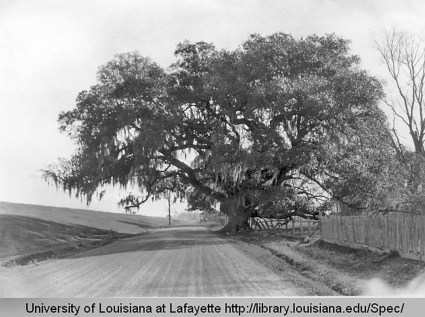
The Stonaker Oak was #18 on Dr. Edwin Stephens list of the first 43 inductee trees in the Live Oak Society in 1934. It’s an old oak with lots of stories. It was named for J.S. Stonaker who in 1934 owned the property on which the old tree was growing. The photo below was made by Dr. Stephens and is from the University of Lafayette archives, probably around 1930-1935.
Library archive of Dr. Stephens’ photo: Stonaker / St.Maurice Oak, circa 1930
Yet, for years prior to 1934, the old oak was known locally as the St. Maurice Oak. The Labatut brothers, whose family has lived next to the old oak since the early 1800s, still call the old tree the St. Maurice Oak.
Dr. Stephens’ photo: Stonaker / St.Maurice Oak, circa 1930
This has always puzzled me. So, where did the St. Maurice name come from? A topographical map of Pointe Coupee Parish shows a small Island, or “towhead,” named the St. Maurice Towhead, located directly offshore from the spot where the St. Maurice/Stonaker Oak grows. Thus, the St. Maurice Oak. But, from where did the Towhead name originate? It’s a mystery.
According to a 1932 article from the Louisiana Conservation News magazine, when the oak was measured by Stanley C. Arthur in September 1929, the tree’s girth was 22 ft. 4 in.; The canopy from north to south was 157 ft, and the east to west spread was 166 ft. 4 in. However, before the large limb was removed that hung over the road alongside the oak, its spread was 217 ft.
circa 1898 photo of St. Maurice Oak, prior to lower limb on right side being removed
In the previously mentioned Louisiana Conservation News magazine, there was a curious story about naturalist and artist, John James Audubon and the St. Maurice Oak. Audubon was hired in 1821 by Mr. and Mrs. James Pirrie, owners of Oakley Plantation, on the east bank of the river near St. Francisville, to teach their daughter Eliza to draw. It was during his time as tutor for Eliza that he became especially interested in drawing and painting birds.
According to the Audubon State Historic Site, while at Oakley “Audubon began work on at least thirty-two of his famed paintings of wild North American birds. He supposedly crossed the river frequently via the Bayou Sara ferry to hunt birds on the Pointe Coupee-side of the river. The Point Coupee ferry landing was located about a mile downriver from the St. Maurice Oak, and Audubon was a welcome guest at the Labatut home (located still just a few hundred feet upriver from the old oak). According to the Louisiana Conservation News article, Audubon “undoubtedly sheltered under the St. Maurice Oak on hot days,” and was fond of the old tree and its wide-spreading branches.
So, was the St. Maurice Oak, Audubon’s favorite live oak? It’s possible…
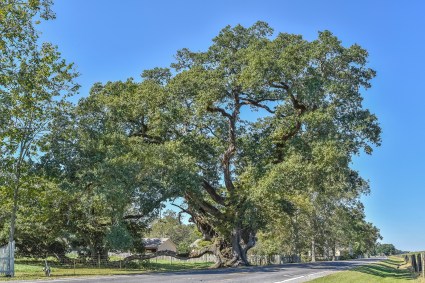
Stonaker / St. Maurice Oak, October 2015, upriver view
Stonaker / St. Maurice Oak, October 2015, downriver view with Labatut home in background
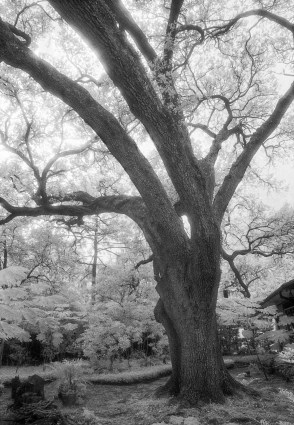
Stonaker Oak, close up view of trunk and scars of lost limbs
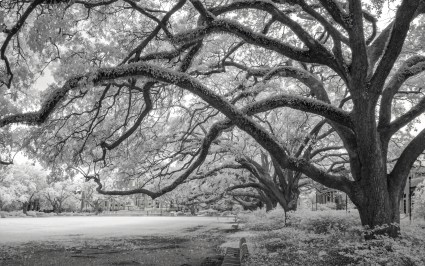
Newcomb College oaks – West side of Quadrangle – 2020
Around 1992-1994, I wrote an article and created a series of infrared black-and-white images for the Newcomb College alumni publication, “Under the Oaks.” It was a fun piece to work on and learn more about New Orleans history. The Tulane Department of Communications, which designed and produced the publication, had to get special permission from Newcomb leadership to run the article because they hadn’t had male contributors to the all-Women’s College publication previously.
Newcomb Oaks – east side of Quadrangle – 2020
In 2020, during the height of the pandemic, I visited several university campuses specifically to photograph or rephotograph old oaks while the grounds were empty of students and faculty. For this post, I’ve mixed a few of the images I made in 1993 with others I made during the summer of 2020, during the pandemic lockdown while the Newcomb campus was empty.
Newcomb oaks, east side of the quadrangle (hand-colored infrared image) 1993
It’s a little-known fact that the Newcomb oaks are closely tied to the history of this famous women’s college in New Orleans. They’ve played a unique role in creating the environment for campus life for almost a century. In 1918, Newcomb College moved from its original location on Washington Avenue to the current campus on Broadway Street, next to Tulane University. As part of the moving ceremonies, women students carried acorns gathered from the oak trees at the original Washington Avenue campus and transplanted them at the new campus site. Those acorns today have grown into the century-old oaks lining the campus quadrangle and sheltering walkways and buildings on campus.
Live Oak located at the original Newcomb campus site off of Washington Ave. – 1993
Newcomb College Oak, 1993 (hand-colored infrared image)
Newcomb Oaks, east side of Quadrangle – 2020
A Brief History of Newcomb College—In 1886, Josephine Louise Newcomb made an initial gift of $100,000 (worth roughly $2.7 million today) to the Tulane Board of Administrators in memory of her daughter, Harriott Sophie Newcomb, who died at the age of fifteen. Over the years, she made other monetary gifts to the school totaling almost 3 million dollars. Newcomb College opened its doors in 1887, offering young women a classical curriculum combined with an innovative art school, with a unique philosophy to train women to be self-supporting in the post-Civil War Southern economy.
Newcomb oaks, east side of quadrangle – 2020
Newcomb College is probably best known for its art school, where in its early years the women students created artworks that reflected an interest in craft and their parents’ desire for their daughters to learn practical, marketable skills. From this direction emerged a line or brand of pottery, recognized worldwide and highly collectable today. The Newcomb art curriculum and its underlying utilitarian philosophy were unique among art programs and women’s colleges of the time and it developed to be a leader in the American Arts and Crafts Movement. Fine art as well as a variety of crafts were taught, yet it was the pottery program that earned the college an international reputation by the early 1900s.
From the Newcomb Art Museum website: Newcomb Pottery is considered one of the most significant American art potteries of the first half of the twentieth century. Influenced by the English Arts and Crafts movement, Newcomb pottery was exhibited around the world, sold in shops on both coasts and written about in art journals throughout the United States and Europe. Newcomb potters (always men) and designers (always women) were awarded eight medals at international exhibitions before 1916.) The Newcomb pottery program produced more than 70,000 pieces before it closed in 1939.
Newcomb Oaks, north side of Quadrangle
After Hurricane Katrina, Newcomb College and its curriculum were restructured, and the old Sophie Newcomb College closed. As part of Tulane University’s Renewal Plan following the major losses and damage of Hurricane Katrina, Newcomb became a co-educational, single undergraduate college called Newcomb-Tulane College. The new college is now more of an extension of the Tulane University System.
Heirs of Mrs. Newcomb sued against this change, challenging Tulane on the issue of donor intent and seeking to preserve Newcomb as a separate coordinate college within the university, but the lawsuit ended in 2011 after an appellate court declined to rule on the case.
In 2006, the Newcomb College Institute was formed as an umbrella organization that runs programs (for women) that were formerly operated by the H. Sophie Newcomb Memorial College. In its first year (2006–07), under the leadership of founding Interim Executive Director Rebecca Mark (Tulane Department of English), the non-academic Newcomb College Institute hosted 104 speakers and 110 different programs for women, men, and guests at Tulane. Today, under the directorship of Sally J. Kenny, the Newcomb Institute strives to continue the goals of the original H. Sophie Newcomb College—”to promote the development of students’ leadership skills, preparing them to advocate for gender equity and lead in a gendered world.”
While traveling to Mandeville from Ponchatoula, Cyndi and I stopped in at the St. Joseph Abbey in St. Benenedict, LA., just west of Covington. The abbey grounds are home to four Live Oak Society member trees. The largest, the Abbot Paul Schaueble Oak (also called the Abbey Oak), has a beautiful spread and a girth of approximately 22 feet 10 inches. The tree is named after the Benedictine monk who was the first head of the monastery established in 1889 by a small group of monks from St. Meinrad Abbey in Indiana.
Abbot Paul Schaueble Oak, study 2
You’ll see in my photos, that several limbs of the 60 foot-tall tree are supported by metal pole braces. According to the abbey historian, the tree was damaged by a wind storm (and possibly a tornado) that swept through the area in November of 1957. The winds damaged the mid-section of the oak causing a severe split. But instead of cutting the tree down, the Abbey chose to secure the split with heavy bolts and limb supports. So far, the tree appears to have stabilized.
Abbey Oak with new spring growth, March 2016
Note: The abbey was hit hard by heavy rain, winds, and flooding the week before our visit. It was spring, and the old oak was shedding leaves to begin new spring growth and flowers. That’s why the oak has so few leaves in the photos above.
This blog chronicles my search to document the 100 oldest and most notable live oak trees in Louisiana. The elder oaks included in this project are primarily “centenarians” – more than 100 years old. Their sizes range from approximately 17 ft. to 40 ft. in circumference and their lives span a time period stretching between 100 to 600+ years, over several human generations. The oldest oaks documented here were possibly mature trees before Europeans settled Louisiana in the early 1700s.
This project began with a search for the original 43 live oaks that in 1934 became charter members of the Live Oak Society. In that year, Dr. Edwin L. Stephens proposed creating an organization comprised of 100+ year old live oaks in an article he wrote for the Louisiana Conservation Review. From my original search, I found that almost 20% of the original 43 member trees had been lost in the 80 or so years since the Live Oak Society was founded — mostly due to urban expansion, development, storms, pollution, decreasing soil quality, and old age.
The ultimate goal of this effort is to raise awareness for the importance of old live oak trees as an important cultural and historic resource. Every old oak has generations of human stories associated with it and when these trees are gone, part of our local history and culture dies with them.
Live oaks are heritage, heirlooms, and history all rolled into one. On the old land maps, oaks marked where one property line ended and another began. They were a point on the horizon to aim the blade of a plow or the nose of a tractor. They mark where back roads cross and provide a shady spot where neighbors can park their pickups, pass a plastic thermos cup of chicory coffee, and discuss the weather. Duels were fought and honor won or lost under their bowed limbs. People picnic under them, get married under them, dance the two-step under them, and finally when the music ends, are laid to rest alongside their massive roots.
Most areas of Louisiana and the South don’t have laws protecting these gentle icons of Southern culture from removal or abuse by humans and so each year we lose a part of our history and a valuable ecological resource.
With a list tools and resources that can help you create a tree ordinance for your town or community. (See Resources Section, bottom of page)
The situation. I’ve received several emails in recent months from individuals desperately looking for information on how they can save a treasured old oak in their community from removal. The circumstances were all sadly similar. In each case, a developer, or individual had purchased the land on which an old or historic oak (or oaks) had been growing, possibly for centuries, but certainly for long enough that the tree had become a much-loved part of local history and culture.
Yet, the new landowner could only see an old tree that was in the way—of a new hotel, housing development, roadway, or real-estate expansion of one form or another. In some cases, an arborist had been hired (by the developer) to give an opinion that the tree was very “old” and possibly even declining in health.
In most cases, the tree was named after a well-known individual and had even been registered with the Live Oak Society as a sign of its importance to those who cared for it and lived around it. The question I got repeatedly was, “certainly, there must be some law protecting a ‘registered’ tree from being cut down?”
Unfortunately, registering an oak with the Live Oak Society or any other local organization provides no legal protection for a tree from its removal. Registering a live oak is only a first step to recognizing an oak as a notable and loved part of a community. Registration is a good idea because it makes people aware of the historical significance of the tree, but unless your community, town, county commission, or other law-making body has created an ordinance or code to protect elder live oaks or other historic trees, then your oak may have no legal protection from the chainsaws of progress and development.
There are rare cases in Louisiana where oaks have been saved. These are situations that I know of in Louisiana where individuals have joined together with neighbors and friends, petitioned local leaders, and raised enough public support (and interest) to save specific trees from being cut down.
Mr. Al Oak, near New Iberia, LA
The Mr. Al Oak. In 2009, a 150-year-old live oak tree named “Mr. Al” was saved from certain death by a group of local citizens in the New Iberia area. The old oak was slated for removal by the Department of Transportation and Development (DOTD) as part of a frontage road construction project on State Hwy. 90. The property owner, Kelli Peltier, called friends and began a petition to save Mr. Al. With the help of local organizations and concerned citizens, as well as support from an ex-governor of Louisiana, the DOTD chose to move the old oak rather than cut it down. (You can read the whole story here.)
Old Dickory Oak, Harahan, LA
Old Dickory Oak. In 2003, neighborhood citizens in Harahan, with the help of The Live Oak Society chairperson Coleen P. Landry, were able to convince the DOTD to reroute the road improvements around the old oak. Landry and the Society also played a role in saving a stand of 13 live oaks near Jeanerette threatened by highway construction by appealing directly to then-governor Bobby Jindal to help save the oaks.
The Youngsville Oak. In another case in which an old historic oak was slated to be removed to make way for a new traffic circle along state Hwy. 92 in Youngsville, local citizens with the help of Trees Acadiana, a local tree-preservation organization, raised enough local support (through the local press and well-known artist George Rodrigue) to convince public officials to spare the tree. The common thread in each of these stories is local support.
Steps to take to save a tree.
1.If an important oak tree in your neighborhood or community is in immediate danger of removal,the first step is to make loud positive noise.
Start a petition, get help and support from local clubs, tree-friendly organizations, and gardening groups, as well as the local media. Create a story of the human history of the old tree and emphasize why it’s important to your community’s cultural and historical identity to save the tree. Appeal to your local city council, commissioners, and mayor as well as state-level politicians. Make a strong “positive” argument for these decision-makers to gain their support. A positive argument is important. Look for a win-win solution, and other options for the new property / tree owner, Highway Department, or developer that will make it worth their while to spare the tree. In the process, they’ll create good feelings, positive publicity, and positive relationships with the community. There’s always a positive benefit for both sides by saving a tree.
Not sure how to start a petition? Here are two websites that can help you start a petition online and get it distributed to your community.
• Petitions.net – This site lets you create a professional petition online, gather signatures, and present your results to decision-makers. It’s free and easy to use.
•Change.org – This website is run by a non-profit and though the petition function they offer is also free and easy to use, they also offer help to review and tweak your petition wording to make the strongest possible message. A donation is requested for this service that is well worth it.
2.Prepare now. Talk to your local garden clubs and find out what laws or ordinances your town or city may have in place already. Does your town have a town or city arborist? Contact that person. He or she can provide guidance on what to do. Most cities in the U.S. have some sort of ordinance that provides guidelines for the removal of large and old trees. Your next step is to get your local ordinance or codes amended or supplemented to include protection for historic, notable, or significant trees. Take steps to establish legal protections now, before a favorite old tree is threatened.
YOU CAN CHANGE LOCAL LAWSAND CREATE A LOCAL TREE ORDINANCE
Developing A Tree Ordinance – Reference Materials, Publications, Books, and Tools
Guidelines for Developing and Evaluating Tree Ordinances
Tree City USA has created a guide, “How to Write a Tree Ordinance” (a downloadable PDF can be found here). This guide provides a model that you can follow to draft and establish a “tree management ordinance” for both small and large communities in Louisiana or elsewhere.
Tree Ordinance Software
Unique software for cities is available to help them develop ordinances that will ensure the future of their community forests. TreeOrd, an interactive CD-ROM, was developed by the Tree Trust with a grant from the USDA Forest Service. The cost is $60 plus shipping and handling. http://www.mnstac.org/RFC/tree_order_form.PDF
A resource home page for urban design, city planning, urban forestry, site design, landscape architecture, architecture, site engineering, land use law and land development–highlighting legal standards and technical requirements for site development plan
U.S. Landscape Ordinances: An Annotated Reference Handbook
by Buck Abbey, D. Gail Abbey
This comprehensive reference brings together and explains the planning ordinances which govern the landscapes of 300 U.S. cities. In it, the author demystifies the complex planning laws that regulate such areas as the design of parking lots, vehicular use areas, landscape buffers, and tree plantings.
Guide to Developing a Community Tree Preservation Ordinance
Presented by the Community Tree Preservation Task Force of the Minnesota Shade Tree Advisory Committee, this guide describes the planning process, typical ordinance elements, and resources available for the task.
Guidelines for developing urban forest practice ordinances
Bell, P.C., Plamondon, S., and Rupp, M.
Oregon Department of Forestry, Forest Practices Program, Urban and Community Forestry Program. This guide is designed to assist cities and counties in the development of urban forest practice regulations.
Urban and community forestry: A guide for the Northeast and Midwest United States
Ascerno, M. et al.
U.S. Forest Service, Northeastern Area State and Private Forestry. 216 pp. + appendix. 1992.
This manual updates a 1990 edition which focused on the interior western region of the U.S. Includes chapters on history, benefits (aesthetic, social, recreational, wildlife, economic, and physical), programs, inventories, planning, ordinances and policy, site evaluation, tree selection and planting, soils, and maintenance. Undated; probable publication date, 1992.
Municipal tree manual
Hoefer, P.J., Himelick, E.B., and DeVoto, D.F.,
Urbana, IL, International Society of Arboriculture. 42 pp.
Prepared in cooperation with the Municipal Arborists and Urban Foresters Society. The purpose of this manual is to be a guide for preparing new, or revising old, municipal tree ordinances.
Community trees: Tree Ordinances for Iowa communities
There are several on-line ordinance clearinghouses. All of these publishing services make it easy to search for specific words or phrases within a given ordinance using a “search” feature.
Post-publication addition to this post: I’m heartened to read two different stories today in newspapers in North Carolina and Florida where the communities started petitions to save old oaks from being removed to make way for new development. These stories are new, as of the day I’m writing this, but the petitions got the attention of both their local government officials and the news media. That’s the way change starts, many voices being raised to create laws to protect historic trees and urban forests and to reconsider the importance of oaks and other trees to the health and well-being of a community.








 100 Oaks Project