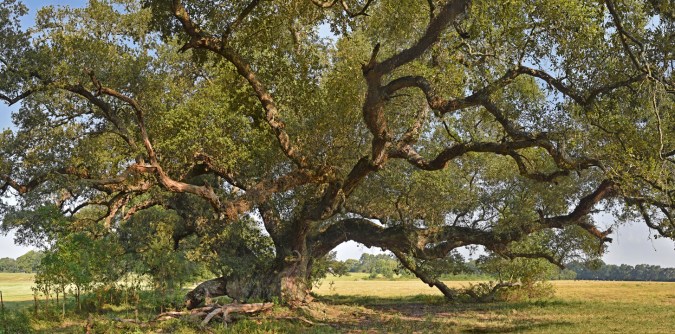
The Faucheaux Oak, Grosse Tete Oak, Mays Oak and list of 30′ girth oaks

We’re nearing the end of my original list of live oaks that I compiled with 30-plus-feet girth. In my search, I identified approximately 20 live oaks in the Live Oak Society registry that had a stated trunk circumference of 30 feet or more (at 4.5’ off the ground). A few of those were originally mis-measured by their owner/sponsors; so my current list (almost final list) now contains 14 oaks larger than 30 ft. in girth, six oaks with girths of more than 29 ft., and a few more that I’ve yet to locate with girths reportedly larger than 29 ft. (You can see my current list at the end of this blog entry.)

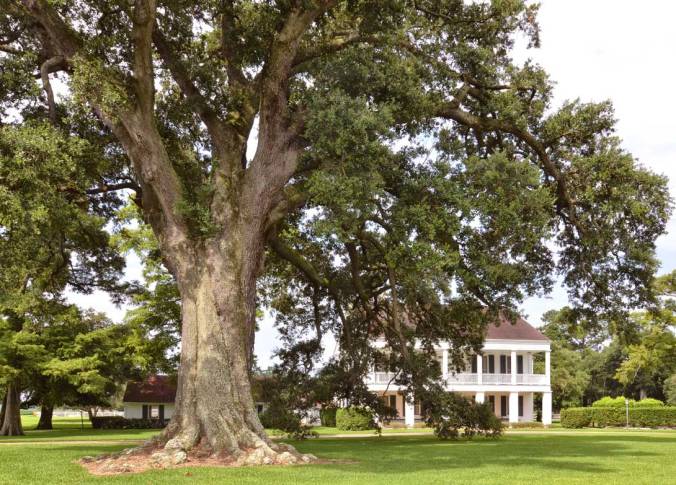
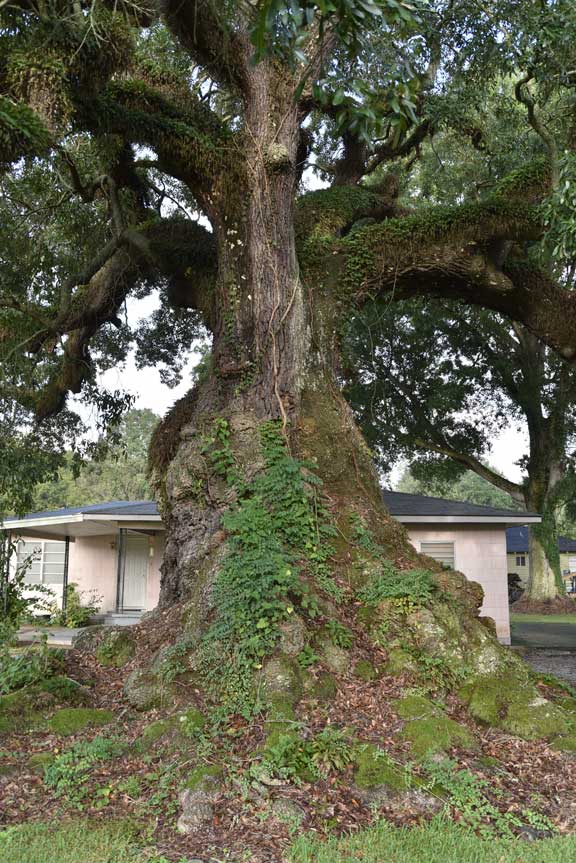
However, I fully suspect to add more oaks to this list in the coming year. In the process of working on this project, we’ve relocated back to Louisiana (I grew up here) to be better able to continue the 100 Oaks Project. Cyndi and I are now living in the old Constant family home outside of Thibodaux where we have a 25’-8” and a 21’-6” oak in the front yard. (The Constants were old family friends of my parents in Thibodaux, and I found their home for rent while photographing the oaks on their property).

Constant-oaks_December-2015

Constant/Faucheaux Oak (21′-6″) in foreground; Faucheux Oak in background (25′-8″)

We’ve also made new friends with several garden club groups across the state, including the Lafourche and Terrebonne parish garden clubs and master gardeners group (Cyndi was a master gardener in Texas and is now taking classes to become certified in Louisiana). The Lafourche and Terrebonne groups have been working hard to register old live oaks in their area—we applaud the great work they’ve done.

Now on to the trees…

Grosse-Tete-Oak_color-study-2

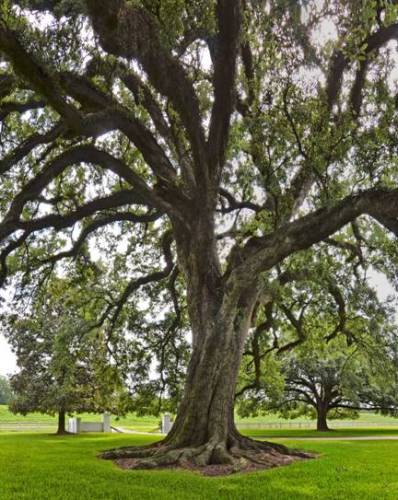
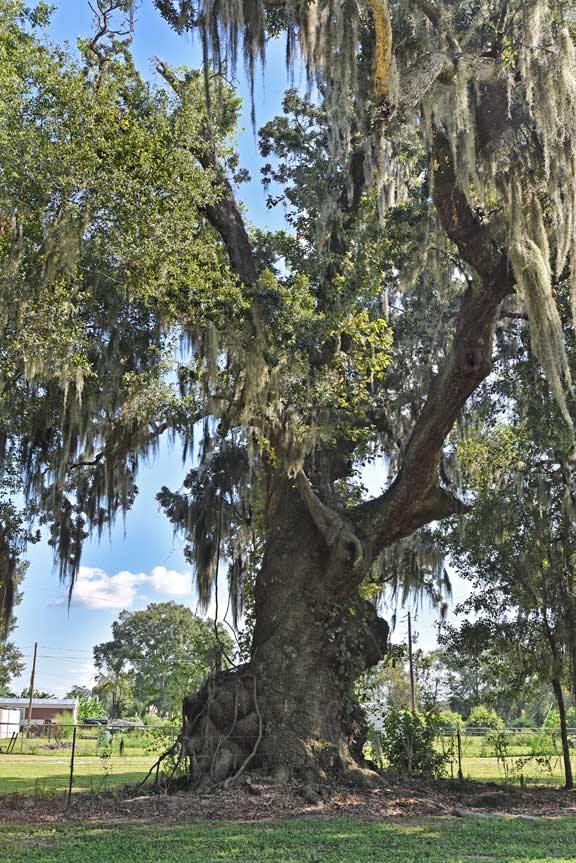
Grosse Tete Oak, color study 1 (30′-2″)

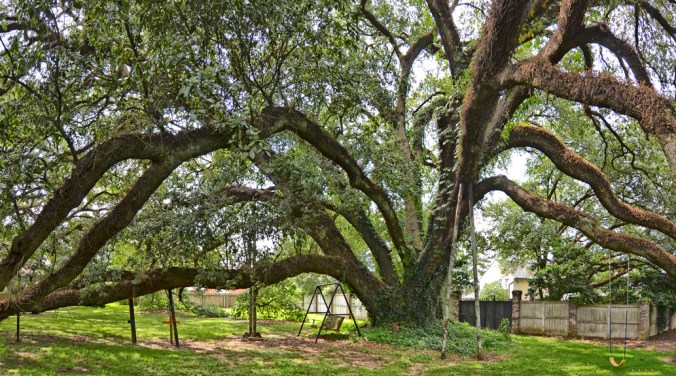
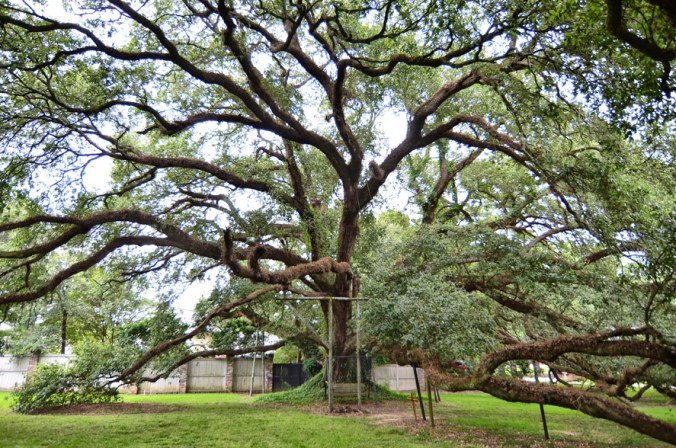
One of the easiest 30-something oaks to locate is the Grosse Tete Oak. You can spot it on the north side of the I-10 overpass at the Highway 77 Grosse Tete / Rosedale exit. There are several lovely old oaks nearby on the grounds of the Iberville Parish Visitor Center, located on the LA. Hwy. 77 side of the bayou, right near the exit. The Grosse Tete Oak is just south of the Visitor Center.

Bayou-Gross-Tete-Oak-1_adj

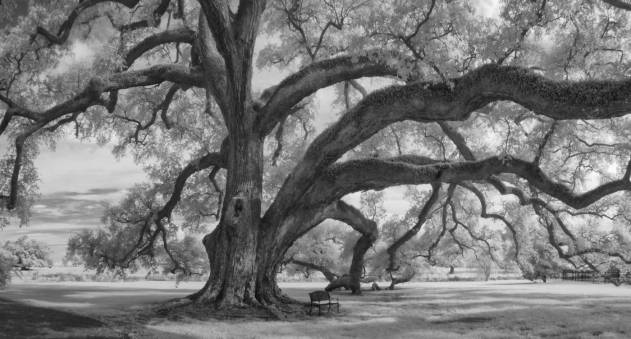
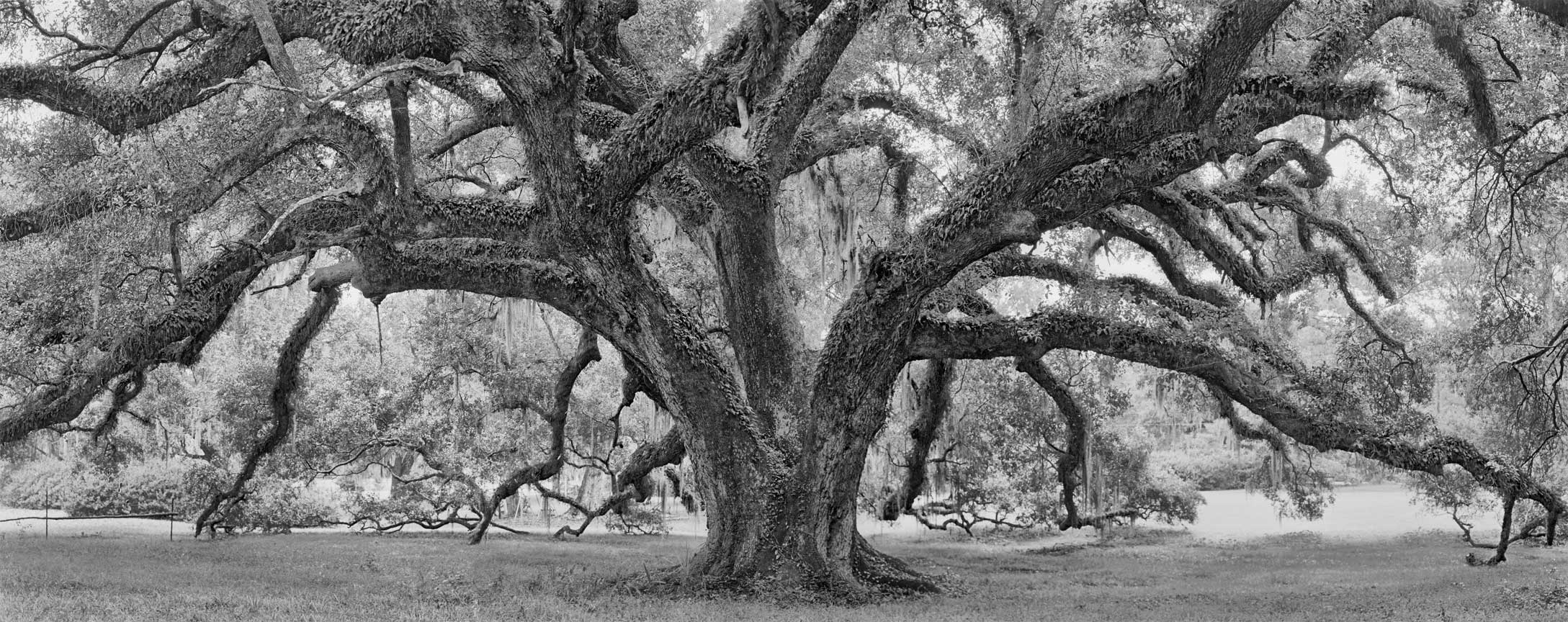
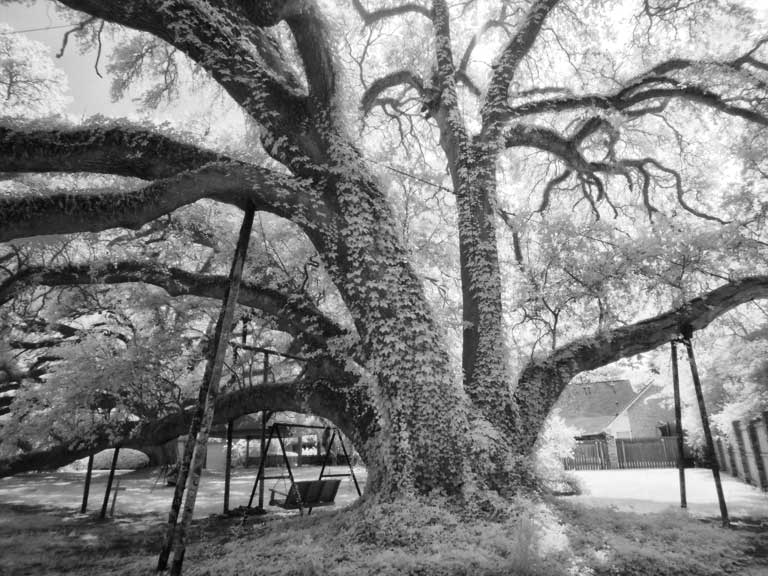
Grosse Tete Oak, b&w study 2

Grosse-Tete-Oak-3

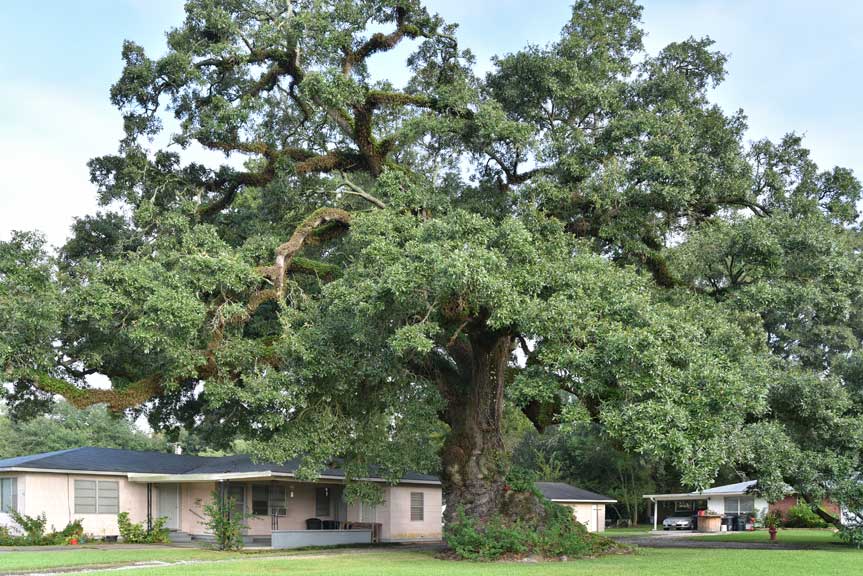
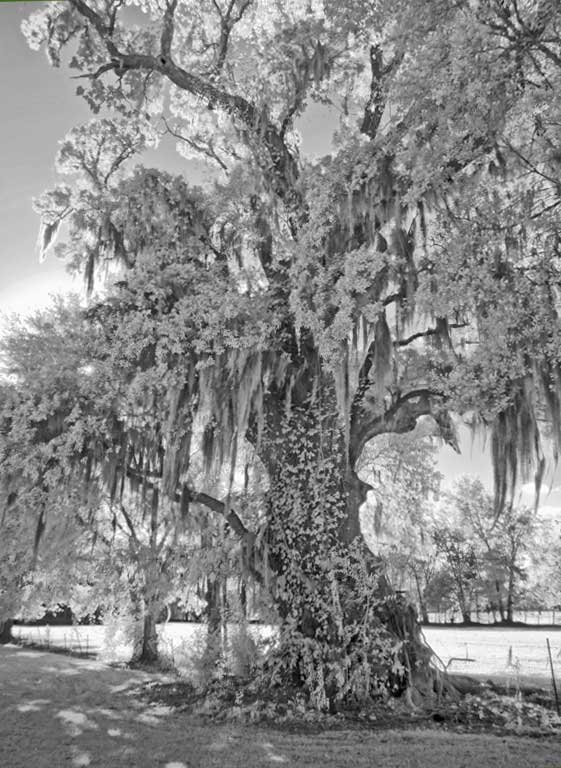
Grosse Tete Oak, infrared study 3

This grand old tree is number 17 on the list of the 43 charter oaks in the Live Oak Society (or number 22 on their current online list). When listed in Dr. Stephen’s Louisiana Conservation Review article of 1934, it had a girth of 22 ft. 6 in. Our most recent measurement in September 2015 shows it with a girth of 30 ft. 2 in.

The Grosse Tete Oak’s original sponsor was Mrs. Lelia Barrow Mays. Both “Barrow” and “Mays” are family names that are significant in local history.

Grosse Tete is a small village with a current population of 647 (according to their website). Much of the village is spread along a two-mile stretch of businesses and homes on both sides of Bayou Grosse Tete (which means “Big Head” in French). Local legend (and the Grosse Tete website) states that the name came about from a big-headed Choctaw Indian who lived and hunted in the area when it was settled by French Acadians. Before the railroad, the bayou was the main route of transportation through this pastoral region of lush green pastures and sugarcane fields.

Mays-Oak-3

The Mays Oak, #6 of 43 Live Oak Society charter member trees.

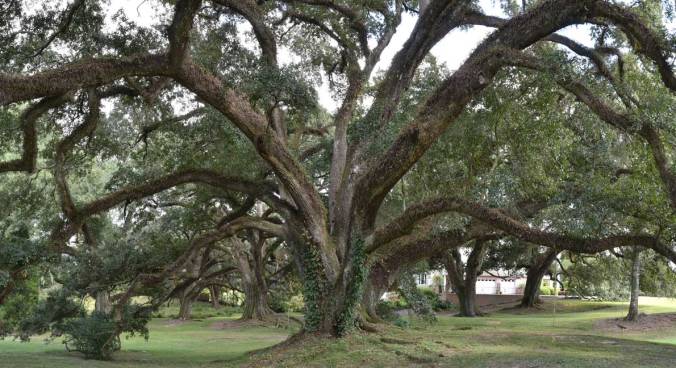
The Mays Oak (30′-11″) is number six (6) of the original 43 charter members of the Live Oak Society. It’s located just a short drive north on LA Hwy. 77 from Grosse Tete on the grounds of Live Oaks Plantation. The plantation home is on the east side of  Hwy. 77, facing Bayou Grosse Tete, and is listed on the National Register of Historic Places.  It’s a private home and not open to the public.

According to the KnowLa website (an online encyclopedia of Louisiana sponsored by the Louisiana Endowment of the Humanities), Live Oaks Plantation was built in 1838 by Charles H. Dickinson. He and his 14-year-old bride, Anna Turner, moved to Louisiana from Tennessee in 1828, almost two dozen years after his father died in a duel with Andrew Jackson in 1806. With the help of slave artisans, he built the two and one-half story plantation house of pegged local cypress and bricks made from clay from the area.

Mays-Oak-study-8

Mays Oak study with brick tomb

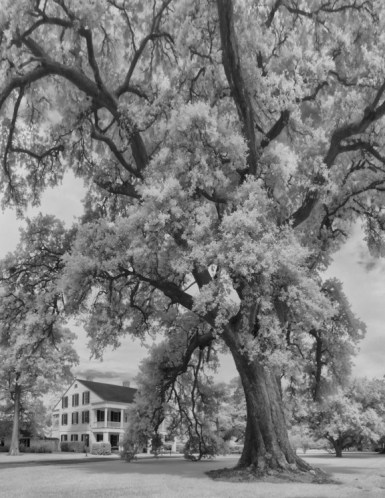
The historic oak is located to the left of the plantation home (viewed from the highway) and next to an unusual brick tomb and brick church that was once used by plantation slaves.  Later the church served as a schoolhouse and Episcopal chapel (both structures can be seen in the color photo above, and the tomb can be seen in the black and white photo to the left).

The brick tomb contains iron caskets cast in the form of a human body. The Smithsonian Institution dated the caskets in the tomb to circa 1830.

For more information about Live Oaks Plantation, go to KnowLa.org  (a great resource on historic info about Louisiana) or look for Karen Kingsley’s book, Buildings of Louisiana published by Oxford University Press, 2003.

My current list of 30-something-size live oaks (as of 2016)
1. Seven Sisters Oak – Lewisburg / Mandeville; 39′-10″
2. Randall Oak – New Roads; 35′-8″
3. Edna Szymoniak Live Oak – LSU Hammond Research Station; 35′-6″
4. Lorenzo Dow Oak – near Pine Grove, LA; 35′- 8″
5. La Belle Colline Oak – Between Sunset and Carencro; 34′
6. The Martin Tree – Gonzales, LA, Ascension Parish; 34′
7. The Governor’s Oak – Baton Rouge; 33′-3″
8. Lastrapes Oak (Seven Brothers Oak) – Washington, LA; 32’-3″ (largest section)
9. Rebekah Oak – Breaux Bridge; 32′
10. Boudreaux Friendship Oak – Lafayette; 31’-10”
11. Lagarde Oak – Luling; 30′-11″
11. Mays Oak – Live Oaks Plantation, near Rosedale; 30′-11″
12. Blanchet Oak – Lafayette; 30′-7″
13. Grosse Tete Oak – Bayou Grosse Tete; 30′-2″
14. Etienne de Bore’ Oak – Audubon Park, NOLA; 30’ (also called the Tree of Life and the Monkey Hill Oak)

29 foot-plus oaks
15. Josephine A. Stewart Oak – Oak Alley Plantation; 29′-11″
16. Hudson Oak – Hudson Oaks home, Prairieville, LA; 29′-9″
17. Grenier Oak – above Thibodaux on Hwy. 1; 29’-?”
18. Stonaker or St. Maurice Oak – New Roads, LA; 29′-6″
19. St. John’s Cathedral Oak – Lafayette; 29’-6″
20. Mr. Mike Oak – Oaklawn Manor, near Franklin; 29′

Yet to locate and photograph
22. Ole Oakie – St. Martinville; 32’-2” (Kennison Ambrose, sponsor)
23. Grandpere Oak – Barataria Bayou, Jefferson Parish; reportedly 29’-4”
24. J. H. Lewis Oak – St. Louis Plantation, Whiteville, LA; 29’+


How to Measure a Live Oak’s Girth

First, get a flexible 50-foot tape measure…

7_brothers_scale

Cyndi takes the tape measure to the Seven Brothers Oak in Washington, LA

While photographing and measuring many live oaks across the state, it’s become apparent to me that there is some general misunderstanding about how one should measure the girth (circumference) of a tree. Several of the older and larger live oaks that I’ve measured have girths (by my measurements) that are far less than what is listed in live oak records.

In this blog entry, I’ll explain the method that I’ve learned—which follows generally accepted guidelines used by many foresters, arborists and other tree-measuring folk. Others, with a more analytic and scientific approaches to tree measurement have gone into great detail about the measuring process. So, If you’re looking for more detail, especially about measuring height and limb spread, I’ve included links below to several sources for measuring height and crown spread using both simple and sophisticated tools. For my purposes, a flexible 50-foot tape measure is sufficient along with some way to record your results (pencil and paper).

Here goes:
• Wrap a flexible tape measure around the oak’s trunk at 4 to 4.5 feet above the ground (about chest height) and take the measurement in inches.

• For trees with rounded knotty growths, bumpy burls, limb extensions, or any other abnormalities at 4 to 4.5 feet above ground, measure the smallest circumference between 4.5 feet and the ground. In other words, measure under anything sticking out that might inflate the girth.

• If the trunk is leaning, wrap the tape at 90 degrees to the axis of the lean, instead of parallel to the ground.

NOTE: Dr. Stephens wrote about measuring at an oaks natural “waist.”  It’s usually apparent where this is – somewhere around the 4 to 4.5 foot area of the trunk there’s usually a natural indent before the main trunk and limbs begin to flare outward.
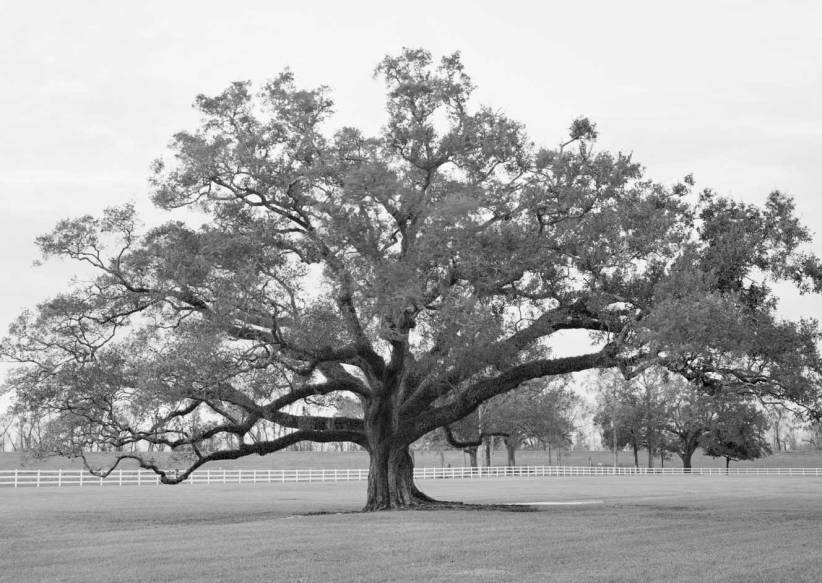
oak-alley-oak-in-west-field

Single trunk oak on flat ground (easy to measure)

There are endless variations in the shapes and sizes of oak trunks that make accurate measurement challenging—not to mention entangling growths of vines and plants (like poison ivy) that can throw off your measurements. Some live oaks have single straight trunks and grow from flat ground, making it easy to estimate 4 to 4.5 feet above the ground.

Others are situated on small mounds of soil, leaf litter and a network of roots that make it hard to know whether 4.5 feet should be measured from the ground directly next to the oak’s base or several feet back from the tree on lower, more level ground.  I take measurements from both places, a few steps back and closer in, then average the two. Generally, this will place the girth measuring line somewhere between 4 feet and 5 feet on the tree’s trunk.
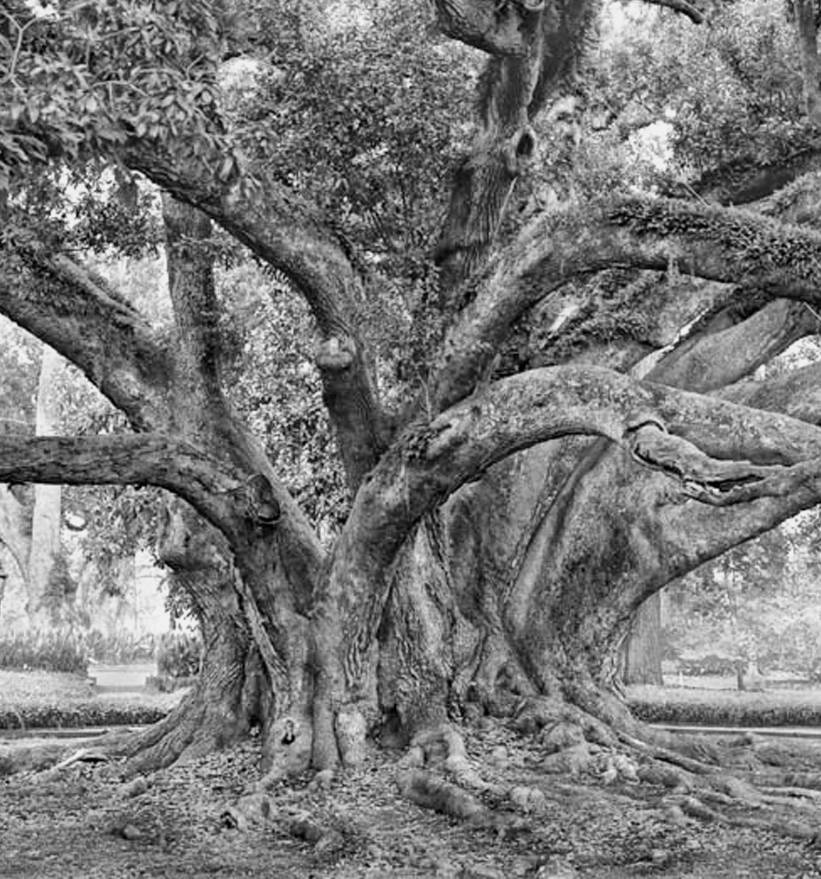
7-Sisters-Oak-_8x10

Multiple trunk oak (hard to measure)

Some live oaks have multiple trunks that divide and flare outward from their main trunk. Sometimes these divisions occur just a few feet from the ground and well below the 4.5 foot point (the Seven Sisters Oak is a typical example). What to do in this case? According to one arborist source, measure below the 4.5 foot line at the place he described as the oak’s “waist”—a natural curve that often occurs below the place where the branch or branches split from the main trunk.
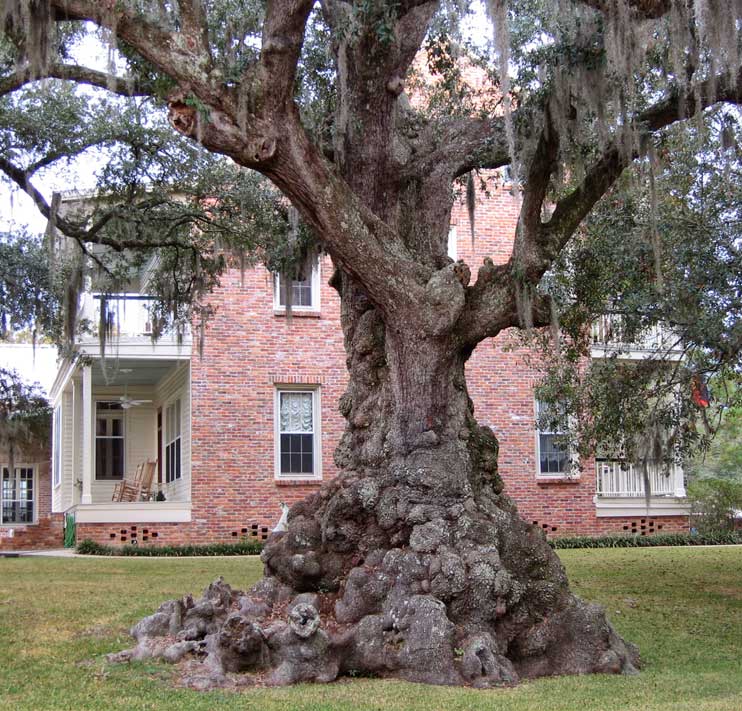
lumpy-oak-St

Oak with root and trunk burls (even harder to measure)

Another oddity of old live oaks is root and trunk burls that can completely encircle a tree and exaggerate the girth considerably. From Wikipedia: A burl (American English) or burr (British English) is a tree growth in which the grain has grown in a deformed manner. It is commonly found in the form of a rounded outgrowth on a tree trunk or branch that is filled with small knots from dormant buds. Burl formation is typically a result of some form of stress such as an injury or a viral or fungal infection.

When I measure the girth of an oak with a burl like the example above, I’ll measure at 4.5 feet and again above the mass of burls, then average the two. If there’s a single burl obstruction, I’ll measure under the obstruction.
Governor's-oak-1

Oak completely covered with poison ivy (let someone else measure!)

Dr. Stephens estimated that an oak with a girth of 17 feet or more (the Live Oak Society today says 16 ft.) should be at least 100 years of age. But he noted also that many live oaks of much smaller girth can be more than 100 years old as well. The girth can vary significantly depending on whether the tree grows out in the open, far from other trees competing for light and water, or in a natural forest setting where it is more crowded (close-grown). Also, the growth rate and overall health of an oak can vary depending on the quality of the soil in which it grows and its access to a regular water source.

As several arborists have explained to me, girth is simply one indication of an oak’s age. This is why Dr. Stephens recommended regular re-measuring of an oak’s girth to determine its growth rate over time—information that may provide a better idea of a particular oak’s true age.

According to Wikipedia: “Girth is a measurement of the distance around the trunk of a tree measured perpendicular to the axis (the vertical center line) of the trunk. In the United States, it is measured at breast height, or at 4.5 feet (1.4 m) above ground level. This “breast height” value is a measurement that’s been used for decades in forestry applications. (CBH is a common acronym you’ll often see in descriptions of tree girth; it means circumference at breast height.)  This technique of measuring at breast height was developed because of the simplicity and ease of measurement. There is no one ideal height at which to measure girth.” (Italic emphasis here is mine.)

With all of that said, I’ve listed below three professional sources of detailed measurement techniques for girth, height and crown spread.

American Forests—American Forests uses a specific formula to calculate “Big Tree” points as part of its Big Tree Program (a sort of competition to determine the largest tree of each species). They award a tree one point for each foot of its height, one point for each inch of girth, and one point for each foot of average crown spread. Their measuring guidelines can be found here as a downloadable handbook.

The Eastern Native Tree Society has published a thorough description of detailed measurement guidelines here.

The Monumental Trees website also has simple instructions with helpful drawings and photos here.

(Next blog entry: More 30-something oaks.)

Governor’s Oak & Ole Glory Oak – Baton Rouge

Old Oaks in Baton Rouge 

Governor's-Oak-study-1-color

Governor’s Oak color study 1, 34′-7″ girth

The Governor’s Oak (Live Oak Society registry #2364) was one of those oaks that made my job feel more like a detective’s than a photographer’s. The Society’s registry lists  the oak’s location as simply Baton Rouge.  And with a name like “Governor’s Oak,” I assumed it must be growing somewhere near the Governor’s mansion or at least the old state capitol grounds where I had found other LOS member oaks.

Governor's-Oak-study-6a-color

Governor’s Oak color study 6

After several unsuccessful trips in search of this venerable oak, I finally contacted the folks from Baton Rouge Green, a non-profit organization dedicated to inspiring Baton Rouge area residents to conserve, plant and sustain local trees. They were able to unearth from their files a 1999 Sunday Advocate newspaper article featuring the Governor’s Oak and the efforts of several local families to save it from being removed to make way for  development.

The 34-plus foot girth oak grows off historic Highland Road near Interstate 10 on property that was being subdivided for home lots in 1999. The developer was planning to remove either the sprawling old oak or a smaller adjacent oak to more evenly split up the property parcels. Fortunately, three families stepped in and purchased two parcels of land on which the oaks grew to save both of them. Bill and Suzanne Terrell purchased one lot for their future home and together with Alvin and Carlissa Bargas and Bill and Kathy Lovell the three families bought the neighboring lot containing the two oaks.

Governor's-Oak-study-7-color

Governor’s Oak color study 7

When the Governor’s Oak was registered with the Live Oak Society by the three couples, it measured 33’-3”. My measurement in 2015 put it a bit closer to 35′, but my measurement was very rough because the trunk of the tree is now covered in poison ivy, which made for delicate and itchy measuring conditions. I still don’t know why the tree is named the “Governor’s Oak” but I’ll amend this post in the future if my research turns up the source.

Ole-Glory-6

Ole Glory Oak color study 6, girth 27′-8″

While tracking down the Governor’s Oak, I discovered that the Highland Road area east and west of I-10 is rich with old and beautiful live oak specimens that have survived development. According to Wikipedia, “historic Highland Road was originally established as a supply road for the indigo and cotton plantations of the early settlers.”

Not far east along Highland Road from the Governor’s Oak, I located the Ole Glory Oak (LOS registry #4592).

Ole-Glory-#1-B&W

Ole Glory Oak infrared study 1

This 30-something oak grows within a grove of old oaks on the property of John and Michelle Sparks. The oak’s sponsor is listed in the LOS registry as the Country Club of Louisiana Garden Club. Ole Glory Oak was originally registered with a girth of 28’-1”. My measurement placed it closer to 27’-8”, but the tree is situated on a slope, making it awkward to accurately identify a level “waist” near 4.5 ft. from the ground. The boxes in the black and white image above are bee hives—Mr. Sparks, who owns the property on which Ole Glory is located, is a beekeeper.

(Next post – How to measure live oaks.)


Dr. Duffel Oak, Miss Hattie Oak, and the Claiborne Plantation Oak

Ascension Parish and River Road toward Baton Rouge – Ascension Parish

Mr-Duffel-2

Dr. Duffel Oak, infrared study 1

This entry continues my historic oak exploration through the Ascension Parish area. While searching for 30-foot plus size trees, I located a few very large oaks with long and interesting histories. And though not quite in the 30-foot circumference category, they are still quite old and beautiful and are worth sharing as part of my longer documentation of the 100 oldest live oaks in Louisiana.

The Dr. Duffel Oak (#2487 on the Live Oak Society registry) is located on the grounds of Mulberry Grove Plantation, just a few miles above Donaldsonville on State Highway 405 (which is the west bank river road in this section of the Mississippi River).

Dr-Duffel-Oak-3

Dr. Duffel Oak, color study 2


image010

Miss Hattie Oak, color study 1

The Dr. Duffel Oak and a younger tree, the Miss Hattie Oak (LOS #2485), are both located at Mulberry Grove and are sponsored by the Noel family, who own and live on the historic plantation grounds. Dr. Duffel is listed as 29’-5” in girth on the LOS registry; my measurement placed it at 26’-3”; Miss Hattie is listed at 26’-3”; my measurement was 24’-10”.

Mulberry Grove was built for Dr. Edward Duffel, a native of Virginia, but a direct descendant on his mother’s side of Acadians from Nova Scotia. Edward was educated at St. Mary’s College in Missouri and graduated from the medical school at the University of Pennsylvania in Philadelphia in 1833. In addition to being a doctor and a planter, Dr. Duffel was a member of the Louisiana state legislature, a delegate to the LA. state constitutional convention of 1852 and a delegate to the secessionist convention in 1861.

The Dr. Duffel Oak was planted either near the time that the plantation was constructed, around 1836, or possibly it was already growing when the plantation was built—making it approximately 180 to 200 years of age.

Claiborne_Panorama-2

Claiborne Plantation Oak, study 1

A bit further up Hwy. 405 toward White Castle, located on the property of Mr. J. M. Evans, is the Claiborne Plantation Oak, #2422 on the LOS registry and originally registered by Mrs. Oscar Evans. When registered, this oak was listed with a girth of 28’-8”; my measurement placed it at 26’-8”.  It’s a beautiful sprawling live oak growing in the back of the Evans’ home with views of acres of cow pastures.

Claiborne-Oak-color-1

Claiborne Plantation Oak, color study 2

According to the wonderful reference book, Along River Road, Past and Present on Louisiana’s Historic Byway, written by Mary Ann Sternberg and published by LSU Press, Claiborne Plantation was named for William C. C. Claiborne, Governor of the Orleans Territory in 1803 (land contained in the Louisiana Purchase). In 1811 Claiborne wrote to Julien Poydras that he had bought a plantation and would become a “plain, simple planter.” Though soon after he was elected as the first governor of the new state of Louisiana (1812), and in 1817 he was elected to the U.S. Senate, but died before taking office.

At 26 feet 8 inches in circumference, the Claiborne Plantation Oak is easily 205 years of age (as old as Claiborne’s purchase of the land) and quite possibly older.

(Next entry: The Governor’s Oak in Baton Rouge )


Ascension Parish – The Martin Oak, the John Hudson Oak

Ascension Parish and Upper River Road

Ascension Parish has always been a sort of blank spot on my live oak radar. Before I began this 30-something series, I was unaware of the number of live oaks that live there. So, I’ve been surprised and delighted to have located several old and beautiful trees that have led otherwise low-profile lives in this historic parish.

The Martin Oak study 1 – 35' 6" in circumference

The Martin Oak, Gonzales, LA – 37′ 8″ in circumference

I’m not sure if I’ve emphasized enough in my earlier blogs how rare it is that 30-something-foot girth oaks have survived all of the changes that have taken place on the Louisiana landscape in the past 300 years. In her invaluable reference book, Louisiana Live Oak Lore, Ethelyn G. Orso describes the process of “live oaking,” a fairly common practice in the past in which woodsmen would cut live oaks and sell the wood to supply the wooden ship industries of Britain, France, Spain, and the United States.

The Martin Oak trunk and burls

The Martin Oak trunk and burls

Here’s an excerpt from her book on the subject:

“As early as 1709, shipwrights recognized that the near-impenetrable wood (of the live oak) was perfect for timbers and ‘knees’ for vessels. ‘Knees’ were the angular sections of wood taken from the joints between tree limbs and trunks. Such natural joints were stronger than any artificial joints made by shipwrights, and braced the sides of the ships… For the European governments that controlled Louisiana in that early colonial period, live oak wood was the state’s most prized natural resource.

Having practically deforested the European continent in search of the indispensable oak wood for their fleets, British, French, and Spanish rulers looked with greedy eyes to the vast expanses of live oak forests in the southern parts of what would become the United States. Those European governments that gained control of the part of ‘West Florida’ that today is eastern Louisiana claimed the live oak forests as state-owned resources. That led, by the mid-1770s, to a thriving illicit trade in live oak wood between the inhabitants of the area and whoever would pay for the poached wood. In 1811, after Louisiana had become a part of the United States, Louisiana Governor William C. Claiborne began communicating with the secretary of the navy in Washington, DC, and in 1817 an act was passed giving the president of the U.S. the authority to reserve lands with live oak forests for use by the U.S. Navy.”

It was hard times for large live oaks in those early years of the colony and the oaks that survived the wooden-ship era were still faced with the widespread clearing of lands for farming and ranching as well as eventual urban development. So, when I express respect and even awe at the few oaks that have managed to survive (and flourish in some cases) after 300+ years of cutting and clearing, you can understand why.  Now, on to the 30-something oaks of Ascension Parish:

Martin-Oak-vert-2

The Martin Oak, vertical view of trunk

The Martin Tree—(See photos above as well) #1405 on the Live Oak Society registry, this tree was registered with a circumference of 34 feet by Ms. Delba E. Martin. She was born in 1906 and passed on in 1995. With help from the Ascension parish assessor’s office, I was able to locate the property that was once owned by Ms. Martin and the tree is still there.

The shape of the tree trunk is similar to the Rebekah Oak and others—it has a very large burled lower trunk that tapers above 5–6 ft. from the ground. Generally, this is above the 4–4.5 ft. line where one would measure the girth, but with trees like this, I take multiple measurements above and below the 4.5 ft. line and make an average measurement. My estimated girth of this oak is approximately 37’-8″ and still growing.

John Hudson Oak, 29'-8" – Prairieville, LA

John Hudson Oak, #6350 – 29′-6″ – Prairieville, LA

The John Hudson Oak is located in Prairieville, LA at the Hudson House, a beautiful historic family home that’s been in the Hudson family for several generations. The John Hudson Oak is the largest and most impressive of numerous live oaks on the grounds. It has a lovely sweeping canopy that reaches to the ground on three sides. Mrs. Ellen Hudson Waller says that several other oaks on her property are Live Oak Society members.

John Hudson Oak, black-and-white study 1

John Hudson Oak, black-and-white study 1

Hudson Oaks; black-and-white infrared study of two other Live Oak Society trees on Hudson property.

The Joseph Romano and Angelle Romano Oaks; Hudson House, Prairieville, LA.

In my next post, I’ll include the rest of the Ascension Parish list of oaks…