A photo-documentary of the 100 oldest live oaks in Louisiana
100 Oaks Project oaks – Bill & Cyndi list
Live oaks in this category were encountered and recorded during our travels to locate and document the Live Oak Society’s founding members and “Top 100”. The age and girth of the trees was apparent, which warranted a stop (and measurement, when possible).
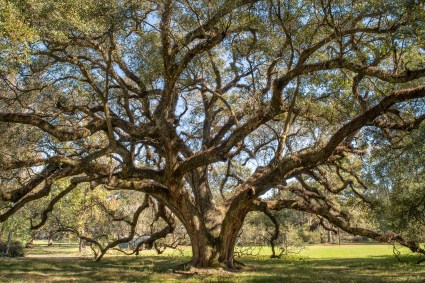
While traveling to Mandeville from Ponchatoula, Cyndi and I stopped in at the St. Joseph Abbey in St. Benenedict, LA., just west of Covington. The abbey grounds are home to four Live Oak Society member trees. The largest, the Abbot Paul Schaueble Oak (also called the Abbey Oak), has a beautiful spread and a girth of approximately 22 feet 10 inches. The tree is named after the Benedictine monk who was the first head of the monastery established in 1889 by a small group of monks from St. Meinrad Abbey in Indiana.
Abbot Paul Schaueble Oak, study 2
You’ll see in my photos, that several limbs of the 60 foot-tall tree are supported by metal pole braces. According to the abbey historian, the tree was damaged by a wind storm (and possibly a tornado) that swept through the area in November of 1957. The winds damaged the mid-section of the oak causing a severe split. But instead of cutting the tree down, the Abbey chose to secure the split with heavy bolts and limb supports. So far, the tree appears to have stabilized.
Abbey Oak with new spring growth, March 2016
Note: The abbey was hit hard by heavy rain, winds, and flooding the week before our visit. It was spring, and the old oak was shedding leaves to begin new spring growth and flowers. That’s why the oak has so few leaves in the photos above.
This blog chronicles my search to document the 100 oldest and most notable live oak trees in Louisiana. The elder oaks included in this project are primarily “centenarians” – more than 100 years old. Their sizes range from approximately 17 ft. to 40 ft. in circumference and their lives span a time period stretching between 100 to 600+ years, over several human generations. The oldest oaks documented here were possibly mature trees before Europeans settled Louisiana in the early 1700s.
This project began with a search for the original 43 live oaks that in 1934 became charter members of the Live Oak Society. In that year, Dr. Edwin L. Stephens proposed creating an organization comprised of 100+ year old live oaks in an article he wrote for the Louisiana Conservation Review. From my original search, I found that almost 20% of the original 43 member trees had been lost in the 80 or so years since the Live Oak Society was founded — mostly due to urban expansion, development, storms, pollution, decreasing soil quality, and old age.
The ultimate goal of this effort is to raise awareness for the importance of old live oak trees as an important cultural and historic resource. Every old oak has generations of human stories associated with it and when these trees are gone, part of our local history and culture dies with them.
Live oaks are heritage, heirlooms, and history all rolled into one. On the old land maps, oaks marked where one property line ended and another began. They were a point on the horizon to aim the blade of a plow or the nose of a tractor. They mark where back roads cross and provide a shady spot where neighbors can park their pickups, pass a plastic thermos cup of chicory coffee, and discuss the weather. Duels were fought and honor won or lost under their bowed limbs. People picnic under them, get married under them, dance the two-step under them, and finally when the music ends, are laid to rest alongside their massive roots.
Most areas of Louisiana and the South don’t have laws protecting these gentle icons of Southern culture from removal or abuse by humans and so each year we lose a part of our history and a valuable ecological resource.
With a list tools and resources that can help you create a tree ordinance for your town or community. (See Resources Section, bottom of page)
The situation. I’ve received several emails in recent months from individuals desperately looking for information on how they can save a treasured old oak in their community from removal. The circumstances were all sadly similar. In each case, a developer, or individual had purchased the land on which an old or historic oak (or oaks) had been growing, possibly for centuries, but certainly for long enough that the tree had become a much-loved part of local history and culture.
Yet, the new landowner could only see an old tree that was in the way—of a new hotel, housing development, roadway, or real-estate expansion of one form or another. In some cases, an arborist had been hired (by the developer) to give an opinion that the tree was very “old” and possibly even declining in health.
In most cases, the tree was named after a well-known individual and had even been registered with the Live Oak Society as a sign of its importance to those who cared for it and lived around it. The question I got repeatedly was, “certainly, there must be some law protecting a ‘registered’ tree from being cut down?”
Unfortunately, registering an oak with the Live Oak Society or any other local organization provides no legal protection for a tree from its removal. Registering a live oak is only a first step to recognizing an oak as a notable and loved part of a community. Registration is a good idea because it makes people aware of the historical significance of the tree, but unless your community, town, county commission, or other law-making body has created an ordinance or code to protect elder live oaks or other historic trees, then your oak may have no legal protection from the chainsaws of progress and development.
There are rare cases in Louisiana where oaks have been saved. These are situations that I know of in Louisiana where individuals have joined together with neighbors and friends, petitioned local leaders, and raised enough public support (and interest) to save specific trees from being cut down.
Mr. Al Oak, near New Iberia, LA
The Mr. Al Oak. In 2009, a 150-year-old live oak tree named “Mr. Al” was saved from certain death by a group of local citizens in the New Iberia area. The old oak was slated for removal by the Department of Transportation and Development (DOTD) as part of a frontage road construction project on State Hwy. 90. The property owner, Kelli Peltier, called friends and began a petition to save Mr. Al. With the help of local organizations and concerned citizens, as well as support from an ex-governor of Louisiana, the DOTD chose to move the old oak rather than cut it down. (You can read the whole story here.)
Old Dickory Oak, Harahan, LA
Old Dickory Oak. In 2003, neighborhood citizens in Harahan, with the help of The Live Oak Society chairperson Coleen P. Landry, were able to convince the DOTD to reroute the road improvements around the old oak. Landry and the Society also played a role in saving a stand of 13 live oaks near Jeanerette threatened by highway construction by appealing directly to then-governor Bobby Jindal to help save the oaks.
The Youngsville Oak. In another case in which an old historic oak was slated to be removed to make way for a new traffic circle along state Hwy. 92 in Youngsville, local citizens with the help of Trees Acadiana, a local tree-preservation organization, raised enough local support (through the local press and well-known artist George Rodrigue) to convince public officials to spare the tree. The common thread in each of these stories is local support.
Steps to take to save a tree.
1.If an important oak tree in your neighborhood or community is in immediate danger of removal,the first step is to make loud positive noise.
Start a petition, get help and support from local clubs, tree-friendly organizations, and gardening groups, as well as the local media. Create a story of the human history of the old tree and emphasize why it’s important to your community’s cultural and historical identity to save the tree. Appeal to your local city council, commissioners, and mayor as well as state-level politicians. Make a strong “positive” argument for these decision-makers to gain their support. A positive argument is important. Look for a win-win solution, and other options for the new property / tree owner, Highway Department, or developer that will make it worth their while to spare the tree. In the process, they’ll create good feelings, positive publicity, and positive relationships with the community. There’s always a positive benefit for both sides by saving a tree.
Not sure how to start a petition? Here are two websites that can help you start a petition online and get it distributed to your community.
• Petitions.net – This site lets you create a professional petition online, gather signatures, and present your results to decision-makers. It’s free and easy to use.
•Change.org – This website is run by a non-profit and though the petition function they offer is also free and easy to use, they also offer help to review and tweak your petition wording to make the strongest possible message. A donation is requested for this service that is well worth it.
2.Prepare now. Talk to your local garden clubs and find out what laws or ordinances your town or city may have in place already. Does your town have a town or city arborist? Contact that person. He or she can provide guidance on what to do. Most cities in the U.S. have some sort of ordinance that provides guidelines for the removal of large and old trees. Your next step is to get your local ordinance or codes amended or supplemented to include protection for historic, notable, or significant trees. Take steps to establish legal protections now, before a favorite old tree is threatened.
YOU CAN CHANGE LOCAL LAWSAND CREATE A LOCAL TREE ORDINANCE
Developing A Tree Ordinance – Reference Materials, Publications, Books, and Tools
Guidelines for Developing and Evaluating Tree Ordinances
Tree City USA has created a guide, “How to Write a Tree Ordinance” (a downloadable PDF can be found here). This guide provides a model that you can follow to draft and establish a “tree management ordinance” for both small and large communities in Louisiana or elsewhere.
Tree Ordinance Software
Unique software for cities is available to help them develop ordinances that will ensure the future of their community forests. TreeOrd, an interactive CD-ROM, was developed by the Tree Trust with a grant from the USDA Forest Service. The cost is $60 plus shipping and handling. http://www.mnstac.org/RFC/tree_order_form.PDF
A resource home page for urban design, city planning, urban forestry, site design, landscape architecture, architecture, site engineering, land use law and land development–highlighting legal standards and technical requirements for site development plan
U.S. Landscape Ordinances: An Annotated Reference Handbook
by Buck Abbey, D. Gail Abbey
This comprehensive reference brings together and explains the planning ordinances which govern the landscapes of 300 U.S. cities. In it, the author demystifies the complex planning laws that regulate such areas as the design of parking lots, vehicular use areas, landscape buffers, and tree plantings.
Guide to Developing a Community Tree Preservation Ordinance
Presented by the Community Tree Preservation Task Force of the Minnesota Shade Tree Advisory Committee, this guide describes the planning process, typical ordinance elements, and resources available for the task.
Guidelines for developing urban forest practice ordinances
Bell, P.C., Plamondon, S., and Rupp, M.
Oregon Department of Forestry, Forest Practices Program, Urban and Community Forestry Program. This guide is designed to assist cities and counties in the development of urban forest practice regulations.
Urban and community forestry: A guide for the Northeast and Midwest United States
Ascerno, M. et al.
U.S. Forest Service, Northeastern Area State and Private Forestry. 216 pp. + appendix. 1992.
This manual updates a 1990 edition which focused on the interior western region of the U.S. Includes chapters on history, benefits (aesthetic, social, recreational, wildlife, economic, and physical), programs, inventories, planning, ordinances and policy, site evaluation, tree selection and planting, soils, and maintenance. Undated; probable publication date, 1992.
Municipal tree manual
Hoefer, P.J., Himelick, E.B., and DeVoto, D.F.,
Urbana, IL, International Society of Arboriculture. 42 pp.
Prepared in cooperation with the Municipal Arborists and Urban Foresters Society. The purpose of this manual is to be a guide for preparing new, or revising old, municipal tree ordinances.
Community trees: Tree Ordinances for Iowa communities
There are several on-line ordinance clearinghouses. All of these publishing services make it easy to search for specific words or phrases within a given ordinance using a “search” feature.
Post-publication addition to this post: I’m heartened to read two different stories today in newspapers in North Carolina and Florida where the communities started petitions to save old oaks from being removed to make way for new development. These stories are new, as of the day I’m writing this, but the petitions got the attention of both their local government officials and the news media. That’s the way change starts, many voices being raised to create laws to protect historic trees and urban forests and to reconsider the importance of oaks and other trees to the health and well-being of a community.
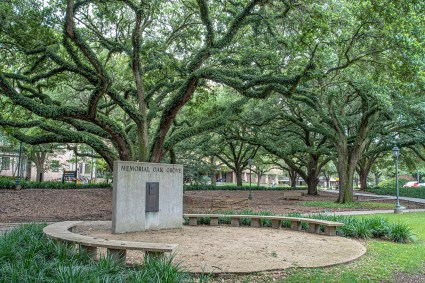
Every old oak in Louisiana has stories connected to it. LSU’s oaks are no exception. Louisiana State University was established in 1860 and construction began at the current location in the early 1920s.
Oxley Oak, LSU Quadrangle
Steele Burden and the planting of LSU’s oaks—Ollie Bryce Steele Burden (known simply as Steele) grew up in Baton Rouge and spent weekends on his family’s 600-acre farm, Windrush Plantation (now Burden Gardens). As a young man Steel traveled to Europe, and was inspired by the gardens he visited there, As an adult, he moved onto the Windrush property permanently and began his experiments with garden design, creating a small formal garden there.
Though he never earned a degree in landscape architecture, Steele took courses at LSU before he began working as a gardener and landscaper for the City of Baton Rouge. In the late 1920s, he designed plantings for Baton Rouge’s City Park and later became its superintendent of gardens. His work on City Park drew the attention and admiration of administrators at LSU and he was invited in 1932 to work for the university as the first grounds caretaker and landscape architect.
From its beginnings, LSU’s campus was envisioned to be a park-like setting whose natural beauty might inspire learning and scholarship. The physical layout was first devised by the Olmstead Brothers, sons of Frederick Law Olmstead, whose landscape architecture firm designed Central Park in New York, Audubon Park in New Orleans, several national parks, and other notable university campuses.
Since the Olmsted brothers were strictly landscape architects, German architect Theodore Link was hired in 1921 to design the buildings for the new campus. He adapted the Olmsteds’ layout and added his own ideas to the specific placement and design of structures. Some of the first buildings to be constructed were those around the Quadrangle.
Steele was given a free hand, but a tight budget, to transform primarily empty agricultural acreage into a pleasant green space. He began planting what he referred to as “street trees” along campus thoroughfares and around the first buildings—the parade grounds and around the Quadrangle complex.
These trees were hearty native stock that Steele knew would provide the most long-term benefit for the campus—primarily southern live oaks (Quercus virginiana), interspersed with southern magnolia trees (Magnolia grandiflora), and pine trees (pinus species) due to the compatibility of these trees. Steel obtained many of these trees with the help of E.A. McIlhenny’s Avery Island nursery and planted them based on his “intuitive” approach to garden design.
Historic aerial photographs of the campus show that the Quadrangle oaks were well-established by February of 1938. That would make the earliest oaks more than 90 years of age today, since McIlhenny’s young oaks were ordinarily 5 to 10 years of age when purchased.
Today, LSU has more than 1300 live oaks on campus comprising what has become an “urban forest”
Supposedly the oldest oak on the LSU campus grows between the Manship School of Mass Communications and Hodges Hall. It predates the earliest oak plantings by Steele Burden and may be well over 200 years old.
I first visited and photographed the John Hudson Oak in late 2015 while searching for live oaks in the 29′ to 30′-plus circumference size in the Ascension Parish area. The John Hudson Oak is located in Prairieville, LA at the Hudson House, a beautiful historic family home that’s been in the Hudson family for several generations.
John Hudson Oak, 29′ 10″, October 2020
The Hudson Oak is the largest and most impressive of numerous old live oaks on the grounds. It has long sweeping limbs that reach to the ground on three sides. Mrs. Ellen Hudson Waller says that this and several other oaks on her property are Live Oak Society members but has no idea exactly how old this oak might be.
I returned to rephotograph and remeasure the old oak in November 2020, five years from my first visit. The oak had grown 5 inches and now measures 29′ 10″ in circumference. But how old is an oak of this size? In all honesty, one can only make an educated guess.
I’ve heard from several arborists that live oaks grow fastest in their first 100 to 150 years then slow down during the next 100 to 150 years. Then, supposedly they grow even slower during the next 100 to 150 years.
Dr. Edwin Lewis Stephens, the founder of the Live Oak Society, often revisited many of the oldest oaks to which he was acquainted. He remeasured them over time and kept records of their growth rate. As a result, Dr. Stephens believed that if you could determine the average annual growth rate for a specific tree, you might get a closer estimate of its true age. Stephens estimated that if an oak had a girth of 17 feet or more, that it was at least 100 years of age.
However, Edwin A. “Ned” McIlhenny (originator of Tabasco pepper sauce), wrote in a letter to Dr. Stephens in the 1930s that he had seen oaks grown in the thick forest at Avery Island that were as little as four feet in girth but had anywhere from 300 to 500 annual growth rings. According to McIlhenny, “A tree grown alone, under ideal conditions, will develop ten times as fast as a tree crowded in the forest under unfavorable conditions.”
So, who knows how old any live oak may actually be. Who can tell today what conditions existed around an old oak 100, 200, or 300 years ago and whether it was growing alone or competing for resources with other trees? It’s likely that any live oak that was growing before Europeans arrived was in a forested setting. Though, some oaks growing along bayous, may have been growing alone. Who can tell today if land was cleared around an oak by settlers, or if they planted the oak after they arrived. One can only speculate. As I’ve noted in other blog posts, when the first Europeans began to arrive in Louisiana in the 1700s, they often chose homesites near old oaks for the protection that the trees offered from winds and weather.Yet, many others planted oak trees near their homes for the same reasons.
All I can say for sure is that the Hudson Oak has grown an inch a year in girth over the past five years. So, if its growth rate has been a consistent one inch per year during most of its lifetime, it would today be close to 350 years of age. This is, at best, only an educated guess. If you consider the observations of E.A. McIlhenny, the size of a live oak may only be known for certain by the Creator or someone with a time machine…



 100 Oaks Project