Revisiting the Lastrapes (Seven Brothers) Oak

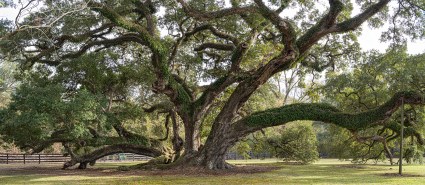
Lastrapes Oak, Afternoon Light, Washington, LA

On a recent visit to Louisiana, I took a side road off of the Interstate Hwy. to visit the small town of Washington and the Lastrapes (or Seven Brothers) Oak. Located about a mile out of town on State Highway 182, the large old oak still stands proudly and is well-maintained by the Lastrapes family who still owns the property on which the oak grows. When I stopped to re-photograph the tree, there was a work crew doing maintenance on the fence (shown behind the tree in the photo above).

The Lastrapes Oak is the seventh tree listed in Dr. Edwin L. Stephens’ 1934 magazine article in the Louisiana Conservation Review. It is one of the original 43 member trees in the Live Oak Society and is #9 on the Live Oak Society’s registry, which contains a growing list of more than 10,000 member trees. Even my panoramic photograph hardly gives an idea of the massive size and girth of the unusual multiple trunks of this old oak. The main trunk is more than 33 feet in circumference. The largest secondary trunk is almost 30 feet around at a height of 4 feet. This beautiful old tree is one of my favorite live oaks in Louisiana and is surely a monument of a different kind.

The Seven Brothers’ name supposedly came from a story that said the tree was named for seven Lastrapes brothers who had left home to fight in the Civil War. Another variation of the story, described in Ethelyn Orso’s Louisiana Live Oak Lore, claimed that the birth of his seventh son prompted Jean Henri Lastrapes to request that seven oaks be planted; the workers arrived late in the day with the seedlings and temporarily put them in one container (or hole). The business of the days that followed in the cotton fields distracted the workers from ever completing the planting task—and thus the trees grew together, sharing the close proximity of their original planting site. For a complete story of the tree’s history, you can read my original post in this blog.

Whichever story is accurate, the tree is more appropriately referred to today as the Lastrapes Oak, after the family who has owned the property where it resides for several generations and takes pride in caring for the well-being of the historic oak. It is one of the best-maintained ancient oaks in Louisiana.

(Prints of all photos in my blog are available for purchase. For information, email bill@williamguion.com)

The Live Oaks of LSU

Every old oak in Louisiana has stories connected to it. LSU’s oaks are no exception. Louisiana State University was established in 1860 and construction began at the current location in the early 1920s.

Oxley Oak, LSU Quadrangle

Steele Burden and the planting of LSU’s oaks—Ollie Bryce Steele Burden (known simply as Steele) grew up in Baton Rouge and spent weekends on his family’s 600-acre farm, Windrush Plantation (now Burden Gardens). As a young man Steel traveled to Europe, and was inspired by the gardens he visited there, As an adult, he moved onto the Windrush property permanently and began his experiments with garden design, creating a small formal garden there.

Though he never earned a degree in landscape architecture, Steele took courses at LSU before he began working as a gardener and landscaper for the City of Baton Rouge. In the late 1920s, he designed plantings for Baton Rouge’s City Park and later became its superintendent of gardens. His work on City Park drew the attention and admiration of administrators at LSU and he was invited in 1932 to work for the university as the first grounds caretaker and landscape architect.

From its beginnings, LSU’s campus was envisioned to be a park-like setting whose natural beauty might inspire learning and scholarship. The physical layout was first devised by the Olmstead Brothers, sons of Frederick Law Olmstead, whose landscape architecture firm designed Central Park in New York, Audubon Park in New Orleans, several national parks, and other notable university campuses.

Since the Olmsted brothers were strictly landscape architects, German architect Theodore Link was hired in 1921 to design the buildings for the new campus. He adapted the Olmsteds’ layout and added his own ideas to the specific placement and design of structures. Some of the first buildings to be constructed were those around the Quadrangle.

Steele was given a free hand, but a tight budget, to transform primarily empty agricultural acreage into a pleasant green space. He began planting what he referred to as “street trees” along campus thoroughfares and around the first buildings—the parade grounds and around the Quadrangle complex.

These trees were hearty native stock that Steele knew would provide the most long-term benefit for the campus—primarily southern live oaks (Quercus virginiana), interspersed with southern magnolia trees (Magnolia grandiflora), and pine trees (pinus species) due to the compatibility of these trees. Steel obtained many of these trees with the help of E.A. McIlhenny’s Avery Island nursery and planted them based on his “intuitive” approach to garden design.

Historic aerial photographs of the campus show that the Quadrangle oaks were well-established by February of 1938. That would make the earliest oaks more than 90 years of age today, since McIlhenny’s young oaks were ordinarily 5 to 10 years of age when purchased. 

Today, LSU has more than 1300 live oaks on campus comprising what has become an “urban forest”  

Supposedly the oldest oak on the LSU campus grows between the Manship School of Mass Communications and Hodges Hall. It predates the earliest oak plantings by Steele Burden and may be well over 200 years old.