Etienne de Boré Oak (Tree of Life)

Audubon Park – New Orleans, Louisiana

Etienne-de-Bore'-oak_2

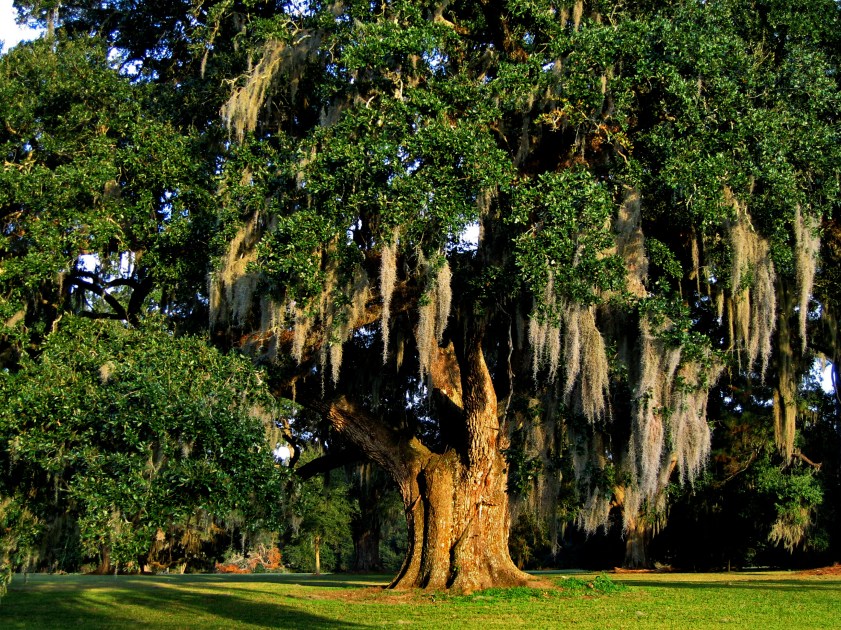
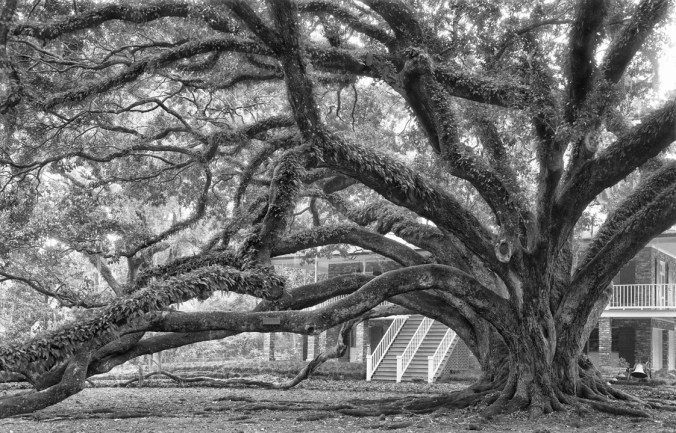
Etienne de Boré oak – Audubon Park, New Orleans

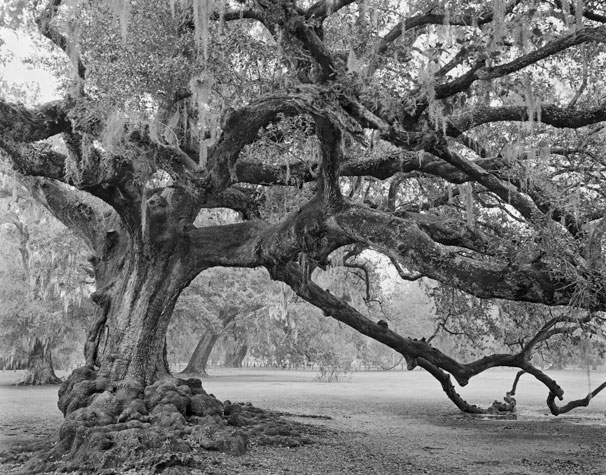
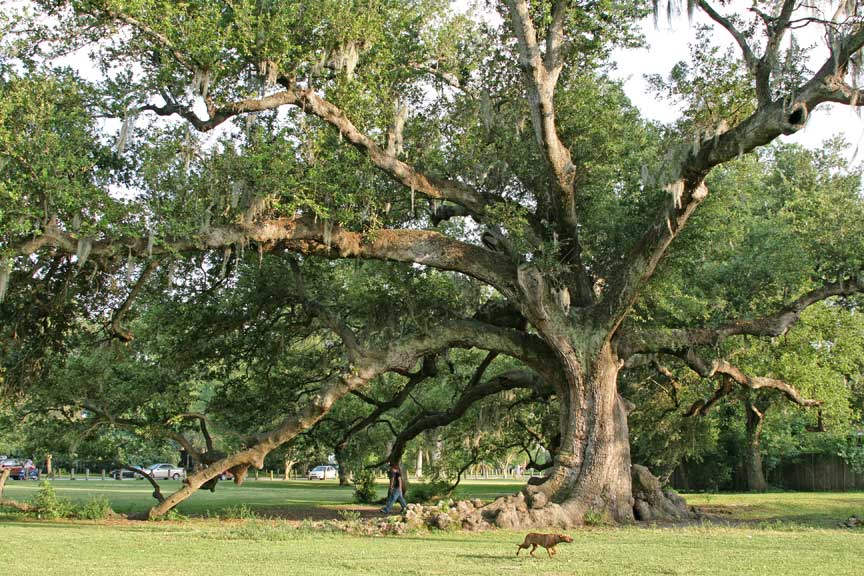
In New Orleans, and especially the neighborhoods surrounding Audubon Park, this oak has been dubbed “The Tree of Life.” Its registered name with the Live Oak Society is the Etienne de Boré Oak. The land on which Audubon Park is located was at one time part of de Boré’s extensive sugarcane plantation.

Registration & Measurements – At just under 35 feet in circumference today, this oak was number 13 on Dr. Edwin Lewis Stephens’ list of 43 original inductee trees into the Live Oak Society and is also in the top 100 oldest surviving oaks on the Society’s member list.  Its girth when it was registered (as #21) was 23 feet 1 inch. The oak is located in Audubon Park on the down-river side of the Audubon Zoo, right over the fence from the giraffe habitat. It’s an enormous tree with a broad gnarly base of roots and a crown of limbs more than 160 feet wide.
De-Bore-Oak-study_1

The Live Oak Society estimates that any oak with a girth of 17 feet in circumference (measured at 4 feet off the ground) is probably 100 years of age or older. This is a rough system of estimation developed by the Society’s founder, Dr. Stephens, which is fairly accurate, though soil, rain, and other habitat conditions can affect a tree’s long-term growth.  A live oak with a girth of more than 30 feet could be 300 years of age or more.  The ages of many of the Society’s oldest and largest trees are only rough guesses, and there’s been much-heated discussion among amateur arborists and other tree-folk over this issue.
De-Bore-oak-4

History

Jean Etienne de Boré is significant in history as the first French planter in Louisiana to successfully granulate sugarcane into sugar on a large scale, helping to make sugarcane the main crop over indigo and tobacco in antebellum Louisiana. He originally cultivated indigo (a highly valued crop and popular dye); but after several years of drought and insect damage, de Boré decide to gamble the last of his and his wife’s personal funds on growing sugarcane. In 1794, he secured a variety of Cuban sugarcane from Don Antonio Mendez (a Cuban of Spanish descent) who had successfully granulated a small amount of sugar in 1791 (a few barrels or hogsheads – approx. 1000 pounds per barrel) at Magnolia plantation in Saint Bernard Parish, downriver from New Orleans.  With the help of Mendez and a Cuban by the name of Antoine Morin who had experience with the sugar granulation process, de Boré succeeded in producing a crop of sugar on his plantation that he sold for $12,000 (quoted from a Times-Picayune story from January 13, 1895).

De Boré was also the first mayor of New Orleans, appointed to the position by Governor William C.C. Claiborne in 1803, the same year Louisiana was transferred from Spain to France.  He resigned in 1804 after New Orleans became an American colony through the Louisiana Purchase.

IMG_0313

Couple getting married under the limbs of the Etienne de Bore’ oak.

Audubon Park is home to several other member trees of the Live Oak Society. The George and Martha Washington oaks were among the original 43 inductee oaks in the Society along with the de Boré oak. George has passed on but Martha is still alive, in the rhino habitat of the Zoo. There are three other unnamed oaks spread across the Park’s grounds that are elder Society members.

Martha-Washington-Oak

Remains of Martha Washington Oak in Audubon’s Rhino habitat
Academy of the Sacred Heart (Sacré-Coeur) Oak Alley

Grand Coteau, Louisiana

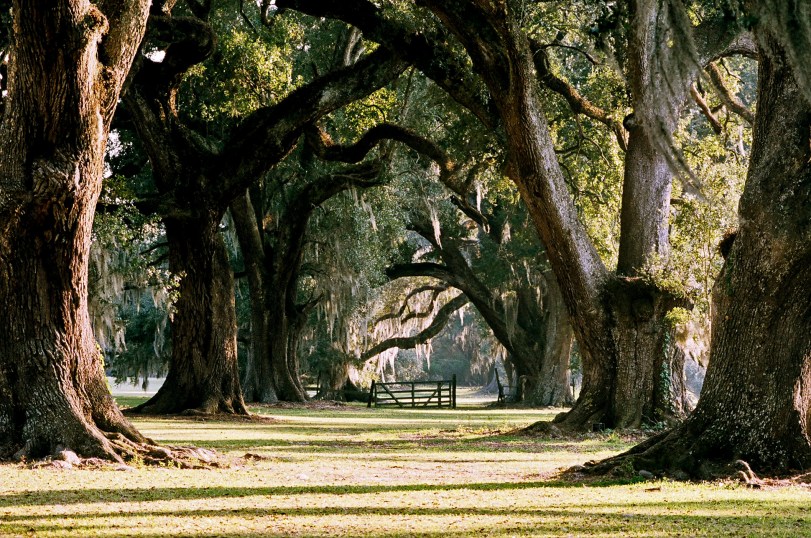
Academy of the Sacred Heart oak alley

Sacre’-Coeur oak alley, Grand Coteau – November 2007 – photo by C.L. Nelson

One of the first stops at the beginning of the 100 Oaks Project, when I set out to relocate and document the founding member trees and the 100 largest oaks registered with the Live Oak Society, was a return to a favorite photographic location:  a serenely beautiful grove and alley of live oaks whose moss-draped canopies arch above the path between the Academy of the Sacred Heart and the former St. Charles College, a Jesuit school for young men (now St. Ignatius School).

History:  The alley of live oaks was reportedly planted around 1840 by Father Nicholas Point, the founder and first Jesuit rector of St. Charles College, to shade his daily route to the chapel at the Academy to celebrate mass:

The Jesuit priests served as chaplains for the cloistered nuns and the Academy students, and the trees were planted to protect them from the intense summer sun as they rode back and forth between the two schools. Today, the college is used as a Jesuit seminary and spirituality center [1].

Father Point’s dedicated service to the Jesuit order continued well beyond his time at St. Charles College.  His subsequent work with the Flathead and Coeur d’Alene Indians, as well as his artistic abilities and contributions, are recognized and documented in the North Dakota Council on the Arts Online Artist Archive in an article contributed by Ken Rogers[2]:

A gifted amateur artist, Point’s pen and ink and pencil drawings are strong; his paintings are reminiscent of George Catlin’s work, spiced with the addition of Christian fervor.

In the spring of 1847, after spending six years with the Flathead and Coeur d’Alene Indians, Point traveled by barge on the Missouri River from near its confluence with the Marias River to Fort Union in present-day North Dakota, and down river aboard the steamer Martha to St. Louis.

Collections of his drawings include scenes at Fort Union, Fort Berthold and the Missouri River near what’s now Bismarck-Mandan.

Registration & Measurements

Academy of the Sacred Heart and St. Charles College live oaks

Sacre’-Coeur live oaks – November 2007 – photo by William Guion

Three of the trees in the grove and alley across the road from the Academy of the Sacred Heart were substantial in size (clearly over 16 feet in circumference) and warranted a measurement:

The circumference of the two largest live oaks measured was:

Oak # 1:  23 feet, 5 inches

Oak #2:  18 feet, 6 inches

A third live oak, which I made several images of, was also more than 18 feet in circumference. Located near the side of the road, the well-formed tree provided cool shade and a pastoral backdrop for the wedding party being photographed beneath its branches.  While waiting for their photo session to conclude, I explored other compositions, re-photographing the oak alley and individual trees within the grove, which I have photographed on several visits over a period of 25 years for my personal portfolio and a variety of publications.

Some of the resident trees at Sacred Heart are registered with the Live Oak Society, whose records are maintained by the only non-tree member, its current chairman and “registrar,” Coleen Perilloux Landry.  In the society’s records dating from 1934 – 2009, the largest trees recorded in Grand Coteau are:

#52 – “Coteau” – circumference  20 feet, 3 inches when registered; sponsor Mother Mary J. Lynch

#3381 – “O.O.O.” –circumference 16 feet, 4 inches when registered; sponsor Ruth Oliver Alba

#4164 – “Duchesne Oak” – circumference 21 feet, 3 inches when registered; sponsor Academy of the Sacred Heart

#6114 – “Ivy” – circumference 18 feet, 6 inches when registered; sponsors John & Nicole McDaniel

Cyndi’s Travel and Nature Notes

St. Charles Borromeo Church – Grand Coteau, LA photo by C.L. Nelson

While Bill photographed in the grove, I was drawn to the steeple of the historic  St. Charles Borromeo Church, which towers above the trees, appearing to pierce the sky.  The church architecture and art [3] reflect the serene beauty of the natural setting, planted by human hands but sculpted by nature over time.  The alley and grove were quiet, shady and cool in the fading light of a late afternoon in November; and the low angle of the sun’s rays and depth of color in the green grass were ideal conditions for Bill’s large format black-and-white compositions.  An occasional comment from a busy squirrel, the rustle of leaves in a light breeze, and conversations between the birds were the only exceptions to the quietude until a lively, curious Boston Terrier ran up to Bill, visited for a bit and then darted off. The small black-and-white dog found Bill again at the next photo stop (greeting him like an old friend); and we met his owners, who paused as they jogged by to introduce us to Woodrow.  Woodrow’s visit has a permanent place in the “tree travel diary,” as we now refer to the large oak Bill was photographing at the time  as “Woodrow’s oak.

Live oak, Academy of the Sacred Heart - Grand Coteau, Louisiana

Woodrow’s oak – Academy of the Sacred Heart – photo by William Guion

The front of the Academy was beautifully lit at that time of day, so we took a few photos of the landscaped gardens and statue, before heading to Lafayette to visit the St. John Cathedral Oak, 2nd Vice President of the Live Oak Society (and one of the “Top 100 Oaks” on the Society’s 2003 list).


[1] http://www.cajuntravel.com/towns/grand_coteau.cfm

[2] http://www.nd.gov/arts/online_artist_archive/images-pdfs/P/Point_NicolasFr.htm

Originally published under the title “Sacred Heart in the Big Sky” in Lewis and Clark: Art of the Upper Missouri. (Ken Rogers, Tim Fought, editors. Jim Bridges, publisher. Bismarck: The Bismarck Tribune, 2000.)

[3] http://www.st-charles-borromeo.org/ (history and photos of the church’s interior and artwork)

Seven Sisters Oak (Doby’s Seven Sisters)

Seven Sisters color 4_7x13

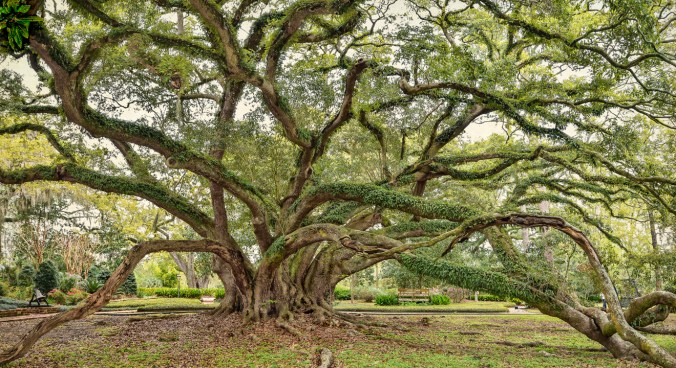
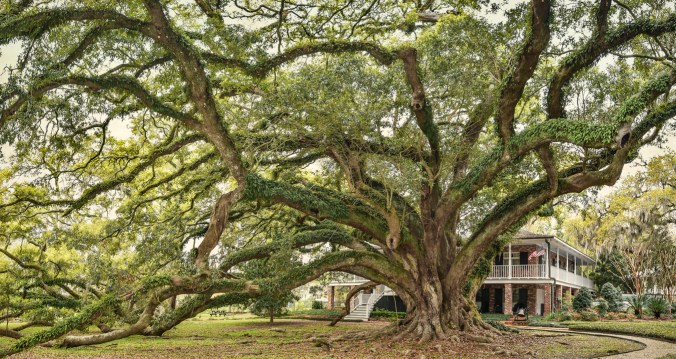
Seven Sisters Oak, current President of the Live Oak Society and the American Forestry Association’s former National “Big Tree Champion” for the species Quercus virginiana.

The Seven Sisters Oak resides in Lewisburg, LA (a small neighborhood community in Mandeville) at a private residence.  The historic and beautiful live oak is the President of the Live Oak Society, a unique organization whose members are all trees, with the exception of the Secretary or Chairman (currently is Coleen Perilloux Landry), who registers live oaks that are submitted for new membership and maintains the 75-year-old roster.  The Seven Sisters Oak was elected in 1968 after the first President died (The Locke Breaux Oak), and is the current President and largest tree in the Society.

Registration & Measurements:  Originally registered as Doby’s Seven Sisters (#200), the live oak’s first sponsors were the Doby family, who then owned the property.  The name was changed and the tree re-registered as the Seven Sisters Oak (#697).  When the live oak was first registered as Doby’s Seven Sisters, the girth was recorded at 36 feet, 1 inch.  It is an enormous tree, measuring approximately 55 feet high, with a limb spread of more than 130 feet.  In 1986, its circumference was measured at 37 feet, 6 inches; in 2003, the circumference was recorded at 38 feet; and a more recent measurement placed the girth at 39 feet 11 inches.  This magnificent tree is a worthy successor to the Locke Breaux Oak, the first President of the Live Oak Society, which died in 1966-68 due to air and groundwater pollution along the Mississippi River. To view vintage photographs of the Locke Breaux Oak go to the blog post “Revisiting the Lock Breaux Oak.”

Seven Sisters color 1_7x13 copy

Seven Sisters Oak, north view toward house, 2016

Titles:  For years, the eligibility of the Seven Sisters Oak as a Live Oak Society member and the principal officer was disputed because it was believed to be several separate trees growing together.  In 1976, after inspection by federal foresters, the tree was proved to have a single root system; and its status as President was accepted without further contest, by virtue of its girth (the greatest measurement of all live oaks then registered with the Society). For more than a decade, the Seven Sisters Oak also held the title of National Champion Live Oak in the American Forests National Register of Big Trees.

The current National Champion live oak (as of November 2019) lives in Georgia. This unnamed live oak has a trunk circumference of 36 feet, 6 inches, a height of 78 feet and a crown spread of 161 feet.  It will remain Champion until the Seven Sisters is remeasured and the new measurements submitted to the Champion Tree Register.

Seven Sisters color 4_7x13 copy

Seven Sisters Oak, color study, 2016

History:  The origin of the name, Seven Sisters, is lost in the obscurity of time and memory.  One current story is that the name describes seven main trunks that comprise the single tree.  Yet, the oak actually has more than seven trunks that split from its immense base in two clusters.  Another speculation is that the name is a translation of an older Choctaw Indian name that’s now forgotten.  The Choctaws were residents of this area for many years before white men arrived and a tree of this size would possibly have been well known and named by them.

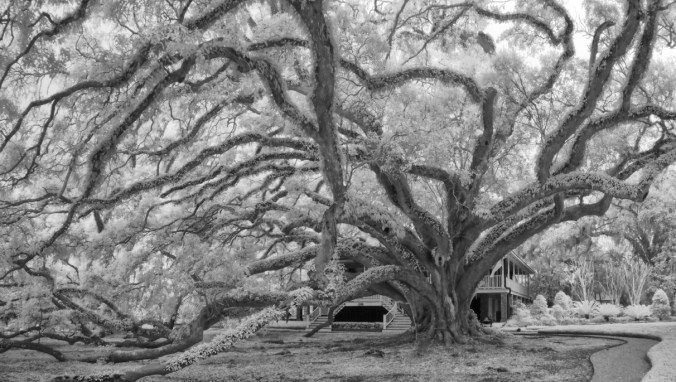
7 Sisters Pano IR 1

Seven Sisters Oak, infrared black-and-white study, 2016

Many Choctaws of the Lewisburg/Mandeville area were converted to Christianity by Father Adrein-Emmanuel Rouquette who preached the Christian gospel to the Indians under the limbs of live oaks, quite probably under this tree.  Father Rouquette was a French Creole from New Orleans, educated in Kentucky and Paris, France.  He so loved the woods near his childhood home along Bayou St. John in New Orleans that after completing his formal education, he returned not to New Orleans, but to the north shore of Lake Pontchartrain and the company of the trees.  There, preaching under the oaks, he felt more plainly God’s touch on the land and saw more clearly the light of His gospel reflected in the eyes and hearts of his congregation.

Seven_Sisters_Oak_1_8x12

Seven Sisters Oak, black-and-white study circa 1990

Sept. 2010 update:  According to Ms. Coleen Perilloux Landry, the Live Oak Society records reflect that “The Seven Sisters Oak was given its name because the owner at the time was one of seven sisters. It was Mrs. Doby who gave the oak its current name. When the tree was designated President of the Live Oak Society, the governor of Louisiana was present at the special event. The Marine Band played and a ballet troupe danced around its roots. Wooden doubloons with the tree’s name imprinted on it were given to everyone present.”

Locke Breaux Oak

Taft, Louisiana – St. Charles Parish

Locke Breaux Oak, first President

Locke Breaux Oak, first President of the Live Oak Society

The Locke Breaux Oak in Taft, Louisiana, was the first President and a founding member of the Live Oak Society, a unique organization whose members are all live oaks (Quercus virginiana).  The society operates under the auspices of the Louisiana Garden Club Federation, Inc. today; and the tree association includes only one human, the acting Secretary (currently Coleen Perilloux Landry, “Chairman”), who maintains the roster of past, present, and future tree members, as they are registered.

History

The Locke Breaux Oak was a beautiful giant, named after the Locke and Breaux families, descendents of English philosopher, John Locke.  Dr. Edwin Lewis Stephens, founder of the Live Oak Society, in an article in the Louisiana Conservation Review (April 1934), begins his list of 43 live oaks proposed for membership in a tree “Association” with a description of the Locke Breaux Oak:

“First on the list, and most outstanding timber of the highest rank in the Association, is the Locke Breaux Live Oak, on the right bank of the Mississippi River, four miles above Hahnville in St. Charles Parish…This is the largest live oak I ever saw.  Its girth four feet above the ground is 35 feet; its height about 75 feet; its spread 166 feet, when I measured it on January 22, 1932, in company with my friend, its owner, the late Samuel Locke Breaux of New Orleans.”

The age of the Locke Breaux Oak has been estimated by various sources.  Ethelyn G. Orso’s Louisiana Live Oak Lore (published by  The Center for Louisiana Studies, University of Southwestern Louisiana, Lafayette, Louisiana) indicates that:

“According to legend, in 1682 LaSalle and his band of explorers knelt beneath it to give thanks for their safe journey down the Mississippi River.  The Locke Breaux Oak was estimated to be between 300 and 400 years old.”

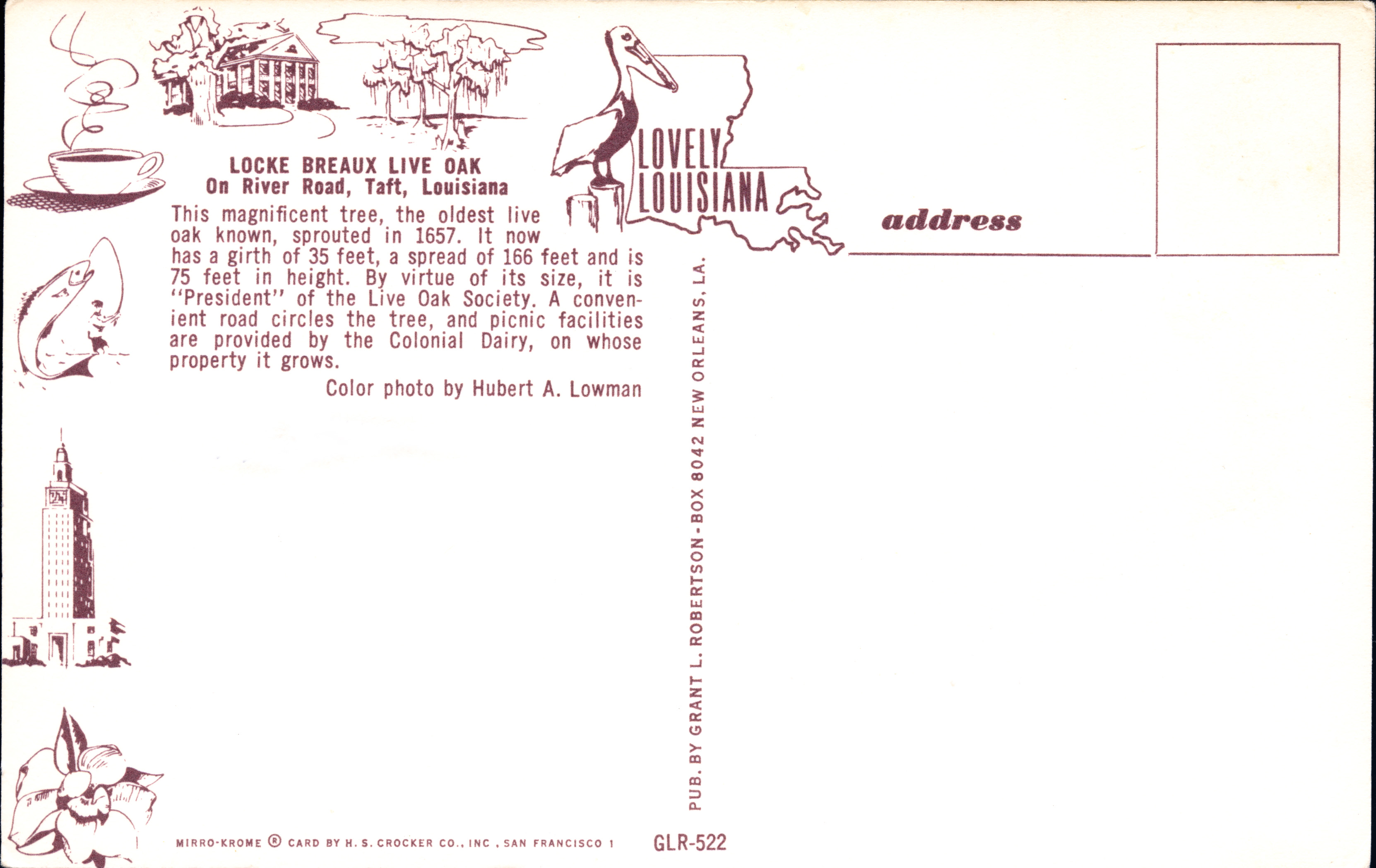
A description of the Locke Breaux Oak is also found on the reverse of a postcard printed with a color image of the tree (photo by Hubert A. Lowman), which we purchased, with many thanks, from Billy’s Postcards).

Description of the Locke Breaux Oak

Postcard of the Locke Breaux Oak - description on reverse

Beneath the bold title, the postcard states,

“This magnificent tree, the oldest live oak known, sprouted in 1657.”

and further describes the setting:

“A convenient road circles the tree and picnic facilities are provided by the Colonial Dairy, on whose property it grows.”

The Locke Breaux Oak is now deceased, its demise 1966-1968 due to air and ground water pollution, testimony to the need for more rigorous means of protection for other oaks of environmental, cultural, historic and aesthetic significance.  The live oak’s original sponsor, Colonial Dairy Farm, was sold to a chemical company, one of many that began to flourish in the parish after the discovery of oil within the region, which resulted in a shift from agriculture to industry.  The former Live Oak Society president remains #1 in the roster; and its impact on the landscape and contribution to history are known today, by those who were never privileged to view it in person, thanks to the individuals and organizations that recognized its grandeur and significance, and paused to record it, as well as to preserve the records.

The second and current President of the Live Oak Society, the Seven Sisters Oak in Lewisburg, LA (near Mandeville), was elected in 1968.  The Seven Sisters Oak was originally known as Doby’s Seven Sisters The name was changed and the oak re-registered as the Seven Sisters Oak.  A magnificent and worthy successor, the live oak’s girth measured 36′ 1″ at registration and was recorded as 38′ in 2002 on the “Society’s Top 100” list.

Seven Brothers Oak (Lastrapes Oak)

Washington, Louisiana

7 brothers oak-1

Seven Brothers (Lastrapes) Oak

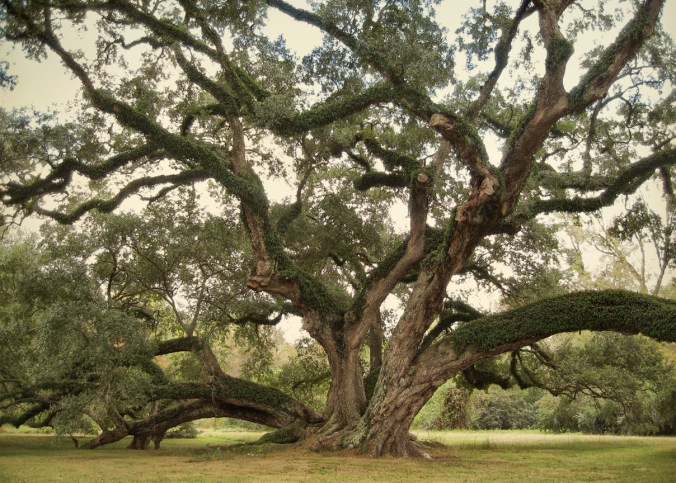
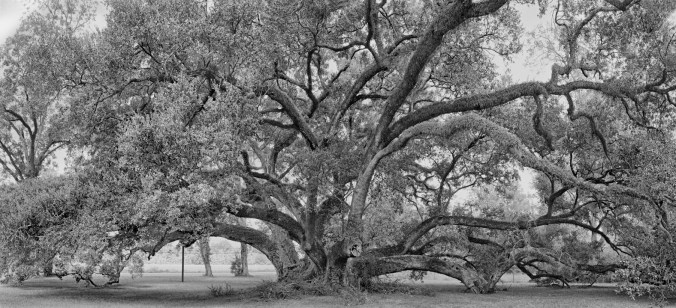
The Seven Brothers Oak is located south of Washington, Louisiana, on Hwy. 182 about a mile out of downtown Washington – at the intersection of Hwy 182 and Par Road 5-25.  The large live oak is usually well-maintained in the open space fronting the Highway.

Referred to (mistakenly) as the “Seven Sisters” by the Live Oak Society‘s founder, Dr. Edwin Lewis Stephens, in an article published in the Louisiana Conservation Review (April 1934), and not to be confused with the Live Oak Society’s current President, the Seven Sisters Oak, in St. Tammany parish—this old oak is best known today as the “Seven Brothers Oak” or the “Lastrapes” Oak.  The Seven Brothers Oak is the seventh tree listed in Dr. Stephens’ 1934 article and is #9 on the Live Oak Society’s registry.

7 Brothers Oak_close-up

Seven Brothers Oak, study in black and white

The tree’s girth (circumference) was reported in two sections by Dr. Stephens in 1934 (27’3” and 26’4”), due to the configuration of the tree’s multi-trunk system.  One section of the system (the larger measurement) had a severed trunk.

The trunk section measurements on Nov. 11, 2007 were:
32’3”      Section nearest to the road (including the severed trunk)
28’11”    Section nearest to the fence

History:  There is more than one story about this particular tree (or group of trees)[1].  On our expedition, the person who currently maintains the tree and grounds of the Lastrapes homestead explained that it had been planted and named for the seven Lastrapes brothers who had left home to fight in the Civil War.  In another variation of the story, described in Ethelyn Orso’s Louisiana Live Oak Lore, the birth of his seventh son prompted Jean Henri Lastrapes to request that seven oaks be planted; the workers arrived late in the day with the seedlings and temporarily put them in one container (or hole).  The business of the days that followed in the cotton fields distracted the workers from ever completing the planting task—and thus the trees grew together, sharing the close proximity of their original planting site.

7 Brothers panorama_2

Seven Brothers Oak, view from the southeast side

In a recent email from Paul Lastrapes, he confirmed my suspicions that, “the version of the story that the tree was named for 7 brothers who went to the Civil War is not only incorrect, but it’s impossible. The tree was planted many decades before the war AND while it is true that some of Jean Henri’s descendants served, 7 from the same family? No. The genealogy tree back to Jean Henri does not support this version in any way. ”

Photo Notes: The skies were alternately sunny and cloudy, as the afternoon thunderheads passed by; so Bill had some wonderful light to photograph the various aspects of the old oak in black & white with his view camera, while Cyndi photographed the nearby cottage.  Although timeworn and no longer in use, the structure seemed content to remain as it was, in the company of its venerable friend.

Cyndi’s Nature Notes:  A frequent visitor to the live oak, a golden silk orb-weaver spider (Nephilia clavipes), also known as the “banana spider”, had created a web amongst the lower branches of the tree.

Banana Spider

Golden Silk Orb-Weaver –  C.L. Nelson 2007


[1]Orso, Ethelyn G; Louisiana Live Oak Lore (pg. 77-78); The Center for Louisiana Studies, University of Southwestern Louisiana; Lafayette, LA 1992.