A Live Oak Tree Owner’s Manual

For this brief owner’s guide to live oak care, I consulted with two professional arborists: horticulturist, arborist, and instructor, Jim Foret, who has extensive experience with old live oaks in the New Iberia area and teaches at the University of Louisiana at Lafayette; and Bob Thibodaux of Bob’s Tree Preservation in Church Point and Scott, LA. I asked them to address the importance of this distinctive tree species for Louisiana and to focus on its proper care and conservation. I’ve distilled their guidance into the following principles for live oak owners and caretakers.

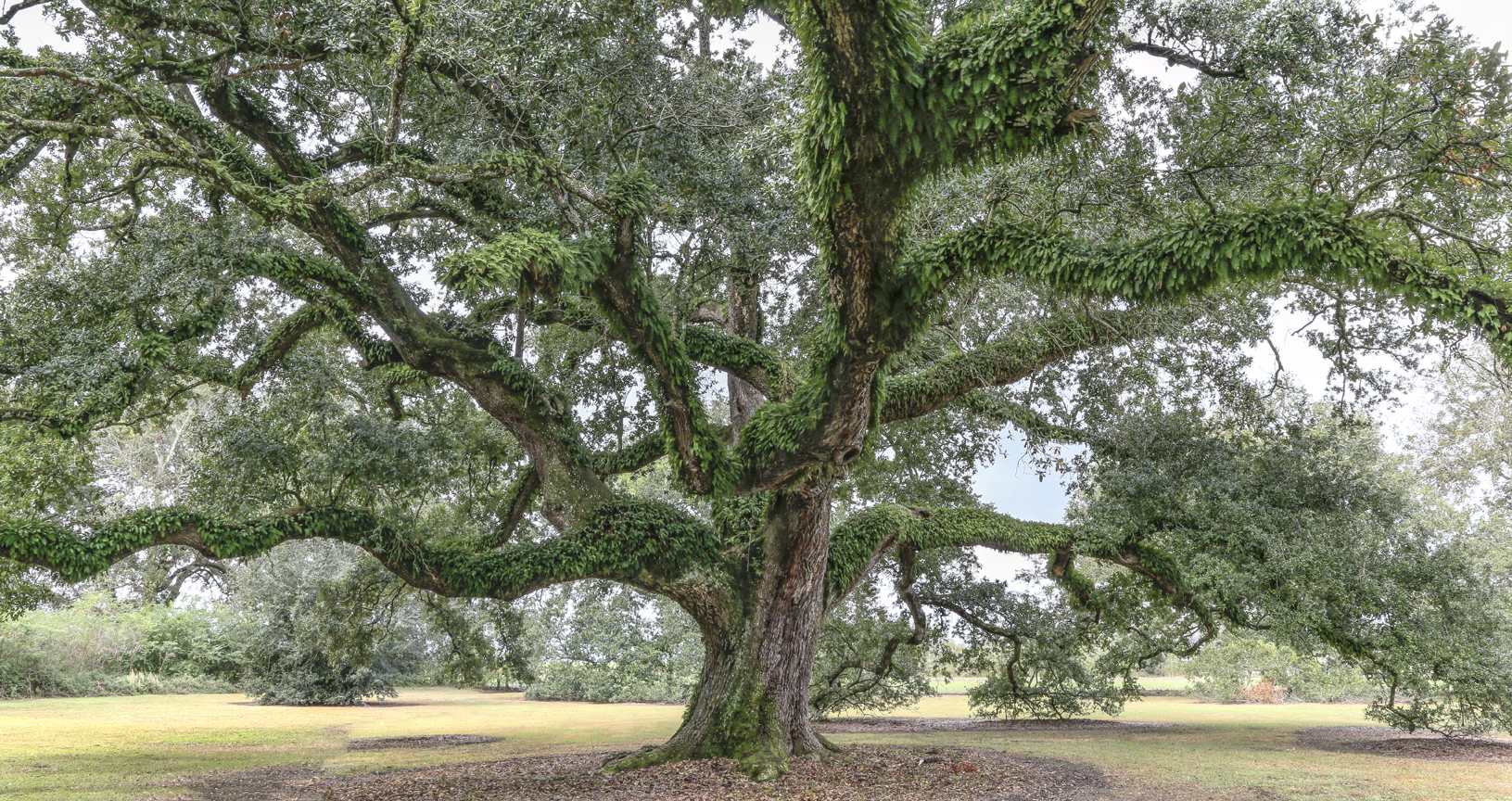
Front yard oak 4_CoulonRoots and soil—It takes room to grow a healthy tree, so don’t crowd your oak. Few people grasp just how large the functioning root system of a live oak really is—your oak’s roots do not stop at the end of its branches but generally extend one-and-a-half to two times the full spread of its crown.

Healthy root zone—Caring for your oak tree begins with creating the best conditions for a healthy root zone and lower trunk. Every square foot of undisturbed, uncompacted soil in an oak’s root zone is GOLDEN to the health of the tree. Caring for the “lower trunk” means keeping the above-ground root flare clear of leaves and soil that can eventually accumulate and weaken the root system.

Don’t fertilize and don’t use weed killers—Live oaks rarely, if ever, need any kind of fertilizer. What they do need is healthy soil. Using weed killers like Roundup or similar products kills more than weeds. These dangerous chemicals kill the fungi and microorganisms living in the soil that help the tree roots absorb and process nutrients and water. If you’re going to give the tree anything, add “mycorrhizal fungi” to the soil in the oak’s root zone. Mycorrhizae are nature’s root boosters, tiny fungi that work to help the tree roots absorb more moisture and nutrients.

Oaks don’t like soggy or compacted soil. They may tolerate it for a short time, but these two conditions block oxygen in the soil that an oak needs to thrive, and compacted soil makes it harder for oak roots to breathe and grow. Over time, these conditions can literally smother a tree. Don’t park automobiles or other heavy equipment under your oak. The weight will seriously compact the soil and kill vital root structures near the surface. And please, don’t slice large above-ground roots when mowing grass around your oak. This injures the root system and the wounds open the tree to infection and disease.

Balance—Live oaks are amazingly strong, within certain limits. The Creator designed them to grow in forests but people have stripped the forests. Today they are living along city streets, crowded between sidewalks and street paving, or they grow in groves where they can spread much wider, with multiple major limbs. You’ll also find them alone in fields of sugarcane, where they’re subjected to a variety of toxic fertilizers, weed killers, and other harmful chemicals. As a live oak grows, its long-spreading branches can become massive and sometimes can create an unbalanced, poorly rooted trunk structure.

Pruning—A balanced shape can improve an oak’s life span. Prune oak limbs (ideally when they’re young) to avoid imbalance, lopsidedness, and excessive limb length and weight that might literally pull the tree apart or uproot it as it grows. Prune dead wood seasonally, ideally during the dormant winter months when the oak is less active, NOT during the summer when untrained tree trimmers like to scout neighborhoods looking to make a quick profit from needless over-trimming of your oaks. Remember, never remove more than 10 to 15 percent of branch growth a year to prevent over-stressing and weakening your tree.

Leave the leaves on the tree—Your oak’s leaves, as with other plants, convert light (radiant energy) to chemical energy. Every leaf is important and necessary to your oak’s vitality. Leaves on the outside of the canopy are designed to absorb bright direct sunlight, while leaves growing inside the oak’s canopy are designed to extract the most energy from filtered light. Both types of leaves are crucial for your oak’s health. So prune carefully and cautiously and leave the healthy limbs and leaves on your tree.

Inspect your oak regularly—Look for signs of stress, bark lifting off in places, leaves dropping out of season, and crotches where limbs branch apart and might create pockets that can collect leaves and water that will eventually rot and weaken the joint.

If you’re fortunate enough to live in the company of live oaks, your life is blessed. And if you don’t live near a live oak, I strongly urge you to plant one, or maybe two or three.

Revisiting the St. John Cathedral Oak – Lafayette

A Brief Review of The Live Oak Society…
In 1934, Dr. Edwin Lewis Stephens
, first president of Southwestern Louisiana Institute (now the University of Louisiana at Lafayette) proposed the creation of an organization made up entirely of the largest and oldest live oak trees in Louisiana. His vision was that the organization’s membership would include trees whose size and age made them significant cultural and natural resources, worth identifying and preserving for future generations to enjoy.

From his orientation as a scholar and writer, Stephens recognized the deeper truth of this Southern icon, the live oak symbolically reflects the most distinctive characteristics of the cultures and people that settled this rich alluvial area: strength of character, forbearance, longevity, and a hearty nature.

Beginning with just 43 inductee oaks in 1934, the Live Oak Society’s roster of member oaks now counts more than 9900 registered trees across 14 southeastern U.S. states. In the Lafayette area, there were 12 oaks among the original 43 charter members. Today, more than a thousand oaks in the Lafayette area are listed on the society’s registry.

The Cathedral Oak – Lafayette  

Cathedral Oak with original fence

Photo of Cathedral Oak by Dr. Stephens, circa the early 1930s

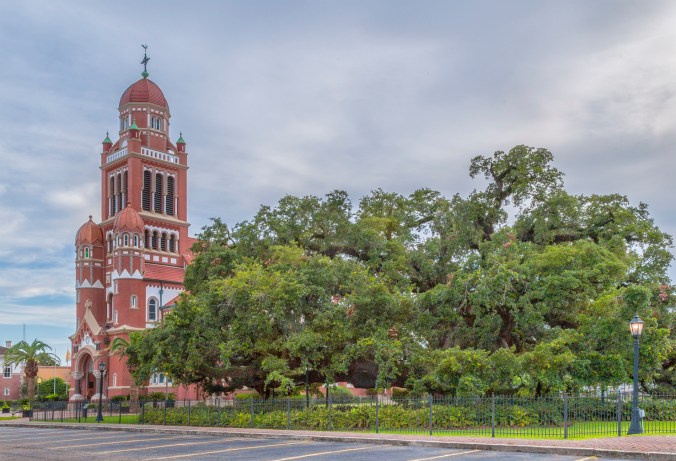
The St. John Cathedral Oak is probably the most well-known live oak in the Lafayette area. It is the second vice president of the Live Oak Society and was one of the society’s 43 original member trees. Some estimates place the tree’s age at more than 450 years old. The distinguished oak is located on the grounds of the Cathedral of St. John the Evangelist on St. John Street in old downtown Lafayette.

Cathedral Oak wide view#1

St. John Cathedral Oak and Cathedral, late afternoon

In 1821, Jean Mouton, an Acadian refugee, and owner of a large plantation named Vermilionville, donated the land on which the oak grows to the church parish. According to the cathedral’s website, the first pastor (Michel Bernard Barriere) may have requested this specific site from Mouton because of the towering live oak tree located there.

Cathedral Oak_#3_7_17

Cathedral Oak, Sunday afternoon light

According to Dr. Stephens, the oak was measured in 1929 with a circumference of 19 feet. In May 2008, local arborist Jim Foret measured the oak. The circumference was 28 feet 8 inches, it was 126 feet tall and had a crown spread of 210 feet. In May 2015, Foret measured the circumference again at 29 feet 6 inches. Foret says that old live oaks ordinarily grow much slower than this, but the soil around the Cathedral Oak received significant nurturing in the past two decades and that may have caused the growth surge. In the 1990s, a parking lot was moved away from the tree and in 1995 a protective fence was added to reduce foot traffic and protect the tree’s extensive root system.

Cathedra Oak morning_pano study 11

Cathedral Oak, morning light

The Cathedral Oak was well known to Dr. Stephens and he posed for several photographs in front of the oak during his tenure at SLI. He and his wife Beverly made frequent driving trips through the Acadiana back roads in search of notable live oaks. To their visiting guests, he was known for his “Live Oak Trail” tours where he would share some of his favorite old trees and groves across the Acadiana countryside. The Cathedral Oak was always at the top of his oak tour list. Many of his photographs documenting these trips can be found online at the Louisiana Digital Library under Southwestern Louisiana Institute Photographs, 1923-1940.

Next… Revisiting the Two Cleveland Oaks – at Avery Island and Jefferson Island.  

Coulon Plantation Oaks

The Coulon Plantation Oaks are on the Bayou Lafourche  Live Oak Tour, a project I’ve been working on for the Bayou Lafourche Cajun Bayou Tourism.  There is a beautiful group of oaks on the property, located at the intersection of LA. Hwy. 308 and Hwy. 3266, in north Thibodaux.  Most of the oaks are just under 100 years of age, but the oldest oak on the property, located to the right rear of the Coulon House, is approximately 300 years of age.

Coulon_old oak 1a

Oldest Coulon Oak,  color study 1

However, the most photogenic oaks at Coulon are along the entry road and across the massive front lawn stretching from Hwy. 308 to the Coulon House.

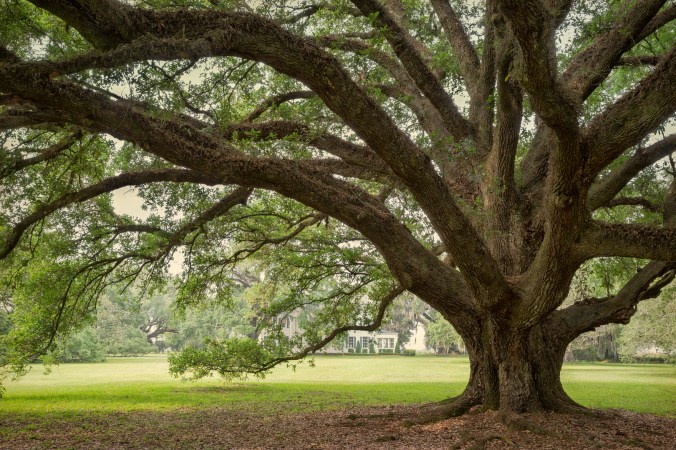
Front yard oak 4_Coulon

Front yard oak, study 2, Coulon

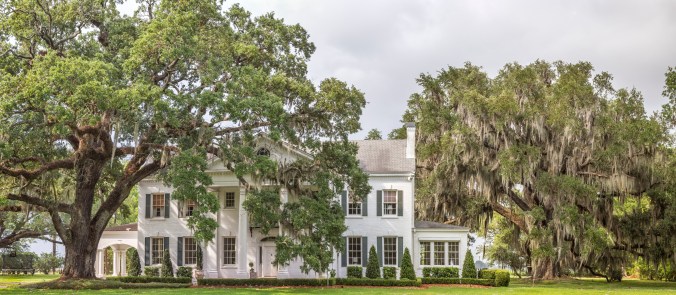
According to the current owner, there was once a matching oak to the right front of the house (similar to the one in the left front corner as shown below. The oldest oak can be seen to the right in this photo.), but it was lost to either lightning or disease.

Coulon House and two oaks_front_3

Near view of Coulon house and two oaks

Coulon Plantation was named for Victor Coulon, who may have owned the property but probably only grew crops there. It was not uncommon during that time for plantation land to be owned by wealthy families who lived elsewhere. Coulon’s primary residence was in Jefferson Parish, according to an 1830 census.

Coulon entry 2

Oaks along entry road

In 1835, Victor Coulon sold the plantation to Thomas Bibb, who also purchased Rienzi Plantation in that same year – 1835.  Bibb served as the second governor of the state of Alabama between 1820 and 1821 and likely kept a home on Bayou Lafourche as a second or third residence. Bibb’s main residence was in Alabama.  Local land records show that the property was purchased circa 1880 by Edward J. Gay, who acquired plantations as a function as a creditor for owners unable to pay off their debts. The land was later sold to a Beattie family.

Front yard oak_1_Coulon

Front yard oak with Coulon home in background

According to information from descendants of the Leche and Caldwell families, the Coulon House was built around 1940–1941 by John (Jean) Leche for his wife Albertine P. Leche. Leche bought Coulon plantation from E.G. Robichaux and Thomas H. Rogers, possibly in the 1930s. The Greek Revival architectural style of the home is reminiscent of antebellum plantations.


Leighton Plantation Oaks

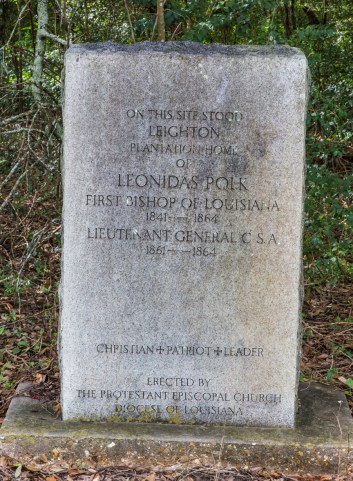
(The Leighton Plantation Oaks are located at 1801-1811 LA Hwy. 1 (St. Mary Street) about 2.5 miles north of downtown Thibodaux. The oaks are on the property between Leighton Road and Leighton Quarters Road. Turn onto Leighton Quarters Road to get the best view of the trees. The oaks range in age and size, the oldest and largest dating back to the early 1800s. There is a historic marker to Leonidas Polk at the St. Johns Episcopal Church in Thibodaux, and another (small and on the roadside) about a hundred feet north of the Leighton Quarters Road on the west side of Hwy 1.)

leighton-plantation-oaks-1

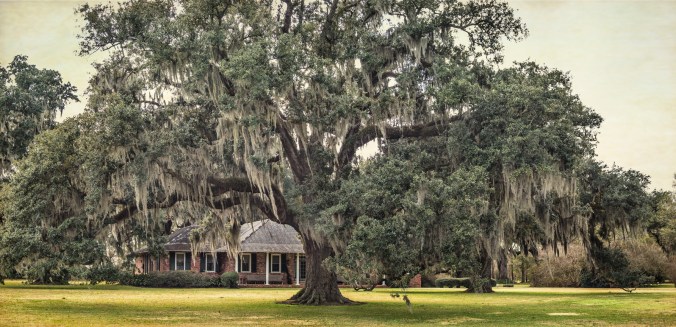
Oaks in front of current home at Leighton

There is a story that 22 of the oaks at Leighton Plantation belonged to the King of Spain in the late 1700s. As the story goes, the land grant for the property contained a stipulation that the King of Spain (Charles IV) could claim these “Royal Oaks” whenever he needed them for construction and repair of his royal navy. At the time, Spain was at war with England (1796–1808), and the wood from Louisiana’s live oaks was known worldwide to be strong enough to deflect an English cannonball.

leighton-oaks-pano-5

Leighton Oaks and back entry road to home

In the early 1800s, Leighton Plantation was owned by Leonidas Polk (April 10, 1806 – June 14, 1864), an Episcopal Bishop and American Confederate General. Polk was a graduate of the University of North Carolina at Chapel Hill and of the U.S. Military Academy at West Point (1827). After graduation from West Point, he received special permission to resign his new commission in the U.S. Army and attend the Virginia Theological Seminary where he was ordained as an Episcopal priest. He went on to become Missionary Bishop of the Southwest in 1838 and was elected Bishop of the Episcopal Diocese of Louisiana in 1841.

leighton-oaks-pano-study-2_layers

Oak grove behind the home, Leighton Plantation

Bishop Polk established Leighton Plantation to be closer to his work as he frequently traveled between Thibodaux and New Orleans where he administered the Louisiana Episcopal Diocese from Christ Cathedral, New Orleans’ first Protestant Episcopalian church. During his tenure as bishop, he personally established St. Johns Episcopal Church in Thibodaux, Christ Church in Napoleonville, the Church of the Ascension in Donaldsonville, the Church of the Holy Communion in Plaquemine, and Trinity Church in Natchitoches. Through his crusading evangelical efforts, the Protestant Episcopal religion made a significant foothold in the predominantly Roman Catholic Louisiana.

l_polk-stone

Historic roadside marker for Leonidas Polk

Bishop Polk strongly believed in states’ rights and that the South was a “distinct cultural entity.” So after Louisiana seceded from the Union in January of 1861 and the Civil War began, he resigned as Bishop of Louisiana and took command of Confederate forces in western Tennessee. His most notable contribution to the Army of Tennessee was his calm ability to inspire confidence and religious beliefs, earning him the nickname, the “Fighting Bishop.” Polk was killed in battle in June 1864 at Pine Mountain, Georgia.

This is a mirror post from the Lafourche Live Oak Tour – which was created through the generous support of the Bayou Lafourche Convention & Visitors Bureau. View more of this blog site and share it with friends at www.liveoaktour.com.

The Lafourche Historic Live Oak Tour

New Hope Plantation Oak, Matthews, LA

Dear readers, I’ve been hard at work on an entirely separate (but equal) blog site that grew out of my work on the 100 Oaks Project. In August, I was awarded a grant through the Bayou Lafourche Convention and Visitors Bureau to create a self-guided driving tour of the historic oaks along Bayou Lafourche.

beauregard-oak-11_8

General P.G.T Beauregard Oak, 20 ft. 2 in. in girth, located on LA Hwy. 1, at the E.D. White Memorial Home site.

For this grant project, I’m photographing historic live oaks around the parish and writing about the history of the people and events that have occurred around these old oaks for a website and brochure. I’m also creating and posting “waymarker signs” (like the image above) that will be located close to the oaks’ locations, near the two main highways that run on either side of Bayou Lafourche (LA Hwy. 1 and Hwy. 308).

boudreaux-oak-study-2-copy

Boudreaux Oak, 29 ft. 2 in. in girth, located near the community of St. Charles, LA Hwy 1

These way-marker signs will have numbers that a visitor can follow using a brochure, or the Tour website. The brochures and website will contain photographs of the trees (like those above) and provide a brief explanation of the significance of their location to the history of the parish. Visitors can take a self-guided driving tour along Bayou Lafourche and learn about the history of the parish through the location of our historic live oaks.

I will begin mirror-posting the Live Oak Tour site pages here, on the 100 Oaks Project site, since they are all part of the same work.  Enjoy!  And if you’d like to see the other site in its entirety, just go to https://liveoaktour.com.

Jamie Oak, Hwy. 308, near Thibodaux