First, get a flexible 50-foot tape measure…

Cyndi takes the tape measure to the Seven Brothers Oak in Washington, LA
While photographing and measuring many live oaks across the state, it’s become apparent to me that there is some general misunderstanding about how one should measure the girth (circumference) of a tree. Several of the older and larger live oaks that I’ve measured have girths (by my measurements) that are far less than what is listed in live oak records.
In this blog entry, I’ll explain the method that I’ve learned—which follows generally accepted guidelines used by many foresters, arborists and other tree-measuring folk. Others, with a more analytic and scientific approaches to tree measurement have gone into great detail about the measuring process. So, If you’re looking for more detail, especially about measuring height and limb spread, I’ve included links below to several sources for measuring height and crown spread using both simple and sophisticated tools. For my purposes, a flexible 50-foot tape measure is sufficient along with some way to record your results (pencil and paper).
Here goes:
• Wrap a flexible tape measure around the oak’s trunk at 4 to 4.5 feet above the ground (about chest height) and take the measurement in inches.
• For trees with rounded knotty growths, bumpy burls, limb extensions, or any other abnormalities at 4 to 4.5 feet above ground, measure the smallest circumference between 4.5 feet and the ground. In other words, measure under anything sticking out that might inflate the girth.
• If the trunk is leaning, wrap the tape at 90 degrees to the axis of the lean, instead of parallel to the ground.
NOTE: Dr. Stephens wrote about measuring at an oaks natural “waist.” It’s usually apparent where this is – somewhere around the 4 to 4.5 foot area of the trunk there’s usually a natural indent before the main trunk and limbs begin to flare outward.
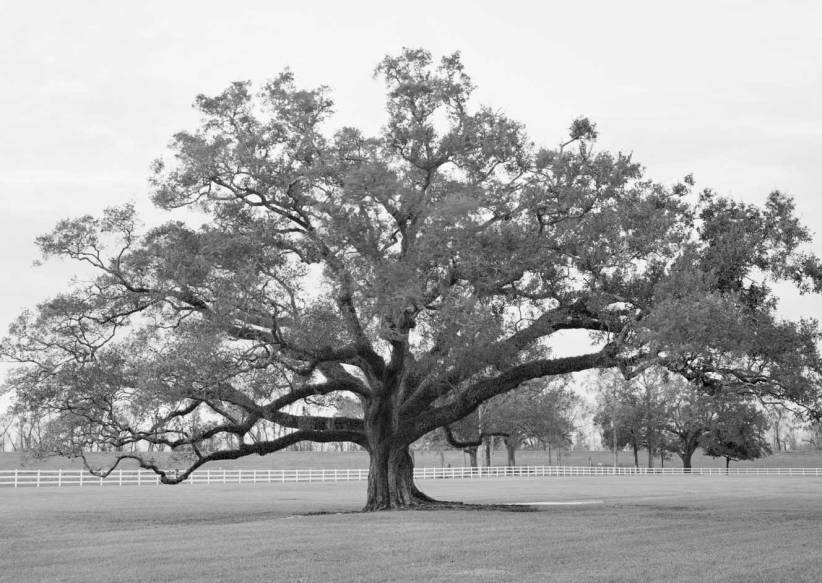
Single trunk oak on flat ground (easy to measure)
There are endless variations in the shapes and sizes of oak trunks that make accurate measurement challenging—not to mention entangling growths of vines and plants (like poison ivy) that can throw off your measurements. Some live oaks have single straight trunks and grow from flat ground, making it easy to estimate 4 to 4.5 feet above the ground.
Others are situated on small mounds of soil, leaf litter and a network of roots that make it hard to know whether 4.5 feet should be measured from the ground directly next to the oak’s base or several feet back from the tree on lower, more level ground. I take measurements from both places, a few steps back and closer in, then average the two. Generally, this will place the girth measuring line somewhere between 4 feet and 5 feet on the tree’s trunk.
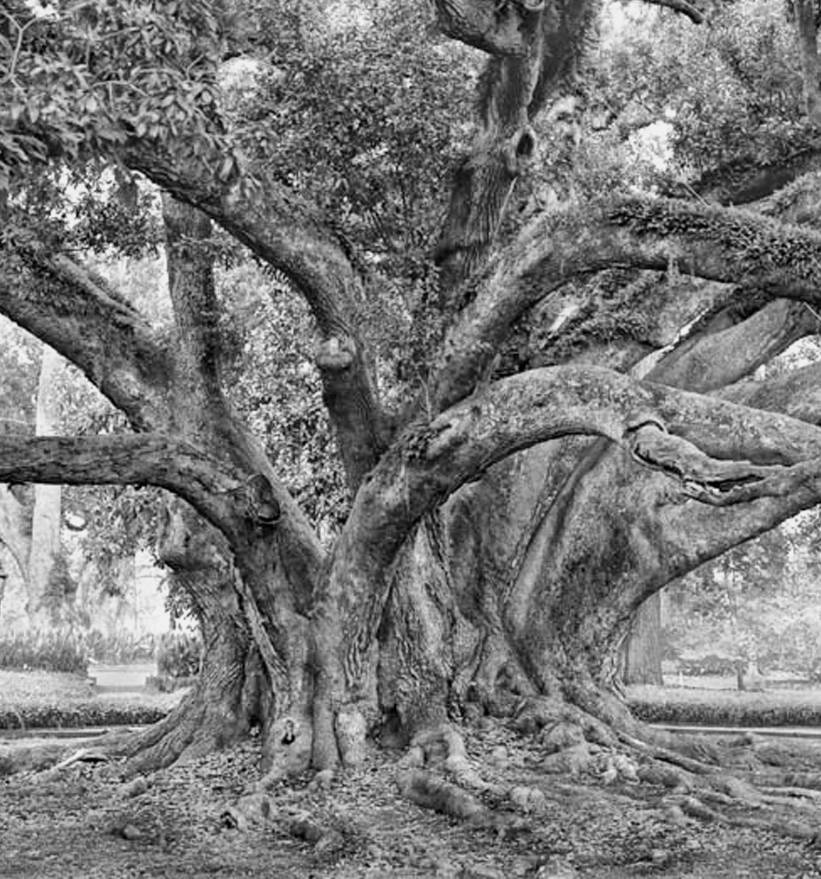
Multiple trunk oak (hard to measure)
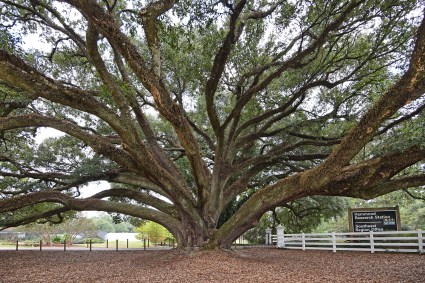
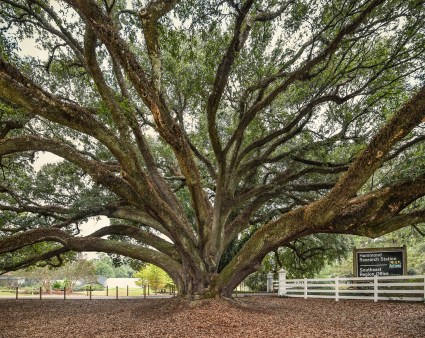
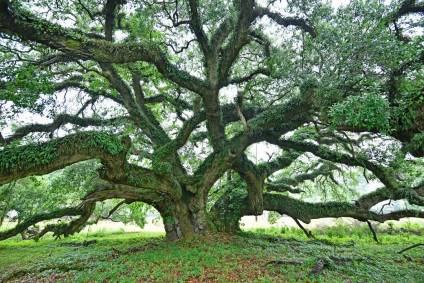
Some live oaks have multiple trunks that divide and flare outward from their main trunk. Sometimes these divisions occur just a few feet from the ground and well below the 4.5 foot point (the Seven Sisters Oak is a typical example). What to do in this case? According to one arborist source, measure below the 4.5 foot line at the place he described as the oak’s “waist”—a natural curve that often occurs below the place where the branch or branches split from the main trunk.
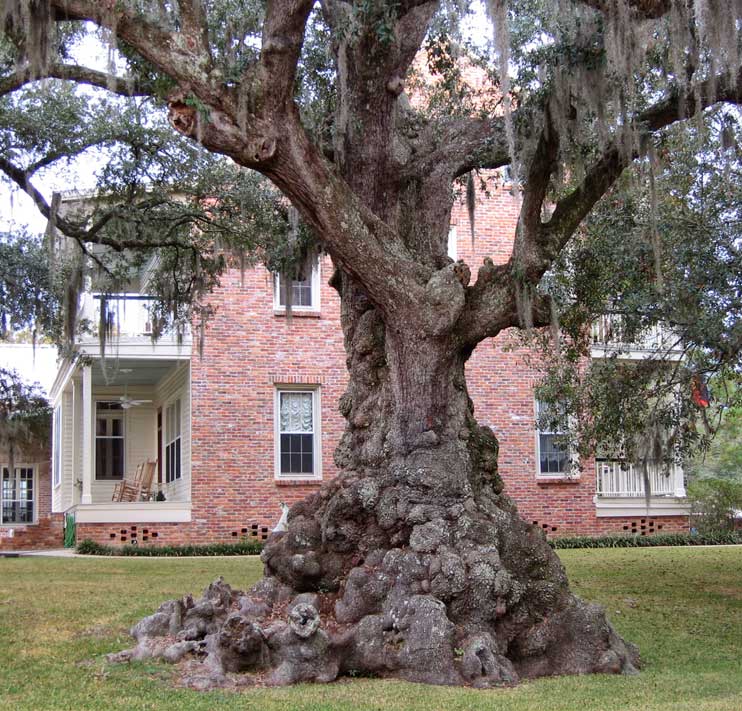
Oak with root and trunk burls (even harder to measure)
Another oddity of old live oaks is root and trunk burls that can completely encircle a tree and exaggerate the girth considerably. From Wikipedia: A burl (American English) or burr (British English) is a tree growth in which the grain has grown in a deformed manner. It is commonly found in the form of a rounded outgrowth on a tree trunk or branch that is filled with small knots from dormant buds. Burl formation is typically a result of some form of stress such as an injury or a viral or fungal infection.
When I measure the girth of an oak with a burl like the example above, I’ll measure at 4.5 feet and again above the mass of burls, then average the two. If there’s a single burl obstruction, I’ll measure under the obstruction.
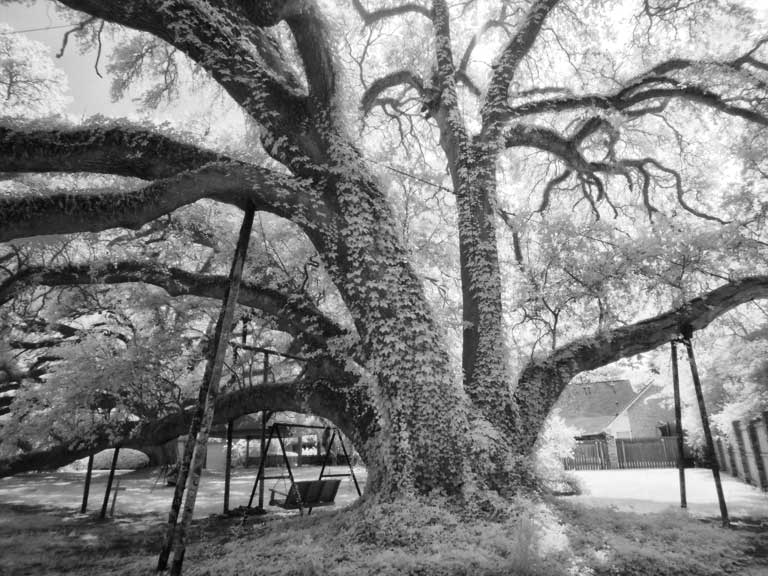
Oak completely covered with poison ivy (let someone else measure!)
Dr. Stephens estimated that an oak with a girth of 17 feet or more (the Live Oak Society today says 16 ft.) should be at least 100 years of age. But he noted also that many live oaks of much smaller girth can be more than 100 years old as well. The girth can vary significantly depending on whether the tree grows out in the open, far from other trees competing for light and water, or in a natural forest setting where it is more crowded (close-grown). Also, the growth rate and overall health of an oak can vary depending on the quality of the soil in which it grows and its access to a regular water source.
As several arborists have explained to me, girth is simply one indication of an oak’s age. This is why Dr. Stephens recommended regular re-measuring of an oak’s girth to determine its growth rate over time—information that may provide a better idea of a particular oak’s true age.
According to Wikipedia: “Girth is a measurement of the distance around the trunk of a tree measured perpendicular to the axis (the vertical center line) of the trunk. In the United States, it is measured at breast height, or at 4.5 feet (1.4 m) above ground level. This “breast height” value is a measurement that’s been used for decades in forestry applications. (CBH is a common acronym you’ll often see in descriptions of tree girth; it means circumference at breast height.) This technique of measuring at breast height was developed because of the simplicity and ease of measurement. There is no one ideal height at which to measure girth.” (Italic emphasis here is mine.)
With all of that said, I’ve listed below three professional sources of detailed measurement techniques for girth, height and crown spread.
American Forests—American Forests uses a specific formula to calculate “Big Tree” points as part of its Big Tree Program (a sort of competition to determine the largest tree of each species). They award a tree one point for each foot of its height, one point for each inch of girth, and one point for each foot of average crown spread. Their measuring guidelines can be found here as a downloadable handbook.


 100 Oaks Project