I have a Google auto search set up so that each morning I receive an email containing any news story that contains the word “live oak” in its content. These days many of the stories are about people and communities working to save one or more oak trees from being removed to make way for everything from new sidewalks, to condominiums, to hotels and even storage units. These stories don’t originate from only the South, but throughout California as well.
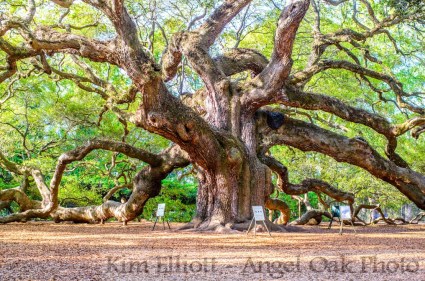
Recently, I read a story titled, the “Oldest Oaks in the World.” Oddly enough the writer listed the Angel Oak on John’s Island, South Carolina, as one of the top 10 oaks. This isn’t the first reference to the Angel Oak I’ve read recently. It comes up quite often in my daily Google auto-search. I have mixed feelings about all of the attention that it receives. It is a beautiful live oak and I don’t mean to throw “shade” toward the tree or the numerous people who work to protect it. It has a long history and at almost 25 feet in circumference, it is likely several hundred years of age. Most accurately between 300 and 400 years, NOT the wild estimates of 1000 years and more. Its massive limbs stretch long and dip to the ground creating a remarkably twisted and distinctive shape. It also has rumors of a dark past when it may have been used as a site of torture or hangings. All the ingredients for strong emotions, both love and hate.
My problems with all of the attention the Angel Oak receives are these:
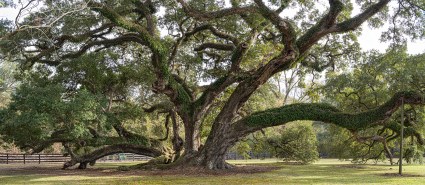
1. The wild claims of its age and size. The Angel Oak is NOT one of the oldest oaks in the world. This is just hyperbole. It’s not even the oldest live oak east of the Mississippi as regularly quoted in so many articles. The Seven Sisters Oak in Mandeville, LA (also east of the Mississippi) is almost 40 feet in circumference and has been dated by arborists to actually be almost 1,000 years old—far older and larger than the Angel Oak. In fact, several Louisiana live oaks featured in my blog are larger and older than the Angel Oak (the Edna Szymoniak Oak in Hammond, LA, the Lorenzo Dow Oak in Grangeville, LA, the Jefferson College Oak in Convent, LA, the Governor’s Oak in Baton Rouge, LA, to name just a handful. All of these oaks have girths of more than 30 feet and were possibly growing before America was colonized by Europeans.
2. Too much attention. People don’t realize that all of the attention directed at the Angel Oak could quickly turn into violence toward the tree, its history, the community members, and even as a reaction to the love and care it receives. A case in point is the much-loved Treaty Oak in Austin, Texas, that in 1989 was poisoned by an individual bent on killing the estimated 600-year-old Austin landmark. Another highly publicized case of tree vandalism occurred in England when two young men cut down the iconic Sycamore Gap tree along historic Hadrian’s Wall in 2023. They were sentenced to four years in prison. There are a lot of angry people in the world today. It would be a tragedy and a heartbreak for oak tree lovers if someone took their anger out on a beautiful and beloved old oak because it was too often in the spotlight.

 100 Oaks Project