More River Road Oak Allées – Evergreen Plantation

Pretty much everyone knows of the oak allée at Oak Alley Plantation in Vacherie – the Grand Dame of live oak allées on Louisiana’s historic River Road. It’s the classic, iconic, most visited, and most photographed allée of live oaks in the South. (Their new photo book documents this fact.)  But plantation country along historic River Road has several lesser-known oak allées that are, to this photographer, each as beautiful and memorable in their own way.

In this post, I’ll feature the first two of four other oak allées that a visitor can enjoy, all within approximately 15 miles (as the crow flies) of Oak Alley Plantation. One is accessible through a paid tour (at Whitney Plantation, Evergreen is now closed to visitors since 2020) and one can be viewed easily from the east bank side of River Road, on Hwy. 44 near Convent (the St. Joseph allée at Manresa House of Retreats).

The Two Oak Allées at Evergreen Plantation
Quarters mid-alle _6589

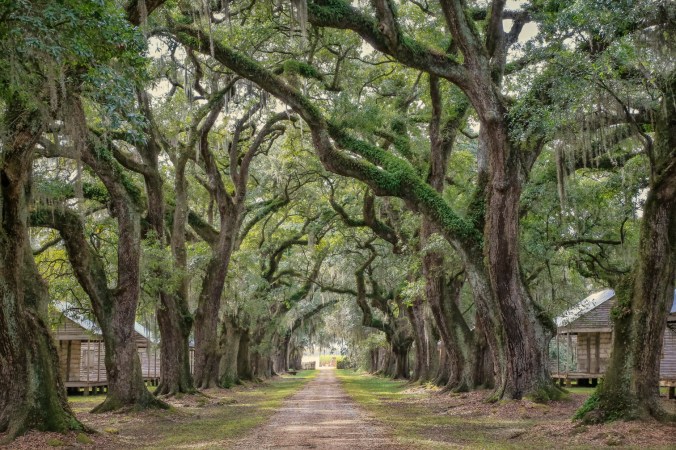
Quarters allée at Evergreen, view from mid-allée

The Quarters Allée is the older of the two oak allées at Evergreen Plantation. It’s the one that’s hidden from passersby on the west-bank side of River Road (LA Hwy. 18). To view and explore both of Evergreen’s oak allées, you must take a guided tour of the plantation, but the experience (and photo opportunities) are well worth it. (NOTE: Unfortunately, Evergreen Plantation is closed to tours for the foreseeable future, due to the Covid pandemic.  Researchers may visit their archives by appointment.)

In my opinion, the 90-minute guided tours at Evergreen are (were) the best that River Road has (had) to offer. One reason is the experience of walking through the historic slave community and stepping into some of the empty cabins.  Other River Road plantations may have one or two original slave cabins that date from the antebellum period.  Most have moved structures from elsewhere or built new structures to recreate the semblance of a slave community to help illustrate their tour narratives of the slave experience.

5 cabins_0364_filt

Six cabins, east row of historic slave quarters

At Evergreen, the original intact quarters community of 22 cabins have been preserved and maintained from the 1830s to the present day. These cabins were lived in first by enslaved individuals and then plantation workers through the Civil War, through emancipation, reconstruction, and the Great Depression, until the early 1950s when its inhabitants were finally moved out.

Old alley_1415_color-sm 2

Older oaks with Spanish moss, at the front of the quarters allée, mid-day light

The quarters allée begins with a group of a dozen older oaks growing behind the overseer’s house, upriver from the main house.  These older oaks are roughly the same age as several large oaks growing along the front of the Evergreen property and flanking the parterre garden behind the manor house. These larger oaks were planted probably in the late 1700s or early 1800s when the first structures were built on this site.

Down the dirt road and past a cypress fence that separates the front and back of the plantation, the quarters oak allée proceeds into, and through, the center of the plantation’s slave quarters. In the heart of the quarters’ community, the presence of the past is almost tangible. Bordering the dirt road and inside the line of 22 slave cabins, approximately 72 oaks make up the quarters’ allee. The oak trees were planted circa 1860, according to Evergreen curator Jane Boddie. These trees were a functional part of the slave community and provided shade and protection from the elements for its residents.

DSC8141-HDR

Slave quarters and allée, mid-day sun

There is evidence that the majority of the quarters’ cabins were built during an 1830–1840 remodel and expansion of the plantation by Pierre Clidament Becnel. He purchased the property from his grandmother, Magdelaine Haydel, in 1830, and began an ambitious Classical Greek Revival renovation of his grandmother’s two-story Creole cottage home and outbuildings. Becnel added the signature front double-return staircase to the home and the Greek-Revival garconnieres, pigeonniers, kitchen, guesthouse, and privy around the main complex.

New alley-8510

Farm road allée at Evergreen Plantation, view from farm road gate.

The Farm Road Allée – The second allée of oaks at Evergreen is located just upriver from the main house and overseer’s cottage and can be glimpsed as one drives past, going up or downriver past Evergreen’s grounds. The farm road entrance off of River Road presents the viewer with a dramatic half-mile long arched tunnel of live oaks lining the dirt road that leads to the farming operations at the rear of the plantation. The trees were moved from another nearby plantation and planted in the 1950s, making them about 70-80 years old.

New Alley_light rays_1860a_72

Evergreen farm road allée, afternoon light

The farm road allée was planted under the direction of Ms. Matilda Gray, who purchased Evergreen in 1944 after it had been abandoned in the early years of the Depression. Under Ms. Gray’s supervision, Evergreen was renovated to restore the buildings and grounds to their former beauty. After her death in 1971, her niece, Mrs. Matilda Stream, inherited Evergreen and has continued to maintain the historic property and protect it from encroachment by local industries.

Both of Evergreen’s oak allées can be explored currently only by historic researchers. Contact the plantation online at www.evergreenplantation.org or by calling 985-497-3837.
 

Academy of the Sacred Heart (Sacré-Coeur) Oak Alley

Grand Coteau, Louisiana

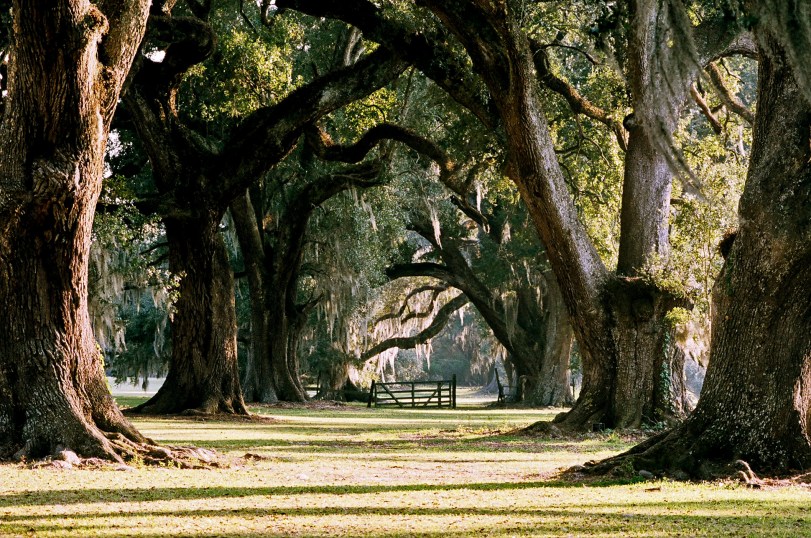
Academy of the Sacred Heart oak alley

Sacre’-Coeur oak alley, Grand Coteau – November 2007 – photo by C.L. Nelson

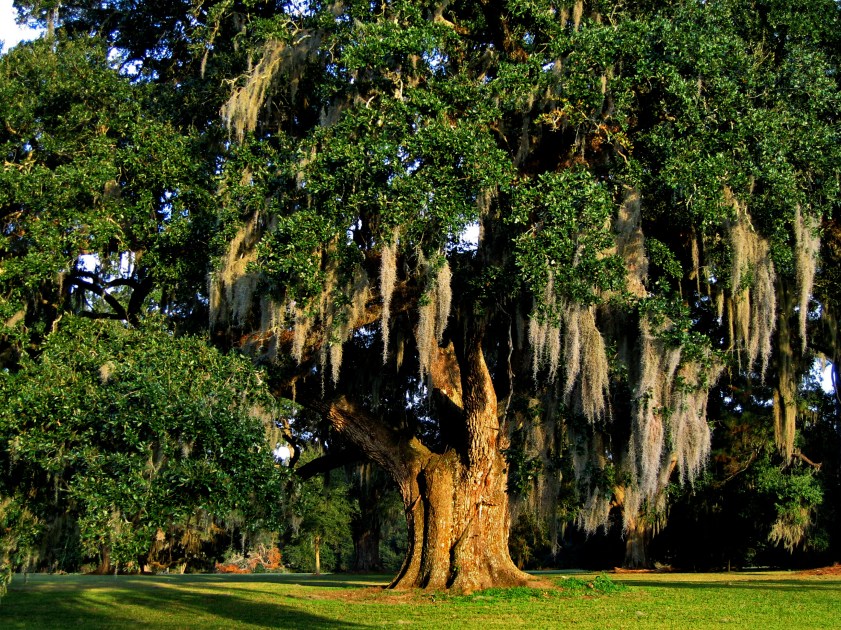
One of the first stops at the beginning of the 100 Oaks Project, when I set out to relocate and document the founding member trees and the 100 largest oaks registered with the Live Oak Society, was a return to a favorite photographic location:  a serenely beautiful grove and alley of live oaks whose moss-draped canopies arch above the path between the Academy of the Sacred Heart and the former St. Charles College, a Jesuit school for young men (now St. Ignatius School).

History:  The alley of live oaks was reportedly planted around 1840 by Father Nicholas Point, the founder and first Jesuit rector of St. Charles College, to shade his daily route to the chapel at the Academy to celebrate mass:

The Jesuit priests served as chaplains for the cloistered nuns and the Academy students, and the trees were planted to protect them from the intense summer sun as they rode back and forth between the two schools. Today, the college is used as a Jesuit seminary and spirituality center [1].

Father Point’s dedicated service to the Jesuit order continued well beyond his time at St. Charles College.  His subsequent work with the Flathead and Coeur d’Alene Indians, as well as his artistic abilities and contributions, are recognized and documented in the North Dakota Council on the Arts Online Artist Archive in an article contributed by Ken Rogers[2]:

A gifted amateur artist, Point’s pen and ink and pencil drawings are strong; his paintings are reminiscent of George Catlin’s work, spiced with the addition of Christian fervor.

In the spring of 1847, after spending six years with the Flathead and Coeur d’Alene Indians, Point traveled by barge on the Missouri River from near its confluence with the Marias River to Fort Union in present-day North Dakota, and down river aboard the steamer Martha to St. Louis.

Collections of his drawings include scenes at Fort Union, Fort Berthold and the Missouri River near what’s now Bismarck-Mandan.

Registration & Measurements

Academy of the Sacred Heart and St. Charles College live oaks

Sacre’-Coeur live oaks – November 2007 – photo by William Guion

Three of the trees in the grove and alley across the road from the Academy of the Sacred Heart were substantial in size (clearly over 16 feet in circumference) and warranted a measurement:

The circumference of the two largest live oaks measured was:

Oak # 1:  23 feet, 5 inches

Oak #2:  18 feet, 6 inches

A third live oak, which I made several images of, was also more than 18 feet in circumference. Located near the side of the road, the well-formed tree provided cool shade and a pastoral backdrop for the wedding party being photographed beneath its branches.  While waiting for their photo session to conclude, I explored other compositions, re-photographing the oak alley and individual trees within the grove, which I have photographed on several visits over a period of 25 years for my personal portfolio and a variety of publications.

Some of the resident trees at Sacred Heart are registered with the Live Oak Society, whose records are maintained by the only non-tree member, its current chairman and “registrar,” Coleen Perilloux Landry.  In the society’s records dating from 1934 – 2009, the largest trees recorded in Grand Coteau are:

#52 – “Coteau” – circumference  20 feet, 3 inches when registered; sponsor Mother Mary J. Lynch

#3381 – “O.O.O.” –circumference 16 feet, 4 inches when registered; sponsor Ruth Oliver Alba

#4164 – “Duchesne Oak” – circumference 21 feet, 3 inches when registered; sponsor Academy of the Sacred Heart

#6114 – “Ivy” – circumference 18 feet, 6 inches when registered; sponsors John & Nicole McDaniel

Cyndi’s Travel and Nature Notes

St. Charles Borromeo Church – Grand Coteau, LA photo by C.L. Nelson

While Bill photographed in the grove, I was drawn to the steeple of the historic  St. Charles Borromeo Church, which towers above the trees, appearing to pierce the sky.  The church architecture and art [3] reflect the serene beauty of the natural setting, planted by human hands but sculpted by nature over time.  The alley and grove were quiet, shady and cool in the fading light of a late afternoon in November; and the low angle of the sun’s rays and depth of color in the green grass were ideal conditions for Bill’s large format black-and-white compositions.  An occasional comment from a busy squirrel, the rustle of leaves in a light breeze, and conversations between the birds were the only exceptions to the quietude until a lively, curious Boston Terrier ran up to Bill, visited for a bit and then darted off. The small black-and-white dog found Bill again at the next photo stop (greeting him like an old friend); and we met his owners, who paused as they jogged by to introduce us to Woodrow.  Woodrow’s visit has a permanent place in the “tree travel diary,” as we now refer to the large oak Bill was photographing at the time  as “Woodrow’s oak.

Live oak, Academy of the Sacred Heart - Grand Coteau, Louisiana

Woodrow’s oak – Academy of the Sacred Heart – photo by William Guion

The front of the Academy was beautifully lit at that time of day, so we took a few photos of the landscaped gardens and statue, before heading to Lafayette to visit the St. John Cathedral Oak, 2nd Vice President of the Live Oak Society (and one of the “Top 100 Oaks” on the Society’s 2003 list).


[1] http://www.cajuntravel.com/towns/grand_coteau.cfm

[2] http://www.nd.gov/arts/online_artist_archive/images-pdfs/P/Point_NicolasFr.htm

Originally published under the title “Sacred Heart in the Big Sky” in Lewis and Clark: Art of the Upper Missouri. (Ken Rogers, Tim Fought, editors. Jim Bridges, publisher. Bismarck: The Bismarck Tribune, 2000.)

[3] http://www.st-charles-borromeo.org/ (history and photos of the church’s interior and artwork)