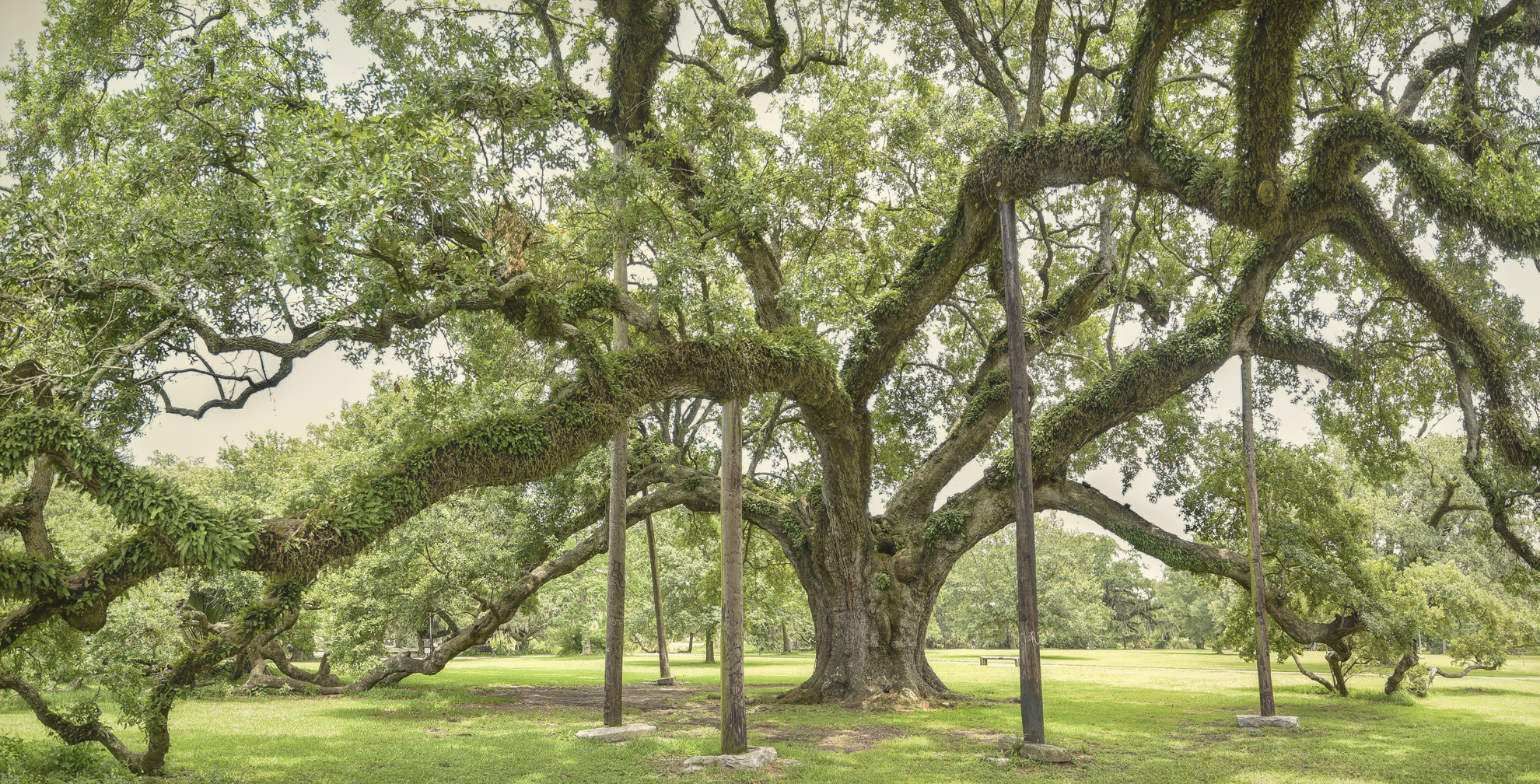
Revisiting the Seven Sisters Oak

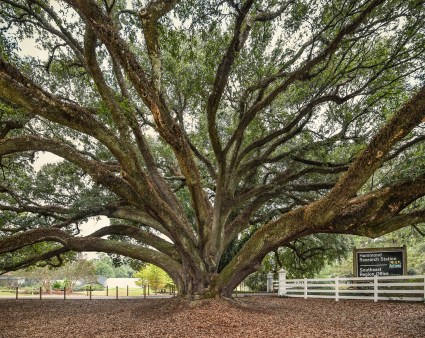
Though I’ve had a couple of other blog posts in the works, I couldn’t leave the 30-something project behind without a nod to the Seven Sisters Oak, the current president of the Live Oak Society and the former national champion live oak tree species in the American Forests’ Big Tree Registry. It’s also top of my 30-something oak list (Louisiana live oaks with a girth of more than 30 feet).

The Seven Sisters Oak – Live Oak Society President and former Champion Tree of the Southern live oak species in American Forest’s Champion Tree List.

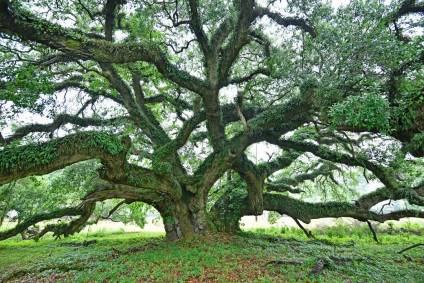
Cyndi and I took a drive from Bayou Lafourche to the north shore of Lake Pontchartrain recently to revisit the Seven Sisters Oak, to make some new photographs for the blog and say hello to an old friend.  The sky was overcast, making it possible a good day to photograph in the shadows of a towering old oak.  The recent rains had turned the resurrection fern a lush bright green. (We also made a stop in Ponchatoula to stock up on local strawberries and visit a couple of other local oaks including the Abbot Paul Schaueble Oak.

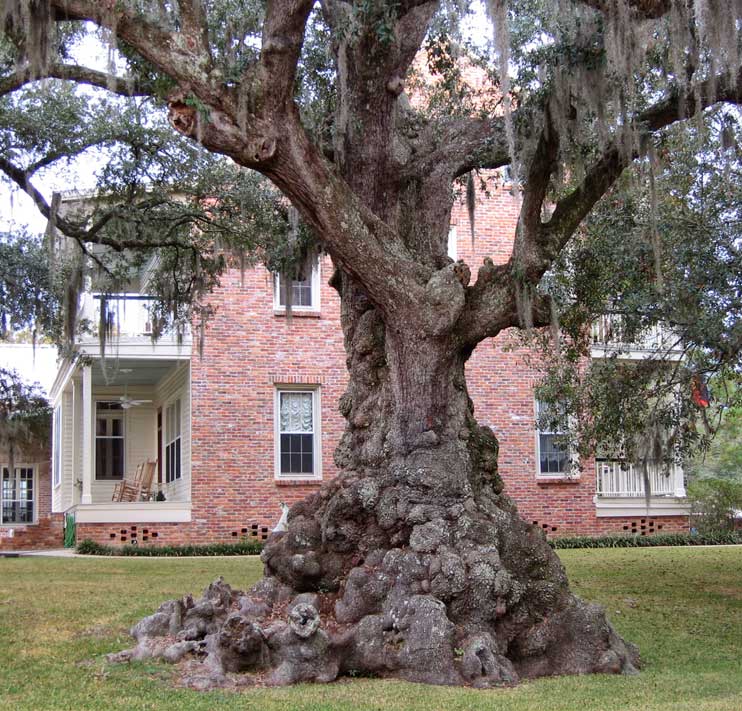
While visiting the tree, we met the current owners, John and Mary Jane Becker. They were welcoming and informative about their term as caretakers of this massive oak (almost 40 feet in circumference).  The Seven Sister’s Oak shades much of the front yard of the Becker’s home in the historic neighborhood of Lewisburg, near the edge of Lake Pontchartrain, in Mandeville.  Mrs. Becker remarked how the old oak was wearing an abundance of new celery green flowers (catkins) when we visited, one indication that the centuries-old tree is still healthy and vital.  She also said that last year the oak produced a bumper crop of acorns.
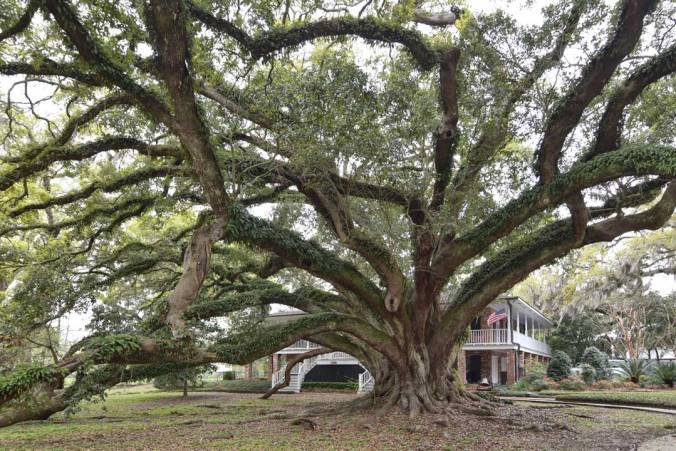
7-sisters-oak-study-10

Seven Sisters Oak, view toward the Becker’s home.

If you missed our previous blog post on the Seven Sisters, I’ll recap some of its known history (though what we know about the oak dates back less than 100 years and some estimates of the tree’s age put it to between 600 and 1,000 years old).

The Seven Sisters Oak is actually the second live oak to take the status of President of the Live Oak Society.  It replaced the Society’s first president, the Locke Breaux Oak, after its death from air and water pollution (see my previous posts about the Locke Breaux Oak for details).

For years, the eligibility of the Seven Sisters Oak as a society member tree was disputed.  It was argued to be several separate trees growing together rather than a single tree. Then in 1976, after inspection by federal foresters, the multiple tree trunks were found to have a single root system.  It was accepted into the Society—registered (#200)—and in time, was appointed the new Society President, based on its girth, limb spread, and height.

(A short sidebar.  From other sources, I see this is an ongoing argument among tree-measuring folks—whether the circumference of a multi-trunk oak can be compared equally to a single-trunk tree. I take a neutral position on this topic. To me, they’re all very old oaks, and as such deserve to be considered as cultural, historic, and environmental treasures, regardless of the shape or number of trunks.)

7-sisters-study-1

The oak tree’s first sponsor was the Doby family who owned the property on which the tree is located at that time (the 1930s). Mrs. Carole Hendry Doby was one of seven sisters in her family and the tree was named originally named “Doby’s Seven Sisters.” The oak was re-registered (#697) by its next owners, Mr. and Mrs. Milton Seiler.  The Seiler’s renamed the tree simply “The Seven Sisters.”

7-sisters-study-8

Seven Sisters Oak, view from outside of the oak’s canopy, showing new green catkins.

According to the American Forests’ Big Tree Registry, the Seven Sisters Oak had a crown spread of 139 feet, a circumference of 467 inches (approximately thirty-nine feet) and a height of sixty-eight feet when it was last officially measured. Its age has been estimated to be somewhere between 500 and 1200 years old. My most recent measurement (in 2019) puts the circumference closer to 479 inches or 39 feet 11 inches.

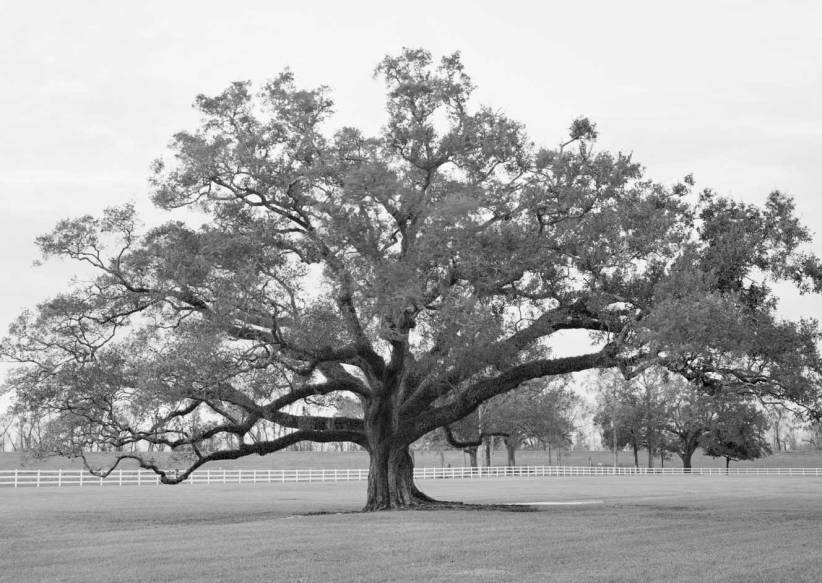
How to Measure a Live Oak’s Girth

First, get a flexible 50-foot tape measure…

7_brothers_scale

Cyndi takes the tape measure to the Seven Brothers Oak in Washington, LA

While photographing and measuring many live oaks across the state, it’s become apparent to me that there is some general misunderstanding about how one should measure the girth (circumference) of a tree. Several of the older and larger live oaks that I’ve measured have girths (by my measurements) that are far less than what is listed in live oak records.

In this blog entry, I’ll explain the method that I’ve learned—which follows generally accepted guidelines used by many foresters, arborists and other tree-measuring folk. Others, with a more analytic and scientific approaches to tree measurement have gone into great detail about the measuring process. So, If you’re looking for more detail, especially about measuring height and limb spread, I’ve included links below to several sources for measuring height and crown spread using both simple and sophisticated tools. For my purposes, a flexible 50-foot tape measure is sufficient along with some way to record your results (pencil and paper).

Here goes:
• Wrap a flexible tape measure around the oak’s trunk at 4 to 4.5 feet above the ground (about chest height) and take the measurement in inches.

• For trees with rounded knotty growths, bumpy burls, limb extensions, or any other abnormalities at 4 to 4.5 feet above ground, measure the smallest circumference between 4.5 feet and the ground. In other words, measure under anything sticking out that might inflate the girth.

• If the trunk is leaning, wrap the tape at 90 degrees to the axis of the lean, instead of parallel to the ground.

NOTE: Dr. Stephens wrote about measuring at an oaks natural “waist.”  It’s usually apparent where this is – somewhere around the 4 to 4.5 foot area of the trunk there’s usually a natural indent before the main trunk and limbs begin to flare outward.

oak-alley-oak-in-west-field

Single trunk oak on flat ground (easy to measure)

There are endless variations in the shapes and sizes of oak trunks that make accurate measurement challenging—not to mention entangling growths of vines and plants (like poison ivy) that can throw off your measurements. Some live oaks have single straight trunks and grow from flat ground, making it easy to estimate 4 to 4.5 feet above the ground.

Others are situated on small mounds of soil, leaf litter and a network of roots that make it hard to know whether 4.5 feet should be measured from the ground directly next to the oak’s base or several feet back from the tree on lower, more level ground.  I take measurements from both places, a few steps back and closer in, then average the two. Generally, this will place the girth measuring line somewhere between 4 feet and 5 feet on the tree’s trunk.

7-Sisters-Oak-_8x10

Multiple trunk oak (hard to measure)

Some live oaks have multiple trunks that divide and flare outward from their main trunk. Sometimes these divisions occur just a few feet from the ground and well below the 4.5 foot point (the Seven Sisters Oak is a typical example). What to do in this case? According to one arborist source, measure below the 4.5 foot line at the place he described as the oak’s “waist”—a natural curve that often occurs below the place where the branch or branches split from the main trunk.

lumpy-oak-St

Oak with root and trunk burls (even harder to measure)

Another oddity of old live oaks is root and trunk burls that can completely encircle a tree and exaggerate the girth considerably. From Wikipedia: A burl (American English) or burr (British English) is a tree growth in which the grain has grown in a deformed manner. It is commonly found in the form of a rounded outgrowth on a tree trunk or branch that is filled with small knots from dormant buds. Burl formation is typically a result of some form of stress such as an injury or a viral or fungal infection.

When I measure the girth of an oak with a burl like the example above, I’ll measure at 4.5 feet and again above the mass of burls, then average the two. If there’s a single burl obstruction, I’ll measure under the obstruction.

Governor's-oak-1

Oak completely covered with poison ivy (let someone else measure!)

Dr. Stephens estimated that an oak with a girth of 17 feet or more (the Live Oak Society today says 16 ft.) should be at least 100 years of age. But he noted also that many live oaks of much smaller girth can be more than 100 years old as well. The girth can vary significantly depending on whether the tree grows out in the open, far from other trees competing for light and water, or in a natural forest setting where it is more crowded (close-grown). Also, the growth rate and overall health of an oak can vary depending on the quality of the soil in which it grows and its access to a regular water source.

As several arborists have explained to me, girth is simply one indication of an oak’s age. This is why Dr. Stephens recommended regular re-measuring of an oak’s girth to determine its growth rate over time—information that may provide a better idea of a particular oak’s true age.

According to Wikipedia: “Girth is a measurement of the distance around the trunk of a tree measured perpendicular to the axis (the vertical center line) of the trunk. In the United States, it is measured at breast height, or at 4.5 feet (1.4 m) above ground level. This “breast height” value is a measurement that’s been used for decades in forestry applications. (CBH is a common acronym you’ll often see in descriptions of tree girth; it means circumference at breast height.)  This technique of measuring at breast height was developed because of the simplicity and ease of measurement. There is no one ideal height at which to measure girth.” (Italic emphasis here is mine.)

With all of that said, I’ve listed below three professional sources of detailed measurement techniques for girth, height and crown spread.

American Forests—American Forests uses a specific formula to calculate “Big Tree” points as part of its Big Tree Program (a sort of competition to determine the largest tree of each species). They award a tree one point for each foot of its height, one point for each inch of girth, and one point for each foot of average crown spread. Their measuring guidelines can be found here as a downloadable handbook.

The Eastern Native Tree Society has published a thorough description of detailed measurement guidelines here.

The Monumental Trees website also has simple instructions with helpful drawings and photos here.

(Next blog entry: More 30-something oaks.)

Edna Szymoniak Oak (Hammond) and Lorenzo Dow Oak (Grangeville)

Oaks east of Acadiana
It was while working on the photographs of Trees Acadiana’s top 10 live oaks that I had the inspiration to extend my search from Acadiana to include the largest and oldest live oaks I could locate across Louisiana.

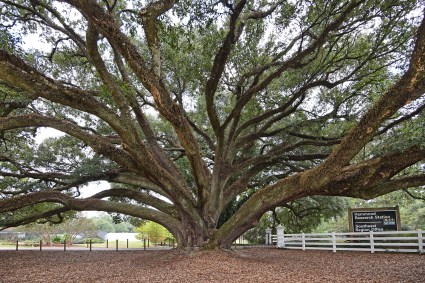
Edna Szymoniak Oak—Number 3 on my 30-something list is the Edna Szymoniak Oak, located at the entrance to the LSU AgCenter Hammond Research Center. Nestled in pine and oak woods about six miles from the city of Hammond, at 21549 Old Covington Highway, the station covers approximately 150 acres of research gardens. It is a beautiful example of a well-cared-for old oak. Its location makes it easy for Research Center visitors to view and it receives the regular protection and care of the AgCenter’s knowledgeable staff.

At 35 ft. 6 inches in circumference, I feel the Edna Szymoniak Oak probably gets far less recognition than it deserves as one of Louisiana’s oldest and largest live oaks. Not much is known about its history prior to the establishment of the Hammond Ag Center, but in this area of the Northshore of Lake Pontchartrain, there are numerous ancient live oaks, including the Seven Sisters Oak in Mandeville. In a recent Times Picayune article of historic live oaks within a short distance of New Orleans, the Edna Oak wasn’t even included.

Edna Szymoniak Oak, 35′-6″; Hammond, LA

The Edna Szymoniak oak is named after the wife of Boleslaus “Bill” Szymoniak, the first superintendent of the research center station. (From their website) “Established in 1922 as the Fruit and Truck Experiment Station, the LSU AgCenter Hammond has traditionally served the strawberry and vegetable industries.

Today, the AgCenter’s focus is landscape horticulture, including plant selection, fertility, weed control and plant growth regulators. Scientists evaluate more than 500 ornamental plants per year and each spring and fall release a list of “Super Plants” that grow well in all parts of Louisiana.

Edna Szymoniak Oak, study #2

Lorenzo Dow Oak—The next oak on my list has an interesting story connected to its name—the Lorenzo Dow Oak, located near Grangeville, LA.

Lorenzo Dow Oak study; 36′-8″; Grangeville, LA

The oak is named after Lorenzo Dow, who (according to Wikipedia) was an eccentric itinerant American preacher who lived between 1777 and 1834. He reportedly preached to more people than any other preacher of his time. Dow traveled widely around the U.S. preaching “against atheism, deism, Calvinism and Universalism.” Though he lived like a pauper, traveling mostly on foot with only the clothes on his back and a box of bibles, Dow was also a successful author. His autobiography was at one time the second most-read book, exceeded only by the bible.

Lorenzo Dow Oak, Masonic Lodge Oak 2 and corner of lodge building.

Dow traveled to this part of the South in 1803–1804 and probably preached in or near the Grangeville area. His dramatic fire-and-brimstone evangelical preaching style (he shouted, screamed, begged, flattered, cried and challenged his listeners and their beliefs) drew crowds wherever he spoke. His wide influence and popularity resulted in many children of this period being named after him as well as this ancient oak.

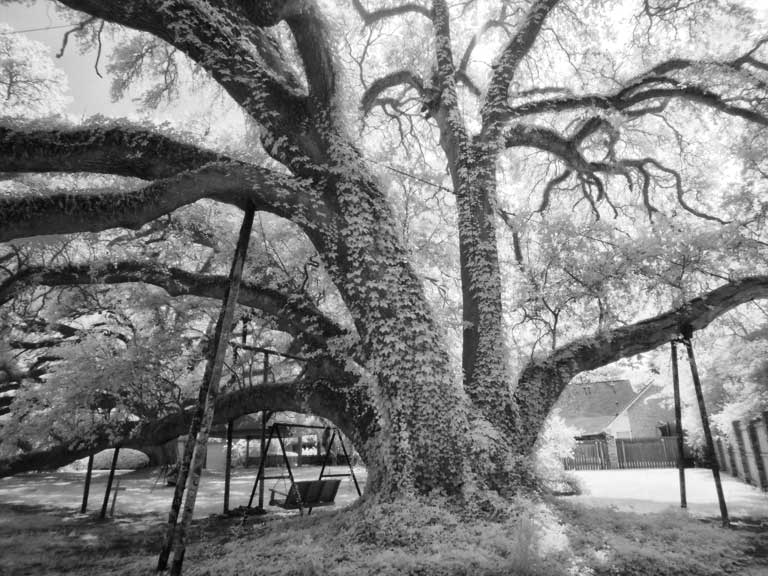
Lorenzo Dow Oak, black-and-white infrared study.

Because he was often unwelcome in churches, Dow would preach wherever he could—in town halls, farmers’ barns, open fields and possibly even under the overhanging branches of these two old oaks.

Lorenzo Dow Oak in rain

The sprawling and partially overgrown Lorenzo Dow Oak is located on the grounds of the Grangeville Masonic Lodge #231, along with a second neighboring oak that is 27 feet 11 inches in girth.

The lodge is one of the oldest Masonic groups in Louisiana, with a membership that dates back to 1889, and a lodge building that was originally constructed in the 1930s (and is currently being restored).

This oak was especially challenging to find since its location on the Live Oak Society registry was simply “East Feliciana.” Grangeville is actually in St. Helena Parish, a few miles west of Pine Grove in a northeastern corner of Louisiana, east of St. Francisville (though in the early part of the 1900s many people referred to this area of Louisiana as the “Florida Parishes and referred to east and west Feliciana as just the “Felicianas.”  I finally found online snapshots of someone who had visited the Grangeville Masonic Lodge and so wrote a letter to the lodge and finally located the old oak.

NOTE: Though, “northeastern” may not seem accurate to those living around Grangeville, since it is due east of St. Francisville which is in the middle of the state. Grangeville is located in the northeastern corner of the “toe” of Louisiana’s boot shape that sticks into Mississippi and is only a few miles directly south of McComb, MS. Grangeville is positioned where the boot laces would be on the toe of the boot shape.

Louisiana’s oldest oaks – older than America

Oaks with 30-something feet girth
In 2015, I marked 30 years that of photographing live oaks of Louisiana and 10 years since I began the 100 Oaks Project (documenting the 100 oldest oaks in Louisiana). Because of these milestones, I decided to devote 2015 to tracking down the very oldest living live oaks in Louisiana—those trees with girths of 30 feet or more. I was already familiar with a few of the more well-known oaks in this size range, but most were still on my longer list of “trees yet to find.”

Stonaker Oak – near New Roads, LA; 29 ft. 6 in; #16 on original Live Oak Society inductee list.

To compile my list, I included all Society member trees with a circumference of 26’ feet or greater when registered. I knew from experience and from discussions with arborists that mature oaks have an average growth rate of 1” to 1.5” per year. In a half-century, a healthy live oak can easily grow three to four feet in circumference. This narrowed my search to fewer than 30 oaks in Louisiana that could potentially be in the 30-foot girth range.

Before America was America—According to several Louisiana arborists I consulted, oaks of this size are probably between 400 and 500 years of age (add another 100 years or more to this estimate for those oaks with a girth greater than 35 feet). That means these live oaks were likely growing before Europeans settled this continent (the earliest colony was established in 1565 by the Spanish in St. Augustine, Florida; Jamestown, Virginia, was established in 1607). Some were quite possibly growing before the name “America” was first used in print in 1507 as a designation for this continent—in other words, Before America was America.

Seven Sisters color 4_7x13 copy
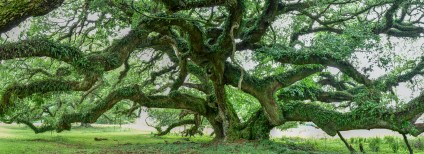
The Seven Sisters Oak, Lewisburg/Mandeville – National Champion

The 30-something club—One New Orleans arborist I contacted about a tree’s location jokingly suggested I call my list the “30-something club.” So, I’ve incorporated that into the title of this blog entry as well and have included in this list oaks that are almost 30 feet in girth (29′-6″ or greater). To me, these venerable oaks should be recognized as cultural and historical landmarks and deserve a more significant place in public awareness—and even some minimal protection that would allow them to live to whatever ripe old age a live oak can live.

Edna Szymoniak Oak, Hammond, LA (35 ft. 8 in. in girth)

Live oak protection—Tragically, several of the oldest oaks on the Society’s registry have died, fallen off the grid of public awareness or even been removed. It’s important to note that it’s only through public awareness and human interest that a tree’s survival is secured. Currently, there are no state laws in Louisiana to protect historic or heritage trees and only spotty local ordinances that offer any protection from human removal.  I’ll cover this in detail in a future blog entry.

Randall Oak, New Roads, LA (36 ft. 7in. girth)
Lorenzo Dow Oak, Grangeville, LA (36 ft. 8 in. girth)

In the next few blog entries, I’ll be documenting my search during 2015 to find these 30-something live oaks. More photos of the oldest oaks can be found at this blog entry here…

Here are the trees in order of size:

  1. Seven Sisters Oak – Lewisburg / Mandeville; 39′-10″
  2. Randall Oak – New Roads; 35′-8″
  3. Edna Szymoniak Oak – Hammond; 35′-6″
  4. Lorenzo Dow Oak – Grangeville; 35′-5″
  5. La Belle Coline Oak – Between Sunset and Carencro; 34’+
  6. The Governor’s Oak – Baton Rouge; 33′-3″
  7. Lastrapes Oak (Seven Brothers Oak) – Washington; 32′-3″ (largest section)
  8. Boudreaux Friendship Oak – Scott; 31′-10″
  9. Lagarde Oak – Luling; 30′-11″
  10. Mays Oak – Near Rosedale; 30′-11″
  11. Blanchet Oak – Lafayette; 30′-7″
  12. Grosse Tete Oak – Bayou Grosse Tete; 30′-2″
  13. Etienne de Bore’ Oak – Audubon Park, New Orleans; 30′
  14. Grenier Oak – Near Thibodaux; 29′-9″
  15. Josephine A. Stewart Oak – Vacherie; 29′-11″
  16. St. John’s Cathedral Oak – Lafayette; 29′-6″
  17. Stonaker Oak – New Roads; 29′-6″
  18. The John Hudson Oak – Prairieville, LA; 29′-6″

(This list has been updated as of December 2020)

As I continue locating and measuring additional oaks through this year, I may expand this 30-something list, but as of September, these are the oaks I’ve personally measured and confirmed to be 29′-6″ or larger.

NOTE:  I’ve found a few oaks with girths stated to be larger than 29 feet on the Live Oak Society registry. However, when I measured them, their sizes were smaller. I suspect they were simply mismeasured. Those oaks are not on this list but will be mentioned in my blog entries that follow because they are still very old trees and fit into my larger 100 oldest oaks list.

A bit of background—For those readers who are new to this blog, my wife Cyndi and I  began the 100 Oaks Project after Hurricanes Katrina and Rita swept across Louisiana in 2005.  We started with the 43 original inductee trees listed by Dr. Edwin L. Stephens in a 1934 article he wrote for the Louisiana Conservation Review titled “In Louisiana, I saw a Live Oak Growing” (a PDF copy of that article is contained in the “Pages” section of this blog).

Dr. Stephen’s original intent was to establish an organization “to promote the culture, distribution, and appreciation of the live oak.” Members were originally limited to oaks that were at least 100 years of age, determined by a circumference of 17 feet or more, though he revised these requirements to allow registration of “junior-league” oaks with a minimum circumference of eight feet.

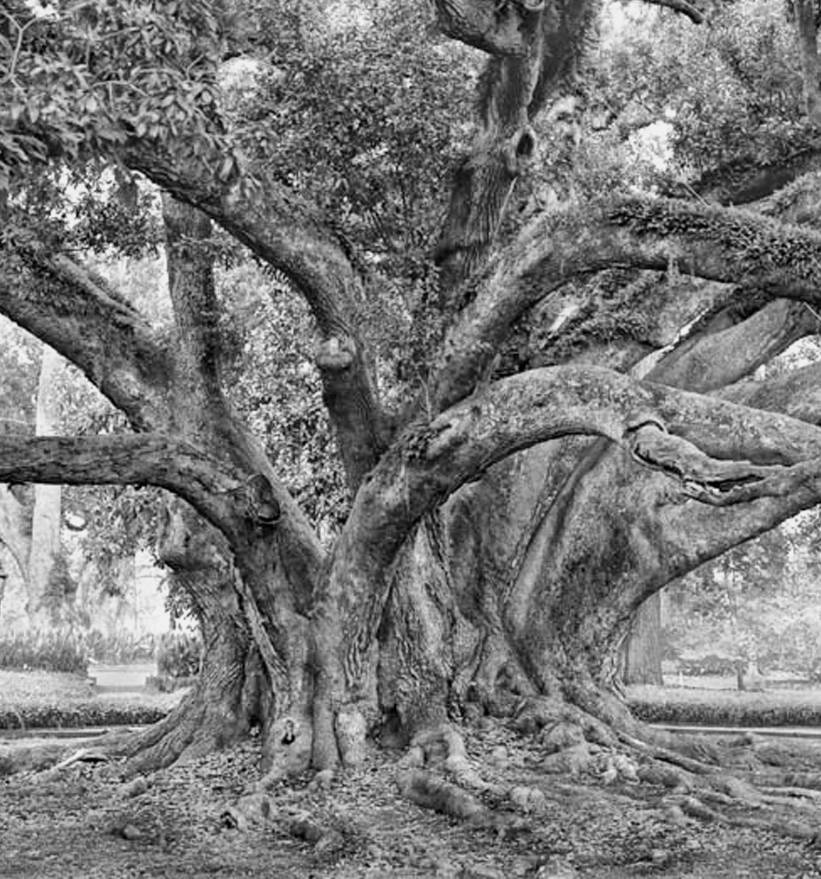
McDonogh Oak, City Park, New Orleans

McDonogh Oak color 2The McDonogh Oak is the largest and oldest oak in New Orleans’ City Park. Along with the Anseman Oak and Suicide Oak, it is part of an ancient oak forest that was possibly hundreds of years old in 1718 when brothers Iberville and Bienville first scouted this area for a portage of bayous connecting the Gulf of Mexico, Lake Pontchartrain, and the Mississippi River. This natural system of waterways was a deciding factor for the brothers’ choice of this location to create the settlement that became New Orleans.
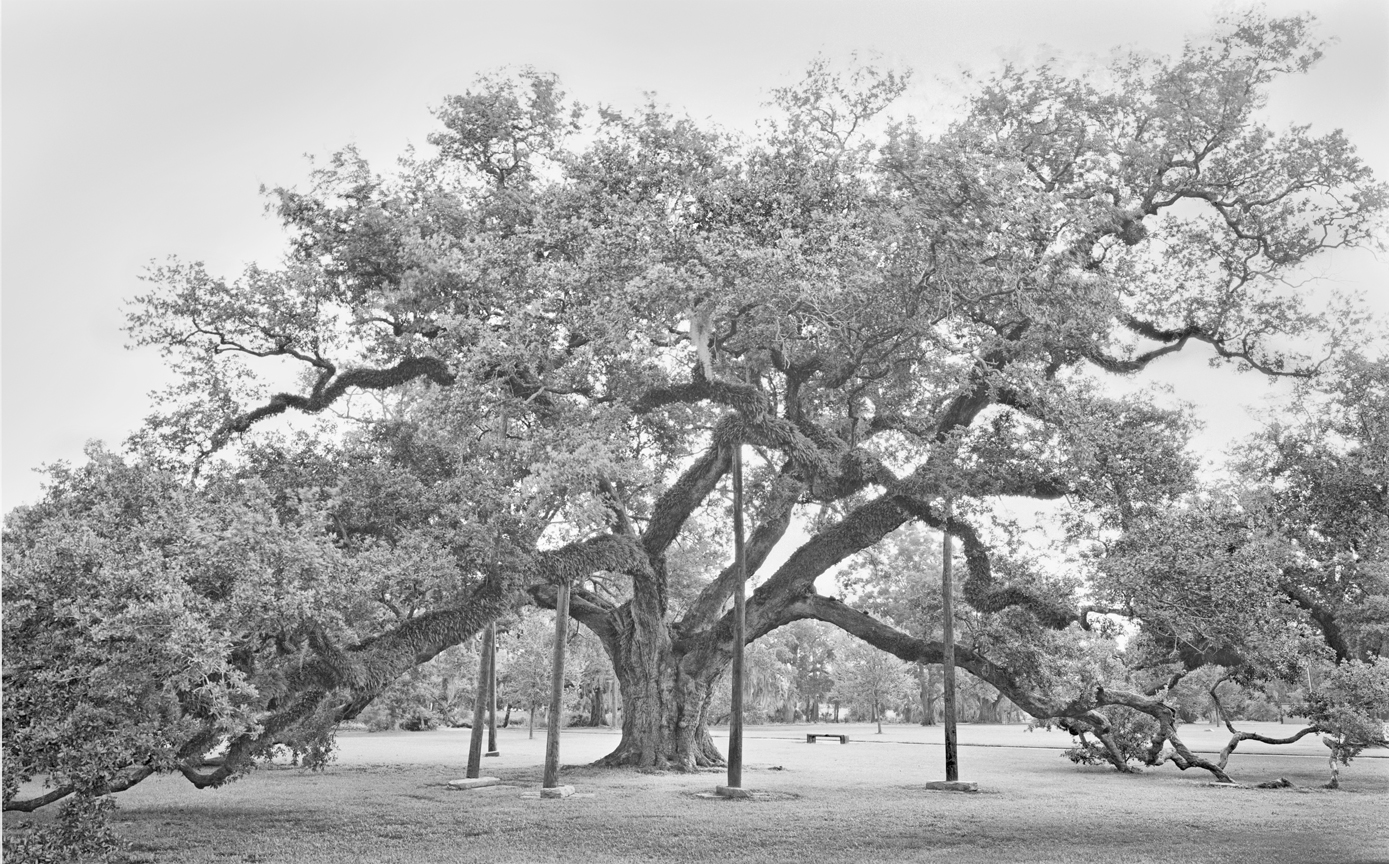
McDonough Oak adjCity Park was once part of the Jean Louis Allard Plantation, originally established in the 1770’s, and later purchased in 1845 by shipping magnate and philanthropist John McDonogh. Upon his death in 1850, McDonogh donated the land to the City of New Orleans and in 1854 a large section was designated as a city park. According to park records, in 1958, the National Park and Recreation Convention met in New Orleans and hosted a breakfast for 1,028 convention attendees under the massive canopy of the McDonogh Oak’s limbs.

In 1981, the ancient oak lost a major branch, causing severe damage. Extensive tree surgery was done and posts were added to help support the remaining main limbs.  In 2015, the McDonogh Oak’s circumference was more than 25 feet, and its crown spread more than 150 feet.