Washington, Louisiana
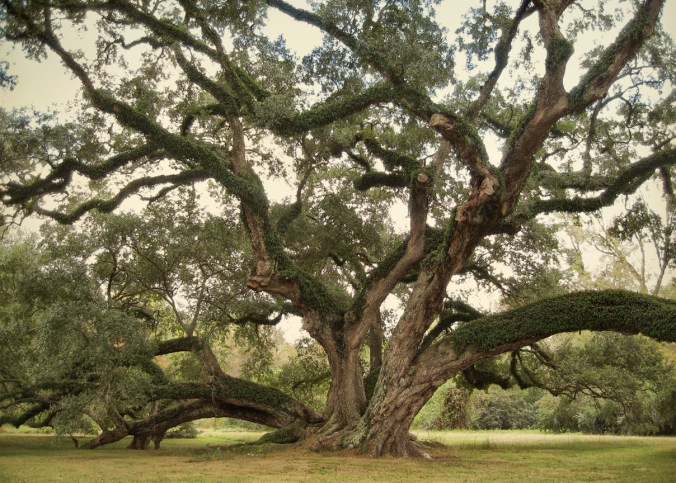
Seven Brothers (Lastrapes) Oak
The Seven Brothers Oak is located south of Washington, Louisiana, on Hwy. 182 about a mile out of downtown Washington – at the intersection of Hwy 182 and Par Road 5-25. The large live oak is usually well-maintained in the open space fronting the Highway.
Referred to (mistakenly) as the “Seven Sisters” by the Live Oak Society‘s founder, Dr. Edwin Lewis Stephens, in an article published in the Louisiana Conservation Review (April 1934), and not to be confused with the Live Oak Society’s current President, the Seven Sisters Oak, in St. Tammany parish—this old oak is best known today as the “Seven Brothers Oak” or the “Lastrapes” Oak. The Seven Brothers Oak is the seventh tree listed in Dr. Stephens’ 1934 article and is #9 on the Live Oak Society’s registry.

Seven Brothers Oak, study in black and white
The tree’s girth (circumference) was reported in two sections by Dr. Stephens in 1934 (27’3” and 26’4”), due to the configuration of the tree’s multi-trunk system. One section of the system (the larger measurement) had a severed trunk.
The trunk section measurements on Nov. 11, 2007 were:
32’3” Section nearest to the road (including the severed trunk)
28’11” Section nearest to the fence
History: There is more than one story about this particular tree (or group of trees)[1]. On our expedition, the person who currently maintains the tree and grounds of the Lastrapes homestead explained that it had been planted and named for the seven Lastrapes brothers who had left home to fight in the Civil War. In another variation of the story, described in Ethelyn Orso’s Louisiana Live Oak Lore, the birth of his seventh son prompted Jean Henri Lastrapes to request that seven oaks be planted; the workers arrived late in the day with the seedlings and temporarily put them in one container (or hole). The business of the days that followed in the cotton fields distracted the workers from ever completing the planting task—and thus the trees grew together, sharing the close proximity of their original planting site.
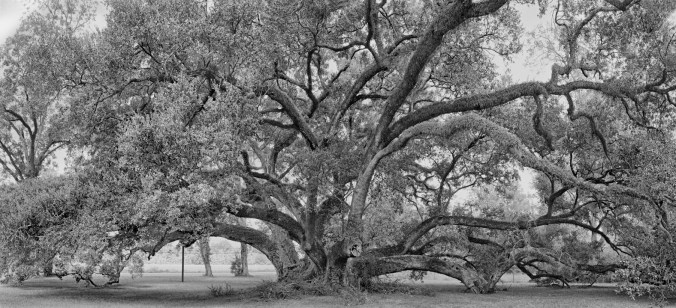
Seven Brothers Oak, view from the southeast side
In a recent email from Paul Lastrapes, he confirmed my suspicions that, “the version of the story that the tree was named for 7 brothers who went to the Civil War is not only incorrect, but it’s impossible. The tree was planted many decades before the war AND while it is true that some of Jean Henri’s descendants served, 7 from the same family? No. The genealogy tree back to Jean Henri does not support this version in any way. ”
Photo Notes: The skies were alternately sunny and cloudy, as the afternoon thunderheads passed by; so Bill had some wonderful light to photograph the various aspects of the old oak in black & white with his view camera, while Cyndi photographed the nearby cottage. Although timeworn and no longer in use, the structure seemed content to remain as it was, in the company of its venerable friend.
Cyndi’s Nature Notes: A frequent visitor to the live oak, a golden silk orb-weaver spider (Nephilia clavipes), also known as the “banana spider”, had created a web amongst the lower branches of the tree.

Golden Silk Orb-Weaver – C.L. Nelson 2007
[1]Orso, Ethelyn G; Louisiana Live Oak Lore (pg. 77-78); The Center for Louisiana Studies, University of Southwestern Louisiana; Lafayette, LA 1992.
 100 Oaks Project
Ellen, just saw your comment while working on my blog – I visited the Lastrapes Oak las November on a trip through south Louisiana and it’s looking quite lovely – the land around the oak was cleared and a new fence was up in back. I’ll write a new post about this in the coming week, but wanted to let you know. Someone – I assume the Lastrapes family – it taking good care of the old tree.
Paul, I wanted to let you know before I publish a post about it… the Lastrapes Oak (Seven Brothers Oak) was looking great when I passed through there last November. I was in Louisiana for a launch of my newest book and on my drive back home (northern New Mexico) I stopped to visit the old tree and photograph it – I plan to post these photos in a new blog post. Someone (the Lastrapes family?) is taking good care of the tree and it was healthy and beautiful. I felt good to see it so well cared for. It’s an example for the rest of the state.
The version of the story that the tree was named for 7 brothers who went to the Civil War is not only incorrect, but it’s impossible. The tree was planted many decades before the war AND while it is true that some of Jean Henri’s descendants served, 7 from the same family? No. The genealogy tree back to Jean Henri does not support this version in any way.
Dearly love this tree! As a child growing up in Lawtell, LA, we frequented the area of Washington with my grandmother Mrs. Effie Joubert (wife of Zeno Jobert, Sr) as the family owned the Step Inn Club and Dance Hall in our hometown. We went to the bayou and cooked many a meal and played with the blocks of kindling left from the furniture store that made rockers. It was a place where we could have an adventure gazing in the Warehouse pretending we were sellers of our own goods and treasures. Fondest memories ever and took a many picture of the Oak Tree. Thank you for sharing💕
nice
Hello Ellen. My father was George Finlay Lastrapes II. I have a picture he took of me in front of the Lastrapes Oaks in 1956, when I was 9 years old. I remember him telling the family story of the oaks. Perhaps your uncle George was a cousin of my father. I believe Paul Lastrapes was a first cousin of his.
Someone in the Lastrapes family compiled a good genealogy of the family. Let me check and see it is posted on-line. It was a few years ago and had quite a bit of excellent detail. I am related to the Lastrapes on my mother’s side. I am not from Louisiana but I have seen the tree as well as the church.
Pete McCoy
Sent from my iPhone
>
Hi Ernest,
My name is Lynn. My mother in law, who is 75 years old, is great grand daughter to Selina Guidry, wife of Henry Lastrapes, mother to Robert Elmer Lastrapes b.1897 d.1928 .
I am digging into the family tree just for knowledge. Can you offer any help?
Thank you!
I stumbled upon this website as part of my ancestry research. While not a Lastrapes descendent, I am a direct descendent through Adolph and Delia’s daughter, Adolphina, who married Charles Gibbon. Their son, Adolph J, married my great-grandmother, who I personally remember from my early childhood.
Fascinating stuff. Thanks for making it available online.
Steve Dollinger
Ellen, I was in Washington last week and visited the Lastrapes Oak to re-photograph it. I see what you mean about its maintenance — there are shrubs growing up around the tree trunks. The grass is being cut regularly, but the shrubs and vines are not being cut back.
I spoke to Frank Thibodaux, arborist with Bob’s Tree Preservation in Scott — he and his dad are familiar with the Lastrapes Oak. He said he believes the property is owned by one of the Lastrapes family in New Orleans. I suspect they just hire a local landscaper / grass cutter to cut the grass on the property, and that person is overlooking cutting back the shrubs around the trunks. You’d need to reach out to whoever owns the property to ask them to get the shrubs trimmed back. Or else get a group of the local Lastrapes family members to meet one weekend and have a family tree-care gathering — which could be fun. And a new family tradition.
Otherwise the tree is looking good. — Best, Bill
My father, Paul Lastrapes Sr. (1942-2005) posted this in 2003:
The Lastrapes genealogy dates back to 1600, in Peyrens, France. The Coat of Arms was created in 1750, and, researched in 1935 and later in 1956, is believed to be accurate.
The Lastrapes home and surrounding 400 acres were purchased by Jean Henri Lastrapes in 1793 from J. Carriere’s widow. Today, it includes 500 acres, and remains in the continuous stewardship of the Lastrapes family.
The landmark, “Seven Brothers Oak”, is an interesting story. Thrilled with the birth of his seventh son in 1810 Jean Henri called his workers to bring seven Oak saplings from the woods to be planted around the large one story Lastrapes home. Returning late in the afternoon, the workers were instructed to place the saplings in a hastily dug hole in front of the home, to be replanted the next day. But a cotton plantation has many chores associated with it and the replanting never took place.
Today, five huge trunks remain in this massive Oak, a member of both the National and Louisiana Live Oak Society email cpl700600@aol.com (lower case of letter L). In June, 2001, the Lastrapes family engaged a well recognized service to trim dead wood, take soil samples, and perform other work to strengthen one of Washington’s many landmarks.
Washington, reputed to be Louisiana’s third settlement in 1720, was an important steamboat port from 1825 to 1910. A round trip passage in the year,1855, beginning from 1 of 7 warehouses on Bayou Courtableau (“Cor-taa-blew”)to New Orleans cost $11. The trip left on Saturday, arrived in New Orleans on Wednesday. From New Orleans Thursday morning, the “J.E.Trudeau” (one of some 90 steamboats documented as having a share of similar commerce)would return with all manner of products from around the world. The cargo could then be offloaded onto a Wells Fargo Stagecoach westward along the Old Texas Road, passing through a community later incorporated as Lake Charles. Or it might leave Washington traveling north to Alexandria via oxen-drawn flatboats along a bayou which was so clean…”one could not gather a switch along it’s banks.”
(me again)My father also did substantial genealogy research and traced descendants of John Henri back to France in the 1500s. He also found the Lastrapes Coat of Arms from France. Finally, he wrote the book, “Looking back at Washington, Louisiana,” a memoir about Washington when it thrived. Please feel free to contact me and I’ll try to find some info, although when he died, LSU contacted me for information, and I donated most of his notes/research/pictures to their state archives.