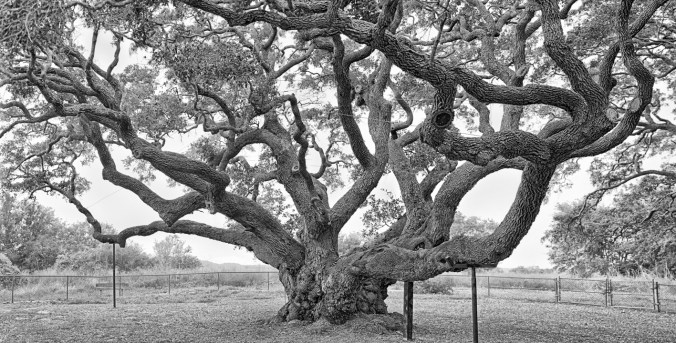
Goose Island “Big Tree” Oak, near Rockport, Texas

Goose Island panoramaGoose Island Oak

In 1966 the Goose Island Oak (the Big Tree) was named National Champion tree in the category of Southern live oaks (Quercus virginiana), in American Forests’ National Big Tree Registry. At the time, it was measured at 35.1 feet in circumference, was 44 feet high, and had a crown spread of 89 feet. It’s also known locally as the Texas Big Tree, the Lamar Oak, and the Bishop’s Oak. For years, the Goose Island Oak held the National Champion position and was even touted to be the largest live oak in the world. However, by the various methods of measuring and earning points to determine “Champion” trees, it is certainly in the top 10 largest live oaks in the U.S., but not the largest.

The Seven Sisters Oak in Lewisburg, Louisiana, and the Middleton Oak in Charleston, South Carolina, (the Live Oak Society’s President and First Vice President) have both been determined to be larger. (To calculate a tree’s total point value, American Forests uses the following equation: trunk circumference (inches) + height (feet) + one-quarter average crown spread (feet) = total points.)

In 2000, an as yet unnamed live oak in Brazoria County, further up the Texas coast, was measured by a Michael Lange, a federal wildlife biologist, who found it to be even larger than the Goose Island Oak. The Brazoria County oak, located deep within the San Bernard National Wildlife Refuge, and about 50 miles south of Houston, is now the Texas state champion live oak. (62’ high and 10’ 3” in diameter).
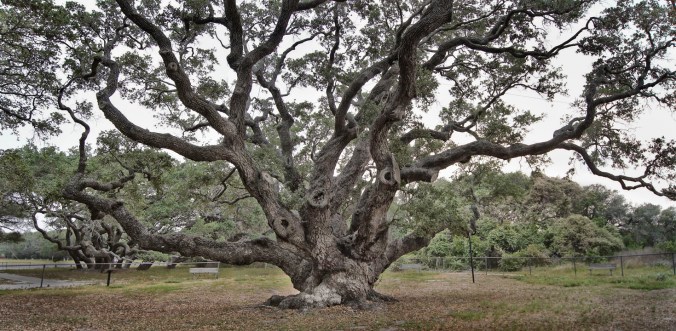
 

Goose Island Oak 1

Goose Island “Big Tree” Oak, near Rockport, TX

None of this information is meant to slight the Goose Island Oak, which is definitely an impressive and old tree. According to climatologists, the Big Tree has survived as many as forty to fifty major hurricanes, as well as numerous floods, droughts and wildfires. The Goose Island Oak has been linked in local history and legend to Indians and pirates. Local stories claim that the cannibalistic Karankawas Indians held councils under the tree (and maybe a cannibal picnic or two). It was also purported to have been a rendezvous site for both pirates and Comanche Indians.


Early European explorers, who supposedly visited the oak, may have included the Spanish explorer Cabeza de Vaca in 1528 and Sieur de LaSalle in 1684. The giant tree is located in Goose Island State Park, approximately 12 miles north of Rockport, Texas, on park road 13, very near the beach. Signs inside the park direct visitors to the tree. In nearby Columbus, Texas, at the intersection of Interstate 10 and state highway 71, you can find the third largest live oak in the state. It’s squeezed in between a private residence and a small business as you enter Columbus on 1218 Walnut Street. There are several old and beautiful live oaks throughout Columbus; a number of them reside in the cemetery across the street from the Columbus Oak.

Revisiting the Locke Breaux Oak

In a November 2009 post, we gave background on the first President of the Live Oak Society—the Locke Breaux Oak.

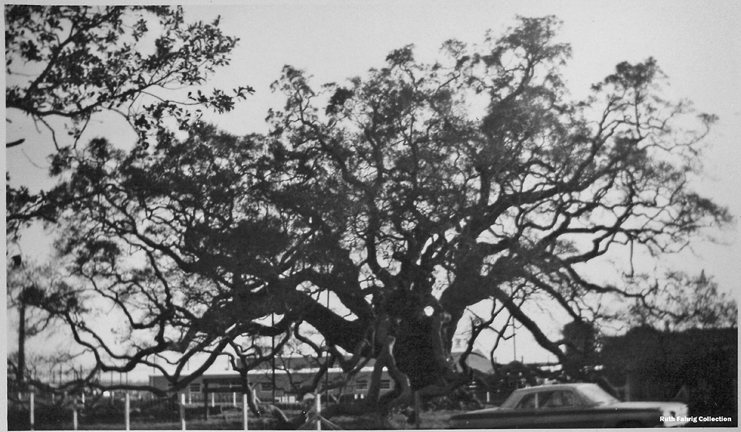
Locke-Breaux Oak circa 1956

Locke Breaux Oak, circa 1956, Southern Dairy property in Taft, LA

Since that post, I’ve received a series of emails from a reader named Brad whose mother lived next to the Locke Breaux Oak for more than a decade. Brad sent me several photographs from his mother’s archives and shared some personal stories and remembrances about his mother’s time living next to the old oak. I am adding those to the 100 Oaks Blog in memory of the Locke Breaux Oak and the people whose lives were touched by this magnificent tree.

Brad’s mother, Ruth Fahrig, was born on a dairy in Pevely, Missouri. At about the age of four, her family moved from Missouri to Louisiana where her father took over management of Southern Dairy in Taft. The family (Ruth, her parents, and two siblings) lived in a huge house owned by the dairy, and the Locke Breaux Oak stood within 100 feet of their home. Ruth and her family knew the old oak simply as “The President” and it was a familiar neighbor and daily part of Ruth’s life for more than a decade.

One of Ruth’s fond memories of “The President” was climbing to what she called the “crow’s nest”—a point in the crown of the tree where you could climb no higher. From that point, some 70 feet in the air, she could see for many miles around and look down on the ship traffic in the Mississippi River. Though there was less ship traffic in those days, it was still a treat when she could sit in her lofty nest and watch a ship slowly make it’s way past her home.  She said that she only made it up to the crow’s nest a few times because it was quite scary going up, and even scarier on the way down, when you are less able to see where to put your feet.

Ruth and her family lived in the Southern Dairy home for more than a decade before her father took over management of the Rex Dairy in Luling, about six to eight miles downriver from Taft.

Locke-Breaux Oak Circa 1940

The photograph (above) is dated 1940 and features Brad’s mother in front of the Locke Breaux Oak.

Another excerpt on the history of the Locke Breaux Oaks is taken from the book Louisiana’s German Coast: A History of St. Charles Parish, 2nd edition by Henry E. Yoes III. “St. Charles Parish held a national attraction within its boundaries, the Locke Breaux Oak named after one of its owners, Samuel Locke Breaux. Breaux was a prominent New Orleanian, a one-time president of the New Orleans Board of Trade. Before the tree was given his name, it was known as the Providence Live Oak, after the plantation that it had watched over in another era.” The Providence Plantation was later bought by the Southern Dairy Products, Inc., around 1935. One man, Leon Weiss, dominated the company. Weiss was the architect and builder of the present state capitol.

Yoes wrote further:  “At four feet above the ground, the oak measured 35 feet in circumference. it was 75 feet high and had a spread of over 166 feet. The massive oak was declared the world’s largest oak and many tourists’ maps listed it as a place to stop and visit. Unfortunately, the oak became the victim of industrialization and died soon after industrial plants began locating on the west bank.”

This 1965 photo (below) shows the dramatic decline of the tree in its very last years.

Image

The next two images show the Southern Dairy house in the background. It also shows the picnic area around the oak.

Image

The last image titled “Under the Big Tree” and dated 1940, is an example of just how huge the tree was in terms of trunk girth. What you see in the photograph is only a little more than half the width of the trunk. You can also see a significant bare bark wound, perhaps from a lightning strike.

Image

At some point, the Southern Dairy changed names to the Colonial Dairy. It’s unclear from St. Charles Parish records if Southern Dairy was purchased by the larger Colonial Dairy, but that’s a possibility since at one point Colonial was reportedly the largest dairy in Louisiana.

Then, around 1966, the property was sold to the Hooker Chemical company (the same company made infamous by the Love Canal chemical waste tragedy in Niagara, New York, publicized in the late 1970s.  After that point, the old tree began a slow decline in health, possibly as a result of groundwater and air pollution from the Hooker Chemical Company operations or else more natural causes.  In either case, it’s a sad day when Louisiana loses a grand old oak such as the Locke Breaux.

Live Oak Society oaks at Avery Island’s Jungle Gardens

Image

E.A. McIlhenny Oak

Image

Bill and McIlhenny historian Shane Bernard at E.A. McIlhenny Oak

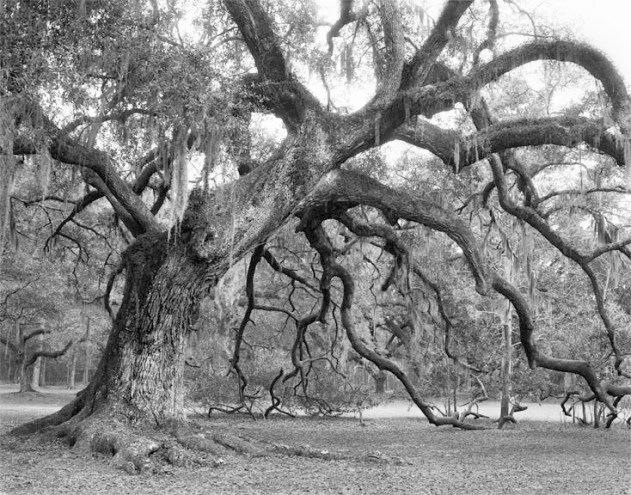
When Dr. Edwin Lewis Stephens founded the Live Oak Society in 1934, he included 43 live oaks as the Society’s original members. These were familiar trees to Stephens, oaks that he had visited frequently and had personally measured to determine the 17 ft. girth minimum he set for Society membership—a size that he estimated would make the age of the tree greater than 100 years.

Of those original 43 inductee oaks, three were located at Avery Island, which for Dr. Stephens was a short day trip from his home in Lafayette. There were several sites within a short distance of Lafayette where Stephens and his wife Beverly would take friends and visiting dignitaries to introduce them to his favorite century-old oaks. These sites were part of what he called his “live oak tours.”

Through his friendship with Tabasco company president Edward Avery (“Ned”) McIlhenny, Dr. Stephens made Avery Island one of the stops on his oak tours. The Cleveland Oak (named after U.S. President Grover Cleveland) and the E.A. McIlhenny Oak were two of the original inductee trees for the Live Oak Society.

Cleveland oak AV 1_sm

Grover Cleveland Oak, Jungle Gardens

Image

Grover Cleveland Oak, view 2, showing scale with Cyndi

Ned McIlhenny was born on Avery Island in 1872 and traveled extensively during his life. He was an arctic explorer, a naturalist and conservationist. Growing up, he studied the plants and animals on Avery Island and in the surrounding salt marshes. In 1895 he founded Bird City, a private bird sanctuary for the once-endangered snowy egret.

In the 1920s, Ned found time from his business role as president of the McIlhenny Tabasco Company to transform his private Avery Island estate into Jungle Gardens. He converted the natural marshy landscape into lush gardens planted with exotic botanical specimens from around the world including more than four hundred varieties of camellias, over a hundred varieties of azaleas, fifty plus varieties of juniper, more than one thousand varieties of iris, and several species of Asian bamboo—all are plants that thrive in south Louisiana’s semitropical summers and mild winters.

Gradually Ned expanded the gardens until it reached its present size of more than 170 acres. In 1935, he opened Jungle Gardens to the public. Since then it has been a favorite tourist destination along with the Tabasco bottling factory on Avery Island.

Jungle Gardens today is home to several Live Oak Society member trees as well as one of the largest and most beautiful stands of mature live oaks in Louisiana. A few of the oaks that Dr. Stephens brought guests to see can still be found today at Avery Island’s Jungle Gardens.

Fontainebleau Oak #2

Fontainebleau Oak #2

Oak alley at Fontainebleau State Park, Mandeville, LA

Located in Fontainbleau State Park off state highway 190 near Mandeville. This alley is comprised of approximately 28 to 30 oaks planted around 1850 when Bernard de Marigny de Mandeville built his plantation and sugar mill on this site. For additional information about the park:

62883 Hwy. 1089, Mandeville, LA 70448
985-624-4443 or 888-677-3668 toll free
For reservations, call 1-877-CAMP-N-LA (877-226-7652) toll free.
Email: fntbleau@crt.la.gov

Photographing the alley at Fontainebleau

Photographing the alley at Fontainebleau

Fontainebleau Oak #1

Fontainebleau Oak #1

Fountainebleau Oak #1

Located in Fontainbleau State Park off state highway 190 near Mandeville. The state park was once the site of a sugarcane plantation and sugar mill owned by Bernard de Marigny de Mandeville. This old leaning oak is approximately 24’ in circumference and grows alongside an alley of oaks that runs from the ruins of the old sugar mill to the bank of Lake Pontchartrain. The wealthy Marginy named his sugar plantation “Fontainebleau” after a beautiful forest near Paris, France. He also owned a plantation downriver from the French Quarter, that became the Faubourg Marigny. In early 2011 when I last photographed this oak, it was home to a newly born pair of great horned owls.