The Marvin McGraw and Mr. Mike oaks

It looks like I’ll be revisiting the 30-something project on and off during 2016, mainly to add a few “stragglers” – oaks that I missed in my original list of possible 30-something-sized trees or others that have turned up since my last entry.  In this post, I’ll feature examples of both.
Marvin-McGraw-Memorial-Oak-1

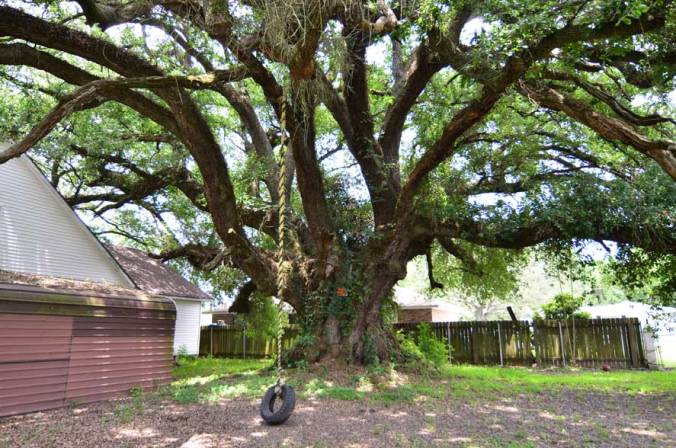
Marvin McGraw Memorial Oak, study 1

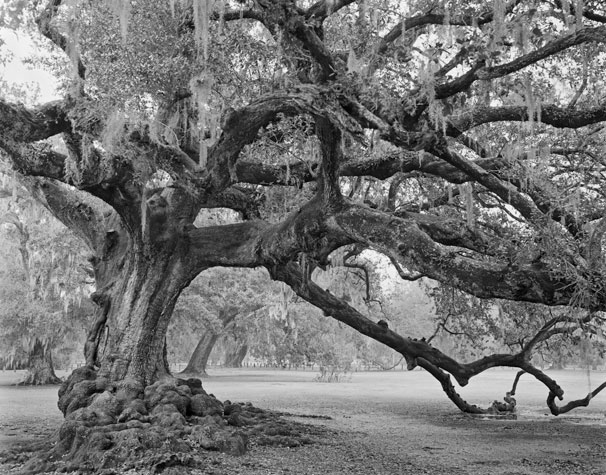
The Marvin McGraw Memorial Oak – This old oak was on the first list I put together of Live Oak Society members that could be in the 30-something category. It is located in Reserve, on the east bank of the Mississippi River in St. John the Baptist Parish. It was registered by Maxie and Pete McGraw (#1428) with an estimated girth of 31 feet (my measurement was 27’-6”). I was able to hone in on the tree’s exact location through help from Maxie and Pete’s brother, Marvin, who is the current director of marketing and public relations for the Louisiana State Museum in Baton Rouge.

McGraw-Oak-color-1

Marvin McGraw Memorial Oak, black-and-white study

He recalled how when he was a child the old oak tree stood in a grassy pasture in the company of grazing cows and horses. His father Marvin, the oak’s namesake, used to tell the kids that the old oak “was already a large tree when Columbus discovered America.” Marvin (the son) also remembered that there was a very old graveyard near the oak where they would find gravestones and wrought-iron crosses with inscriptions written in French.

When I visited the oak, the graveyard had long ago disappeared. And over the years, the open pasture shrunk steadily as it was parceled up into lawns. I found the oak still growing in a small side yard sandwiched between two homes at the end of a quiet residential street.

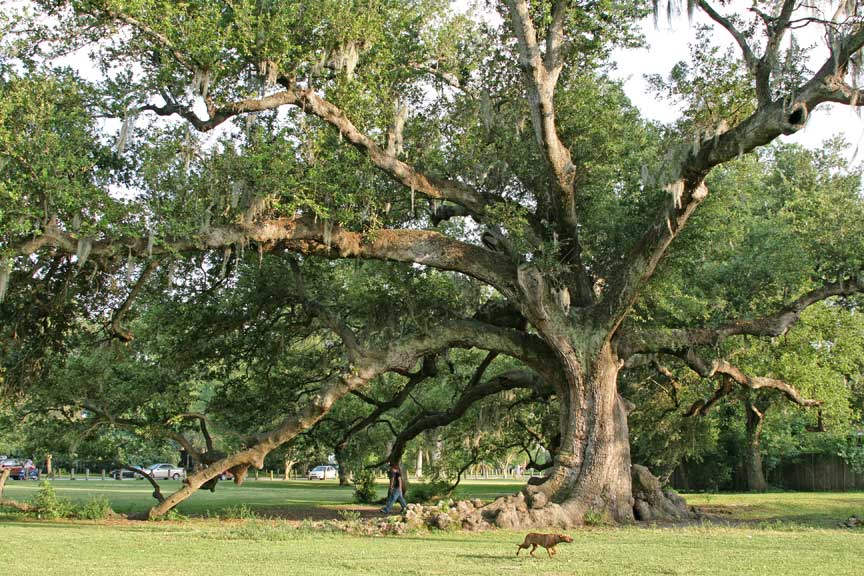
The Mike Oak – The Mike Oak is located outside of the entrance gate to Oaklawn Manor, which is just off Irish Bend Road and a few miles above Franklin. On the entrance road onto Oaklawn Drive, the oak is in the lot to the left of the driveway that turns right into the Oaklawn Manor gate house and home.  It is not the most lovely of the many oaks in the grove lining Oaklawn Drive, or of the oaks on the Manor grounds, but it is the largest, with a girth in 2015 of 30 feet.

Mr_Mike-Oak

The Mike Oak, study 1, Oaklawn Manor near Franklin, LA

The land that became Oaklawn Manor Plantation was purchased in 1809 by Irish-born attorney Alexander Porter and it was his Irish ancestry that gave this stretch along Bayou Teche the name “Irish Bend.”Porter served on the Louisiana Supreme Court and also as U.S. Senator representing Louisiana. After his time in the U.S. Senate, Porter retired to Irish Bend and built the Greek Revival home near Franklin that he named Oaklawn Manor Plantation.

Mr_Mike-3

Mike Oak, infrared study

After a series of owners and renovations in the 1960s, the Manor was purchased in 1986 by Murphy “Mike” Foster, Jr. and his wife Alice and underwent another restoration. Foster was elected 53rd governor of Louisiana in 1995 and still owns and lives at Oaklawn Manor today.  The home and grounds are open to the public for tours. Call ahead for tour hours (337-828-0434).

The Mike Oak was registered (#3447 in the Live Oak Society registry) by Mr. Foster and his wife.  I’ve met with Mr. Foster on a few occasions when photographing the oaks at Oaklawn. He even gave me a tour of the grounds on his golf cart to point out the many old live oaks on his property.

As a side note, ex-governor Foster is an oak preservationist at heart. He realizes the importance of this iconic tree to the cultural heritage and ecology of the state and has in the past interceded to stop the removal of many old oaks along the Grand Chenier highway (state Hwy. 82). This highway parallels the southern edge of the state between Pecan Island and Cameron. The chenier oaks, though weather-beaten and bent, help slow erosion of the delicate coastal ridges throughout the “Chenier Plain,” an area extending roughly from Sabine Lake (west) to Vermillion Bay (east) along Louisiana’s Gulf Coast.

Mr Mike Oak #1

Mike Oak, color study 2


Bartholomew Barrow Oak, Afton Villa Gardens

8. Afton Villa oakBarrow Oak, near ruins, end of entrance alley

This is another lesser-known old oak and one of my personal favorites. It grows on the grounds of Afton Villa Gardens, in St. Francisville, Louisiana. It is in the 23’ to 24’ circumference range, and was reportedly planted between 1820 and 1839 by Bartholomew Barrow, the first member of the Barrow family to purchase and settle this land. The oak is registered with the Live Oak Society and has a distinctive shape, size and bushy texture formed by the thick resurrection fern growing profusely on its limbs. It’s located in front of the Afton Villa ruins near the end of the ½ mile long alley of oaks leading from Louisiana state Highway 61 to the gardens.

Bacas Oak, near Edgard, LA

Baccas oak diptich_8x17_BRNBacas Oak, West Bank of River Road, Hwy 18 near Edgard

This little known, but magnificent oak is located on Songy Court, on the west bank of the Mississippi River, behind the historic Bacas House which was built around 1840–1850. The property has been in the Bacas family since 1895 when Alcide Bacas purchased it from Willis Becnel. It’s likely that the oak was already mature when the Bacas house was built. The property is today part of the small community of Wallace, just downriver from Edgard, Louisiana.

The oak is approximately 25’ in circumference with a ropy twisting trunk and a huge crown that is nearly 200 feet wide. It has the classic upside-down bowl shape with long drooping limbs that reach to the ground, distinct to a live oak that grows away from competing trees.

This area along the west bank of the Mississippi River is part of the first German settlements along the Mississppi River, called the German Coast.  Wikipedia has a good description of the history of this area.

The Bacas Oak lost a major limb in late 2009, or early 2010. This image was made during the summer of 2010. I had searched for this tree for several years. Having only rough directions to go by, I was unable to locate it because it’s drooping limbs completely hid it’s trunk. From River Road it appeared to be a grove of oaks instead of a single tree. It was only after the tree lost a major limb, revealing almost a third of its interior limbs, that I was able to locate and photograph it. This view is from the south side of the tree, the opposite side from where the limb was lost.

Josephine Oak, Oak Alley Plantation

Josephine Oak, view across alley, morning light

The Josephine oak, named after Mrs. Josephine Stewart, is the largest in the alley of 28 oaks at Oak Alley Plantation in Vacherie, LA.  This immense tree is approximately 31’ in circumference, more than 70’ tall, and with a crown spread of approximately 150’.

It is in the west row of 14 trees in the historic alley. Oddly, most people assume the oaks at Oak Alley were planted at the same time that the plantation home was built between 1836–1839. However, according to the Oak Alley Foundation historians, only the first four oaks closest to the house were planted around the time when the home was constructed. The remaining oaks in the allee’ were planted several years later after the land closest to the river was drained.  

Josephine-Oak-panorama-1
Josephine Oak view towards levee

All of the trees in the alley at Oak Alley are registered members of the Live Oak Society.

Etienne de Boré Oak (Tree of Life)

Audubon Park – New Orleans, Louisiana

Etienne-de-Bore'-oak_2

Etienne de Boré oak – Audubon Park, New Orleans

In New Orleans, and especially the neighborhoods surrounding Audubon Park, this oak has been dubbed “The Tree of Life.” Its registered name with the Live Oak Society is the Etienne de Boré Oak. The land on which Audubon Park is located was at one time part of de Boré’s extensive sugarcane plantation.

Registration & Measurements – At just under 35 feet in circumference today, this oak was number 13 on Dr. Edwin Lewis Stephens’ list of 43 original inductee trees into the Live Oak Society and is also in the top 100 oldest surviving oaks on the Society’s member list.  Its girth when it was registered (as #21) was 23 feet 1 inch. The oak is located in Audubon Park on the down-river side of the Audubon Zoo, right over the fence from the giraffe habitat. It’s an enormous tree with a broad gnarly base of roots and a crown of limbs more than 160 feet wide.

De-Bore-Oak-study_1

The Live Oak Society estimates that any oak with a girth of 17 feet in circumference (measured at 4 feet off the ground) is probably 100 years of age or older. This is a rough system of estimation developed by the Society’s founder, Dr. Stephens, which is fairly accurate, though soil, rain, and other habitat conditions can affect a tree’s long-term growth.  A live oak with a girth of more than 30 feet could be 300 years of age or more.  The ages of many of the Society’s oldest and largest trees are only rough guesses, and there’s been much-heated discussion among amateur arborists and other tree-folk over this issue.

De-Bore-oak-4

History

Jean Etienne de Boré is significant in history as the first French planter in Louisiana to successfully granulate sugarcane into sugar on a large scale, helping to make sugarcane the main crop over indigo and tobacco in antebellum Louisiana. He originally cultivated indigo (a highly valued crop and popular dye); but after several years of drought and insect damage, de Boré decide to gamble the last of his and his wife’s personal funds on growing sugarcane. In 1794, he secured a variety of Cuban sugarcane from Don Antonio Mendez (a Cuban of Spanish descent) who had successfully granulated a small amount of sugar in 1791 (a few barrels or hogsheads – approx. 1000 pounds per barrel) at Magnolia plantation in Saint Bernard Parish, downriver from New Orleans.  With the help of Mendez and a Cuban by the name of Antoine Morin who had experience with the sugar granulation process, de Boré succeeded in producing a crop of sugar on his plantation that he sold for $12,000 (quoted from a Times-Picayune story from January 13, 1895).

De Boré was also the first mayor of New Orleans, appointed to the position by Governor William C.C. Claiborne in 1803, the same year Louisiana was transferred from Spain to France.  He resigned in 1804 after New Orleans became an American colony through the Louisiana Purchase.

IMG_0313

Couple getting married under the limbs of the Etienne de Bore’ oak.

Audubon Park is home to several other member trees of the Live Oak Society. The George and Martha Washington oaks were among the original 43 inductee oaks in the Society along with the de Boré oak. George has passed on but Martha is still alive, in the rhino habitat of the Zoo. There are three other unnamed oaks spread across the Park’s grounds that are elder Society members.

Martha-Washington-Oak

Remains of Martha Washington Oak in Audubon’s Rhino habitat