The Effects of Flooding on Live Oaks

2oaks-and-reflection_Audubon-copy

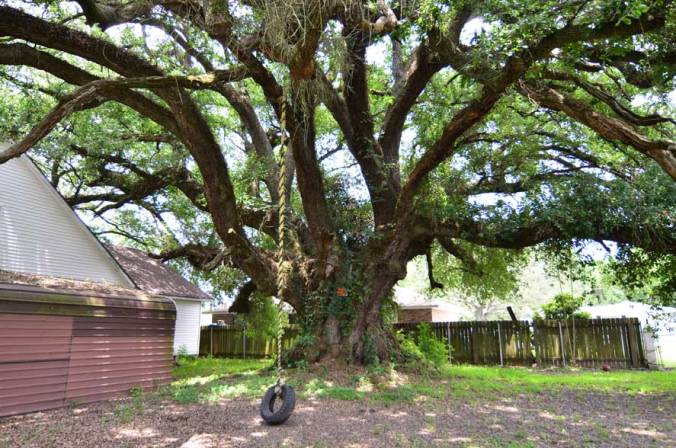
In general, live oaks have a high tolerance to storms and floods. But I’ve received questions from several friends concerned about how the recent flooding in Louisiana might affect their live oaks. Most centenarian (100 years +) live oaks in Louisiana have weathered multiple storms in its lifetime. The Seven Sisters Oak in Mandeville, being the oldest live oak in the South, has probably weathered hundreds of storms and several floods.I asked several arborists/ horticulturists who I know and whose opinions I respect to provide some answers about the effects of flooding on live oaks.  Here’s what they had to say:

Carefully watch the oaks: Arborist Jim Foret (The Tree Guy) from St. Martinville, teaches at ULL and has years of experience with old live oaks in the Acadiana area. He says that short-term flooding, as we’ve experienced recently, is likely to have little effect on healthy live oaks. Jim advises to watch your trees closely after the floodwater subsides to see if they begin dropping leaves, which could be an indication of root damage. If there’s indication of root damage, the tree may require mulch and a microbial boost (mycorrhiza). He believes in this case that the oaks can pretty much take care of themselves with minimum help from human caregivers.

Help the roots dry: An article by Dan Gill, the Times Picayune garden columnist and LSU AgCenter horticulturist says to “remove all mulches to allow the soil to dry out more rapidly. Then replace them. (read the full article below)

Speaking of mulch: Church Point arborist Bob Thibodaux (Bob’s Tree Preservation) who has worked with oak live oaks for decades believes that live oaks prefer mulch made from other live oaks. He manufactures and uses an “eco-mulch” made from local vegetation composed mostly of live oak compost and recommends it over other types of mulches.

Bruce Verdun, another arborist from Gray (Organicure) who is especially interested in the care and maintenance of old oaks, says that ideally you should have a skilled arborist look at and evaluate the impact of flood waters fairly soon after a flood. Each tree is different he emphasizes, and each needs to be examined and evaluated individually.

Pollutants in the waters? One serious problem with flooding is contaminants in the water that might stay in the soil and slowly affect the health of the tree.  A soil sample can help determine the amount of pollution and what needs to be done to rebalance soil post-flood. Contact your local LSU agent or an arborist to have a soil sample evaluation.

Allen Owings from the LSU Ag Center in Hammond (where they had floods) passed along an article by Dan Gill published right after the flooding. I’ll quote it in its entirely.

08/16/16) BATON ROUGE, La. – Root damage through drowning or root rot is the greatest danger to landscape plants caused by flooding. And even if a property didn’t have standing water, it likely has been saturated. And the longer the soil stays saturated, the more damage occurs.

Plant roots get the oxygen they need from air spaces in the soil, said LSU AgCenter horticulturist Dan Gill. When these spaces are filled with water, roots are deprived of the oxygen and may drown. “Initially, the roots stop functioning properly,” Gill said. “When the bright sun comes out, it’s not unusual for plants to wilt because the roots quit absorbing water.”

If floodwaters remain for several days, shrubs and herbaceous plants may be extensively damaged or killed. “Carefully assess shrubs that may appear dead,” Gill said. Scrape the bark in several areas. Green tissue under the bark indicates the shrubs are still alive and may recover.

Don’t be too hasty in removing landscape plants. Some plants that appear dead may begin to send out new growth a few weeks after the water recedes, Gill said. But shrubs that show no green tissue below the bark are likely dead. Floodwaters carry silt and debris that may be deposited on lawns as well as low-growing plants, such as shrubs, ground covers, annuals and perennials. It’s important to remove the debris as soon as possible, using a rake to remove most of the larger material and then a hose to wash off the remainder.

Also remove all mulches to allow the soil to dry out more rapidly. Then replace them. Even if fruit and vegetable plants are still alive, do not consume any fruits, vegetables or herbs that were or could have been touched by flood waters, Gill said. Remove and discard any produce.

You may, however, eat any fruit from trees, shrubs and vines in the future. And you may also generally eat the new growth of herbs and vegetables produced after the floodwaters recede. If a lawn is damaged or killed, a new lawn can be established or an existing lawn can be repaired using sod, plugs or seed.

Hope this helps – Best, Bill
 

Revisiting the Lorenzo Dow Oak

Lorenzo-Dow_49

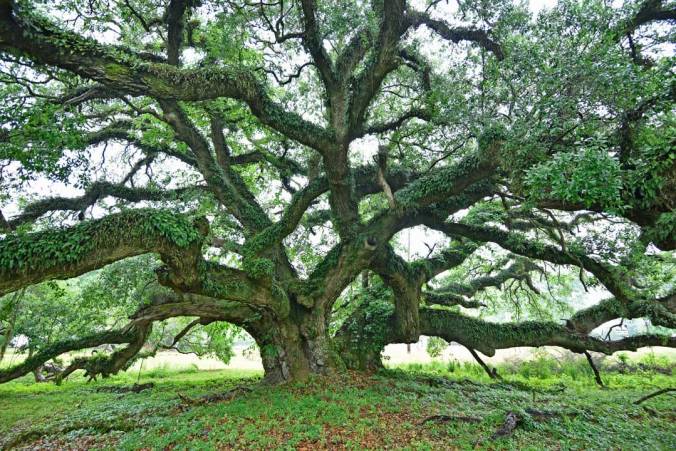
Lorenzo Dow Oak in the rain, Grangeville Masonic Lodge grounds, 35′-8″ girth

Since moving to Bayou Lafourche last December, I regularly consult with the two old oaks in our front yard over photographic work matters. (Cyndi likes to say that I left the corporate world and now I’m employed full-time by the oak trees.) Crazy? Maybe. But the ideas I get when talking to the old oaks are at least as good as those from some of the human supervisors I’ve had over the years.

Last Saturday morning, after checking in with the front-yard oaks and the weather app on my phone, we decided to brave the impending thunderstorms and make a two-hour drive to Grangeville, LA, a postage-stamp-sized town near the Amite River just north and west of Pine Grove. Our objective was to re-photograph the Lorenzo Dow Oak (see my previous blog entry), a 35-foot-plus girth oak located on the grounds of the historic Grangeville Masonic Lodge.

Lorenzo-pano-5

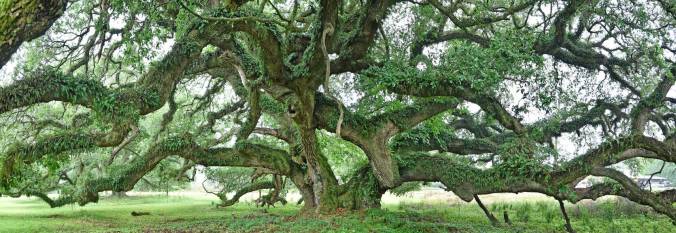
Lorenzo Dow Oak, panoramic view, study 5

Threatening rain or not, we hit the road and arrived at Grangeville just as the first drops began to fall. I made a flurry of photos, trying to hold my baseball cap over my camera’s wide angle lens to shield it from rain, with a fair amount of success. Since August 2015 when I first photographed the Lorenzo Dow Oak, the Grangeville Masonic Lodge members have cleared away the undergrowth that obscured the trunk and main limbs of the old oak,  revealing the full profile of this huge tree. At 35 ft. 8 in. in girth, this little-known oak is tied with the Randall Oak in New Roads as the second largest and oldest of live oaks in Louisiana.

Lorenzo-IR-panorama-1

Lorenzo Dow Oak, infrared black and white study 1

An interesting side note about this tree that I discovered after my 2015 visit: The Lorenzo Dow Oak was registered tree #261 with the Live Oak Society (LOS). This was probably sometime after 1963, when the LOS became active again after a dormant period of about 16-17 years. Dr. Edwin Lewis Stephens acted as secretary of the Society until his death in November 1938. At that time, his list of member trees included 57 oaks. In 1945, Stanley C. Arthur, executive director of the Louisiana State Museum, assumed responsibility for record keeping, admission of new tree members and continued measurements of tree growth.

In the  Live Oak Society Bulletin, a hand-typed newsletter he produced, Mr. Arthur added another 62 oaks to Dr. Stephens’ registry, including their names, locations, measurements and sponsors. This brought the total of member oaks to 119. In that list, there is an oak named the Dr. E.O. Powers Oak, also located in Grangeville, LA. So, it’s possible the Lorenzo Dow Oak was in the first 119 oaks on the Society registry under a different name and with a different sponsor but was renamed and re-registered 20 years later.

In 1957, the Louisiana Garden Club Federation assumed record keeping responsibility for the Society; and since then the secretary/chairmanship and record keeping responsibilities have passed on continually, slowing adding to the now 8,000-plus roster of senior and junior member live oaks.

The “Lone Oak” – visiting an old friend

icon-lone-oak-1

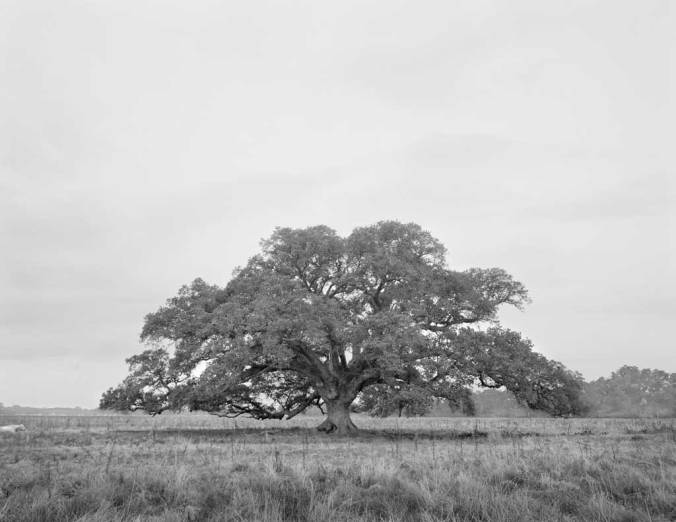
The “Lone Oak” or Maryland Farms Oak, St. Gabriel, Louisiana, circa 1984

Sometime around 1984, when I had just begun using a 4″ x 5″ view camera and black-and-white sheet film to photograph live oaks, I stumbled across an oak with a beautiful, iconic shape that I called the “lone oak.” I didn’t know if it had a name and so just dubbed it lone oak because that’s pretty much how it had grown for who knows how many years – standing in the middle of several hundred acres of grazing pasture, downriver from the White Castle ferry landing near St. Gabriel. It’s one of the trees that I’ve visited and revisited over three decades – always looking to make an even more accurate representation of its personality and to document the progression of its life over time.

It’s a very old and very distinctive oak, with a near perfect mushroom shape – just the way you’d sketch it if someone asked you to draw a live oak tree. It’s the kind of iconic shape that makes Southern live oaks distinguishable from other trees. Its girth is approxmately 25’-6” and its crown spread is nearly 125 feet.

I liked the tree’s shape so much that I’ve used a small silhouette of one of my photographs as a sort of logo for my photography letterhead.  The images I’ve made of the Lone Oak have been well-liked by others as well. It was included in two separate books: Louisiana Live Oak Lore by Ethelyn Orso and Folklife in Louisiana through Photography by Frank DeCaro, and several individuals have purchased prints.

Lone-oak-and-moon_8x10

Lone oak with sun behind cloud cover, circa spring 1993

To photograph the old tree, I had to hop a barbed wire fence surrounding the pasture with my camera and tripod and then wade through shin-high grass to get within an intimate distance. As is my usual practice when I visit a tree, I will walk a large circle around its perimeter to view it from all sides, looking for a new or different perspective that would emphasize some distinguishing quality. Though with this oak, I quickly settled on one perspective on its east side that seemed to me like the tree was “facing me.”

Some days, I had to wind my way through grazing cows that were scattered about the field in which the tree stood.  On hot humid summer days, those same cows would gather in the shade under the oak – one day in particular there must’ve been upward of 60 to 70 cows lounging in the shadow under its limbs.

Lone_oak_with_cows-1-Edit

Lone oak with cows taking shelter, circa summer 1991

I visited the lone oak both early and late in the day, comparing the quality of morning and evening light, though I found that cloudy days, when harsh contrasting shadows were minimized, were my favorite. I also visited in different seasons to compare the density of the foliage and see which I felt made for a better image. Sometimes when the weather was less than optimum for a photograph, I would just sit in the oak’s shade (when cows weren’t around) to feel how this place and this tree felt compared with others.

Lone_oak_with-bull

Lone oak with Brahma bull (near the lower left corner), circa fall 1994

On one visit, instead of the usual grazing cows there was a small group of maybe 20 Brahma bulls lounging around in the field. The funny part of this story was that I didn’t realize they were bulls until I was in the middle of them with my large 4×5 view camera on a tripod and bull-fighter-sized dark cloth draped over my shoulder. Luckily, since they were all bulls with no female cows to protect, they didn’t seem the least interested in me and my camera.  But, believe me, I made the picture and left as quickly as I could…

Lone-Oak-and-graves-2

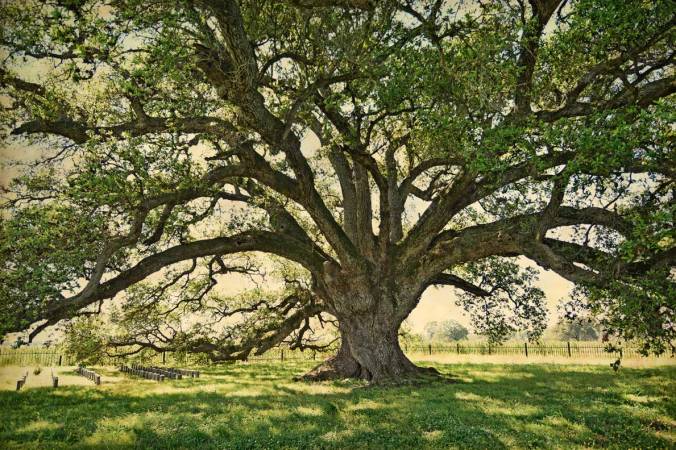
Lone oak with grave headstones, spring 2016

Over the years, I’ve revisited the lone oak many times. At one point around the mid- 1990s, I even researched who owned the land and learned it was the property of the Elayn Hunt Correctional Center. I wrote a letter to the head of the facility suggesting they register the oak with the Live Oak Society and got a pleasant positive reply.

Eventually they did register the oak (now it’s named the Maryland Farms Oak) and around 2001, it was enclosed within a fence and became the centerpiece of a cemetery for prison inmates whose bodies were unclaimed by family after their death.

This month was my first visit to the lone oak since the late 1990s and the first time I’d seen the old tree since it became the centerpiece for the new prison cemetery.  It reminded me of a paragraph I wrote for a recent article in the Country Roads magazine:  “In South Louisiana, live oaks are heritage, heirlooms, and history all rolled into one. On the old land maps, oaks mark where one property line ended and another began. They were a point on the horizon at which to aim the blade of a plow or the nose of a tractor. They mark the intersections of crossroads where back roads cross and provide a shady spot for neighbors to park their pickups, pass a plastic thermos cup of chicory coffee, and discuss the weather. Duels were fought and honor won or lost under their bowed limbs. People picnic under them, get married under them, dance the two-step under them, and, finally when the music ends, are laid to rest alongside their massive roots.”

Lone-Oak-color-1

Lone Oak and cemetery, color study, spring 2016

Besides the rows of headstones, little else had changed  about the lone oak on my recent visit, except it has an entirely different ambiance now that it’s part of a cemetery (the Lone Oak Cemetery). There’s a new sense of peace that I didn’t remember on past visits. Stop by and see it someday. It even has its own website.

Revisiting the Seven Sisters Oak

Though I’ve had a couple of other blog posts in the works, I couldn’t leave the 30-something project behind without a nod to the Seven Sisters Oak, the current president of the Live Oak Society and the former national champion live oak tree species in the American Forests’ Big Tree Registry. It’s also top of my 30-something oak list (Louisiana live oaks with a girth of more than 30 feet).

The Seven Sisters Oak – Live Oak Society President and former Champion Tree of the Southern live oak species in American Forest’s Champion Tree List.

Cyndi and I took a drive from Bayou Lafourche to the north shore of Lake Pontchartrain recently to revisit the Seven Sisters Oak, to make some new photographs for the blog and say hello to an old friend.  The sky was overcast, making it possible a good day to photograph in the shadows of a towering old oak.  The recent rains had turned the resurrection fern a lush bright green. (We also made a stop in Ponchatoula to stock up on local strawberries and visit a couple of other local oaks including the Abbot Paul Schaueble Oak.

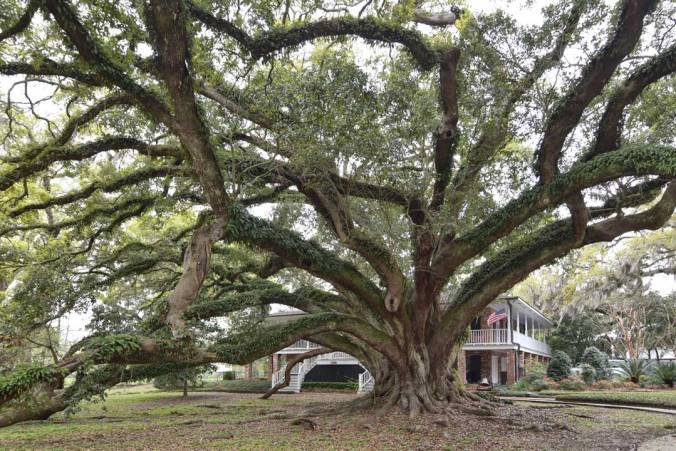
While visiting the tree, we met the current owners, John and Mary Jane Becker. They were welcoming and informative about their term as caretakers of this massive oak (almost 40 feet in circumference).  The Seven Sister’s Oak shades much of the front yard of the Becker’s home in the historic neighborhood of Lewisburg, near the edge of Lake Pontchartrain, in Mandeville.  Mrs. Becker remarked how the old oak was wearing an abundance of new celery green flowers (catkins) when we visited, one indication that the centuries-old tree is still healthy and vital.  She also said that last year the oak produced a bumper crop of acorns.

7-sisters-oak-study-10

Seven Sisters Oak, view toward the Becker’s home.

If you missed our previous blog post on the Seven Sisters, I’ll recap some of its known history (though what we know about the oak dates back less than 100 years and some estimates of the tree’s age put it to between 600 and 1,000 years old).

The Seven Sisters Oak is actually the second live oak to take the status of President of the Live Oak Society.  It replaced the Society’s first president, the Locke Breaux Oak, after its death from air and water pollution (see my previous posts about the Locke Breaux Oak for details).

For years, the eligibility of the Seven Sisters Oak as a society member tree was disputed.  It was argued to be several separate trees growing together rather than a single tree. Then in 1976, after inspection by federal foresters, the multiple tree trunks were found to have a single root system.  It was accepted into the Society—registered (#200)—and in time, was appointed the new Society President, based on its girth, limb spread, and height.

(A short sidebar.  From other sources, I see this is an ongoing argument among tree-measuring folks—whether the circumference of a multi-trunk oak can be compared equally to a single-trunk tree. I take a neutral position on this topic. To me, they’re all very old oaks, and as such deserve to be considered as cultural, historic, and environmental treasures, regardless of the shape or number of trunks.)

7-sisters-study-1

The oak tree’s first sponsor was the Doby family who owned the property on which the tree is located at that time (the 1930s). Mrs. Carole Hendry Doby was one of seven sisters in her family and the tree was named originally named “Doby’s Seven Sisters.” The oak was re-registered (#697) by its next owners, Mr. and Mrs. Milton Seiler.  The Seiler’s renamed the tree simply “The Seven Sisters.”

7-sisters-study-8

Seven Sisters Oak, view from outside of the oak’s canopy, showing new green catkins.

According to the American Forests’ Big Tree Registry, the Seven Sisters Oak had a crown spread of 139 feet, a circumference of 467 inches (approximately thirty-nine feet) and a height of sixty-eight feet when it was last officially measured. Its age has been estimated to be somewhere between 500 and 1200 years old. My most recent measurement (in 2019) puts the circumference closer to 479 inches or 39 feet 11 inches.

The Marvin McGraw and Mr. Mike oaks

It looks like I’ll be revisiting the 30-something project on and off during 2016, mainly to add a few “stragglers” – oaks that I missed in my original list of possible 30-something-sized trees or others that have turned up since my last entry.  In this post, I’ll feature examples of both.

Marvin-McGraw-Memorial-Oak-1

Marvin McGraw Memorial Oak, study 1

The Marvin McGraw Memorial Oak – This old oak was on the first list I put together of Live Oak Society members that could be in the 30-something category. It is located in Reserve, on the east bank of the Mississippi River in St. John the Baptist Parish. It was registered by Maxie and Pete McGraw (#1428) with an estimated girth of 31 feet (my measurement was 27’-6”). I was able to hone in on the tree’s exact location through help from Maxie and Pete’s brother, Marvin, who is the current director of marketing and public relations for the Louisiana State Museum in Baton Rouge.

McGraw-Oak-color-1

Marvin McGraw Memorial Oak, black-and-white study

He recalled how when he was a child the old oak tree stood in a grassy pasture in the company of grazing cows and horses. His father Marvin, the oak’s namesake, used to tell the kids that the old oak “was already a large tree when Columbus discovered America.” Marvin (the son) also remembered that there was a very old graveyard near the oak where they would find gravestones and wrought-iron crosses with inscriptions written in French.

When I visited the oak, the graveyard had long ago disappeared. And over the years, the open pasture shrunk steadily as it was parceled up into lawns. I found the oak still growing in a small side yard sandwiched between two homes at the end of a quiet residential street.

The Mike Oak – The Mike Oak is located outside of the entrance gate to Oaklawn Manor, which is just off Irish Bend Road and a few miles above Franklin. On the entrance road onto Oaklawn Drive, the oak is in the lot to the left of the driveway that turns right into the Oaklawn Manor gate house and home.  It is not the most lovely of the many oaks in the grove lining Oaklawn Drive, or of the oaks on the Manor grounds, but it is the largest, with a girth in 2015 of 30 feet.

Mr_Mike-Oak

The Mike Oak, study 1, Oaklawn Manor near Franklin, LA

The land that became Oaklawn Manor Plantation was purchased in 1809 by Irish-born attorney Alexander Porter and it was his Irish ancestry that gave this stretch along Bayou Teche the name “Irish Bend.”Porter served on the Louisiana Supreme Court and also as U.S. Senator representing Louisiana. After his time in the U.S. Senate, Porter retired to Irish Bend and built the Greek Revival home near Franklin that he named Oaklawn Manor Plantation.

Mr_Mike-3

Mike Oak, infrared study

After a series of owners and renovations in the 1960s, the Manor was purchased in 1986 by Murphy “Mike” Foster, Jr. and his wife Alice and underwent another restoration. Foster was elected 53rd governor of Louisiana in 1995 and still owns and lives at Oaklawn Manor today.  The home and grounds are open to the public for tours. Call ahead for tour hours (337-828-0434).

The Mike Oak was registered (#3447 in the Live Oak Society registry) by Mr. Foster and his wife.  I’ve met with Mr. Foster on a few occasions when photographing the oaks at Oaklawn. He even gave me a tour of the grounds on his golf cart to point out the many old live oaks on his property.

As a side note, ex-governor Foster is an oak preservationist at heart. He realizes the importance of this iconic tree to the cultural heritage and ecology of the state and has in the past interceded to stop the removal of many old oaks along the Grand Chenier highway (state Hwy. 82). This highway parallels the southern edge of the state between Pecan Island and Cameron. The chenier oaks, though weather-beaten and bent, help slow erosion of the delicate coastal ridges throughout the “Chenier Plain,” an area extending roughly from Sabine Lake (west) to Vermillion Bay (east) along Louisiana’s Gulf Coast.

Mr Mike Oak #1

Mike Oak, color study 2