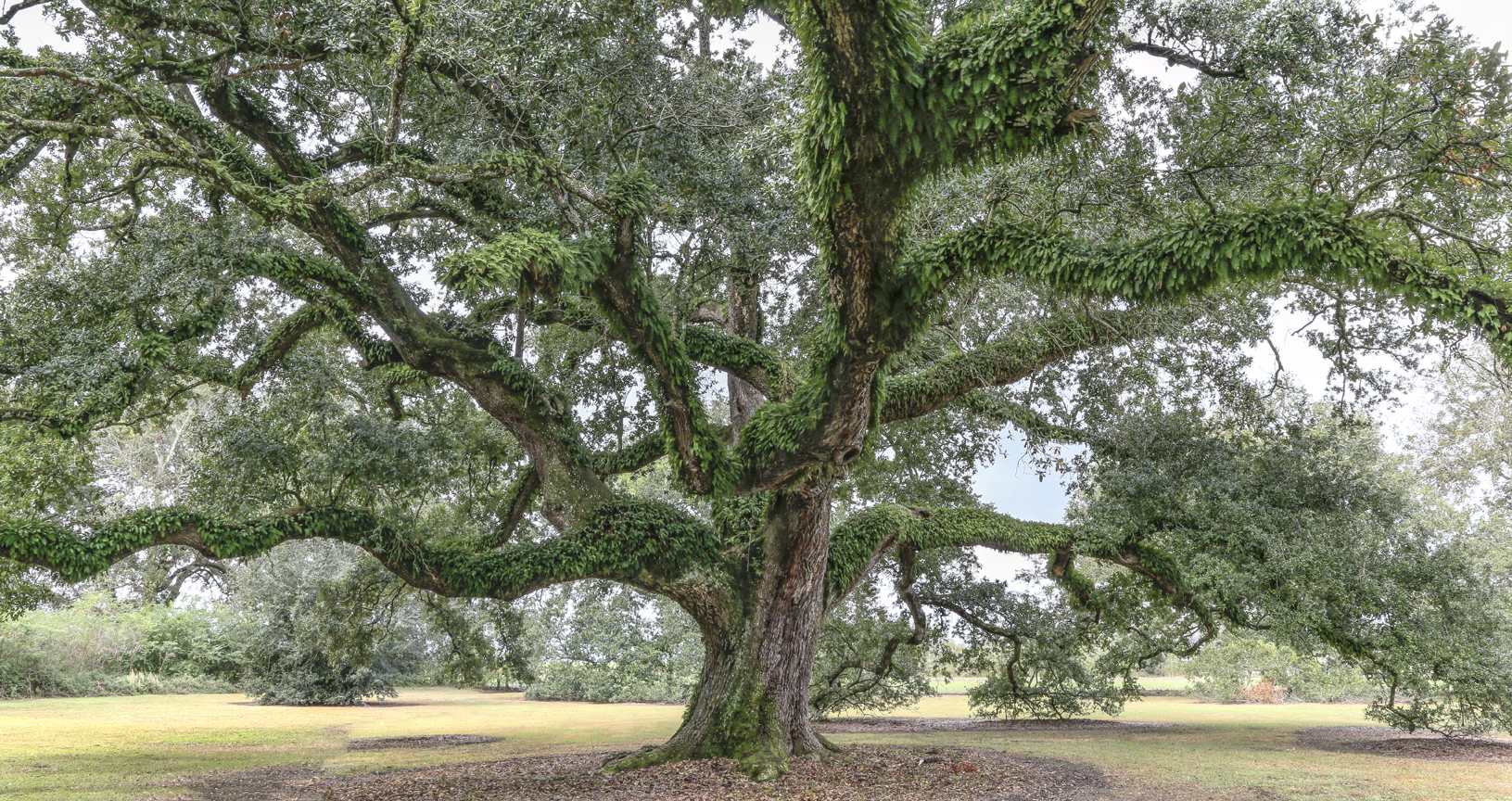
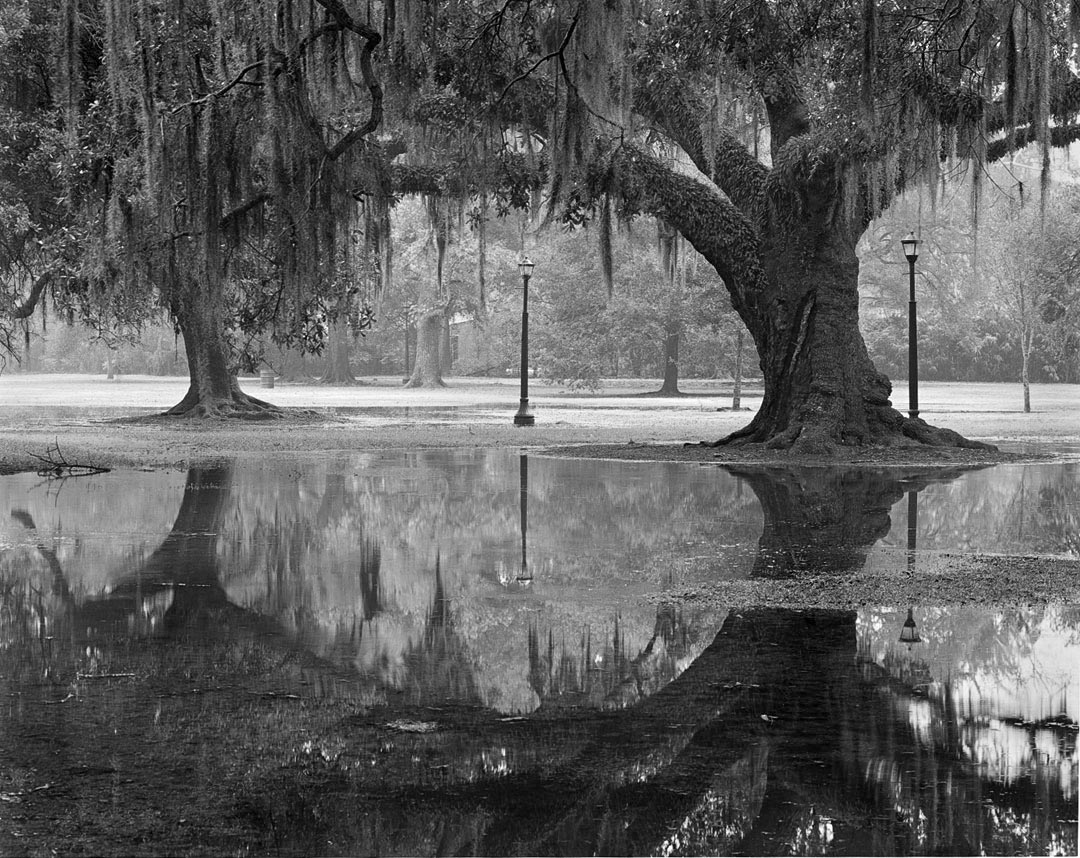
Revisiting the St. John Cathedral Oak – Lafayette

A Brief Review of The Live Oak Society…
In 1934, Dr. Edwin Lewis Stephens
, first president of Southwestern Louisiana Institute (now the University of Louisiana at Lafayette) proposed the creation of an organization made up entirely of the largest and oldest live oak trees in Louisiana. His vision was that the organization’s membership would include trees whose size and age made them significant cultural and natural resources, worth identifying and preserving for future generations to enjoy.

From his orientation as a scholar and writer, Stephens recognized the deeper truth of this Southern icon, the live oak symbolically reflects the most distinctive characteristics of the cultures and people that settled this rich alluvial area: strength of character, forbearance, longevity, and a hearty nature.

Beginning with just 43 inductee oaks in 1934, the Live Oak Society’s roster of member oaks now counts more than 9900 registered trees across 14 southeastern U.S. states. In the Lafayette area, there were 12 oaks among the original 43 charter members. Today, more than a thousand oaks in the Lafayette area are listed on the society’s registry.

The Cathedral Oak – Lafayette  

Cathedral Oak with original fence

Photo of Cathedral Oak by Dr. Stephens, circa the early 1930s

The St. John Cathedral Oak is probably the most well-known live oak in the Lafayette area. It is the second vice president of the Live Oak Society and was one of the society’s 43 original member trees. Some estimates place the tree’s age at more than 450 years old. The distinguished oak is located on the grounds of the Cathedral of St. John the Evangelist on St. John Street in old downtown Lafayette.
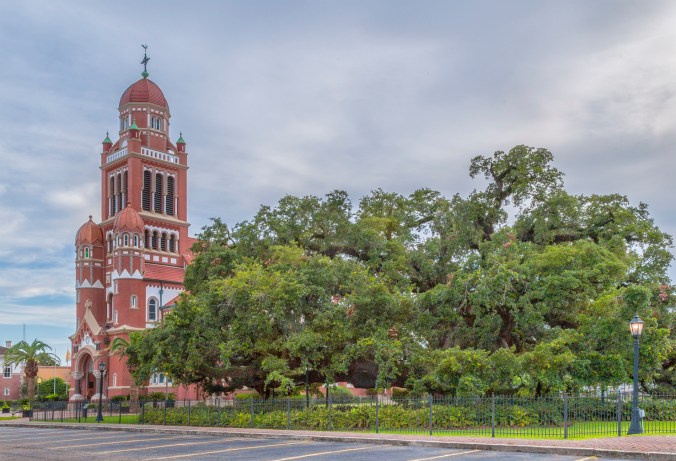
Cathedral Oak wide view#1

St. John Cathedral Oak and Cathedral, late afternoon

In 1821, Jean Mouton, an Acadian refugee, and owner of a large plantation named Vermilionville, donated the land on which the oak grows to the church parish. According to the cathedral’s website, the first pastor (Michel Bernard Barriere) may have requested this specific site from Mouton because of the towering live oak tree located there.

Cathedral Oak_#3_7_17

Cathedral Oak, Sunday afternoon light

According to Dr. Stephens, the oak was measured in 1929 with a circumference of 19 feet. In May 2008, local arborist Jim Foret measured the oak. The circumference was 28 feet 8 inches, it was 126 feet tall and had a crown spread of 210 feet. In May 2015, Foret measured the circumference again at 29 feet 6 inches. Foret says that old live oaks ordinarily grow much slower than this, but the soil around the Cathedral Oak received significant nurturing in the past two decades and that may have caused the growth surge. In the 1990s, a parking lot was moved away from the tree and in 1995 a protective fence was added to reduce foot traffic and protect the tree’s extensive root system.

Cathedra Oak morning_pano study 11

Cathedral Oak, morning light

The Cathedral Oak was well known to Dr. Stephens and he posed for several photographs in front of the oak during his tenure at SLI. He and his wife Beverly made frequent driving trips through the Acadiana back roads in search of notable live oaks. To their visiting guests, he was known for his “Live Oak Trail” tours where he would share some of his favorite old trees and groves across the Acadiana countryside. The Cathedral Oak was always at the top of his oak tour list. Many of his photographs documenting these trips can be found online at the Louisiana Digital Library under Southwestern Louisiana Institute Photographs, 1923-1940.

Next… Revisiting the Two Cleveland Oaks – at Avery Island and Jefferson Island.  
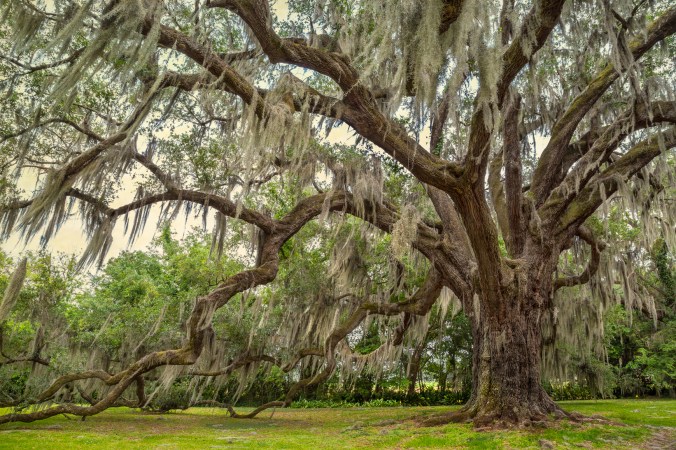
Coulon Plantation Oaks

The Coulon Plantation Oaks are on the Bayou Lafourche  Live Oak Tour, a project I’ve been working on for the Bayou Lafourche Cajun Bayou Tourism.  There is a beautiful group of oaks on the property, located at the intersection of LA. Hwy. 308 and Hwy. 3266, in north Thibodaux.  Most of the oaks are just under 100 years of age, but the oldest oak on the property, located to the right rear of the Coulon House, is approximately 300 years of age.

Coulon_old oak 1a

Oldest Coulon Oak,  color study 1

However, the most photogenic oaks at Coulon are along the entry road and across the massive front lawn stretching from Hwy. 308 to the Coulon House.

Front yard oak 4_Coulon

Front yard oak, study 2, Coulon

According to the current owner, there was once a matching oak to the right front of the house (similar to the one in the left front corner as shown below. The oldest oak can be seen to the right in this photo.), but it was lost to either lightning or disease.

Coulon House and two oaks_front_3

Near view of Coulon house and two oaks

Coulon Plantation was named for Victor Coulon, who may have owned the property but probably only grew crops there. It was not uncommon during that time for plantation land to be owned by wealthy families who lived elsewhere. Coulon’s primary residence was in Jefferson Parish, according to an 1830 census.

Coulon entry 2

Oaks along entry road

In 1835, Victor Coulon sold the plantation to Thomas Bibb, who also purchased Rienzi Plantation in that same year – 1835.  Bibb served as the second governor of the state of Alabama between 1820 and 1821 and likely kept a home on Bayou Lafourche as a second or third residence. Bibb’s main residence was in Alabama.  Local land records show that the property was purchased circa 1880 by Edward J. Gay, who acquired plantations as a function as a creditor for owners unable to pay off their debts. The land was later sold to a Beattie family.

Front yard oak_1_Coulon

Front yard oak with Coulon home in background

According to information from descendants of the Leche and Caldwell families, the Coulon House was built around 1940–1941 by John (Jean) Leche for his wife Albertine P. Leche. Leche bought Coulon plantation from E.G. Robichaux and Thomas H. Rogers, possibly in the 1930s. The Greek Revival architectural style of the home is reminiscent of antebellum plantations.


Leighton Plantation Oaks

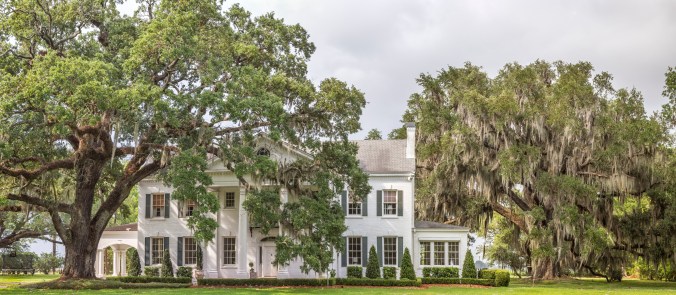
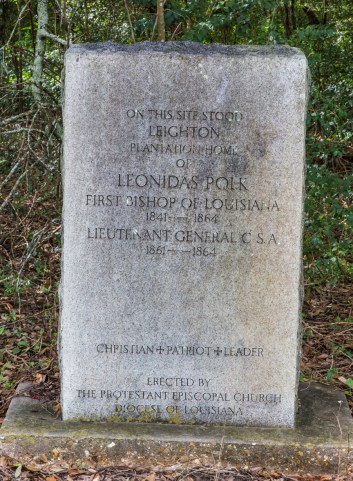
(The Leighton Plantation Oaks are located at 1801-1811 LA Hwy. 1 (St. Mary Street) about 2.5 miles north of downtown Thibodaux. The oaks are on the property between Leighton Road and Leighton Quarters Road. Turn onto Leighton Quarters Road to get the best view of the trees. The oaks range in age and size, the oldest and largest dating back to the early 1800s. There is a historic marker to Leonidas Polk at the St. Johns Episcopal Church in Thibodaux, and another (small and on the roadside) about a hundred feet north of the Leighton Quarters Road on the west side of Hwy 1.)

leighton-plantation-oaks-1

Oaks in front of current home at Leighton

There is a story that 22 of the oaks at Leighton Plantation belonged to the King of Spain in the late 1700s. As the story goes, the land grant for the property contained a stipulation that the King of Spain (Charles IV) could claim these “Royal Oaks” whenever he needed them for construction and repair of his royal navy. At the time, Spain was at war with England (1796–1808), and the wood from Louisiana’s live oaks was known worldwide to be strong enough to deflect an English cannonball.

leighton-oaks-pano-5

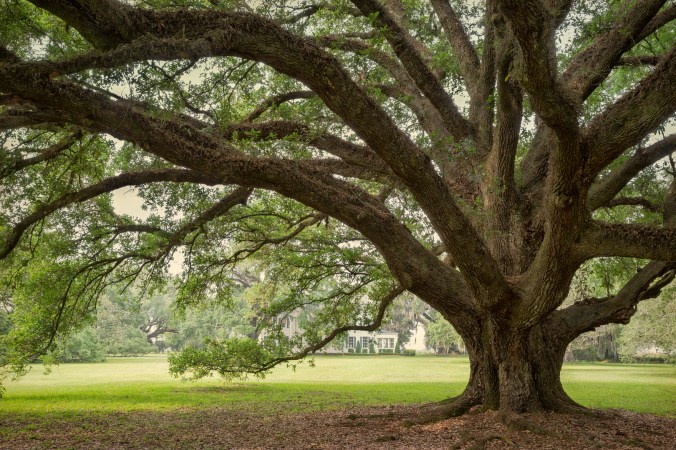
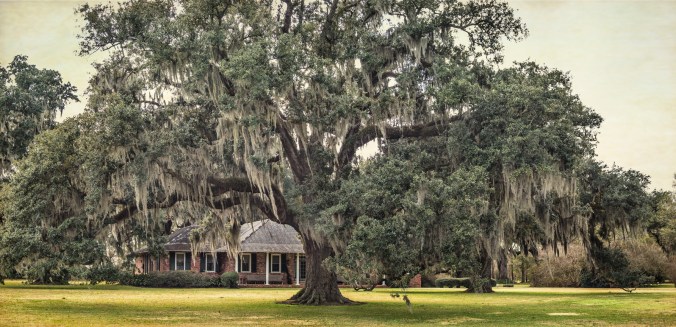
Leighton Oaks and back entry road to home

In the early 1800s, Leighton Plantation was owned by Leonidas Polk (April 10, 1806 – June 14, 1864), an Episcopal Bishop and American Confederate General. Polk was a graduate of the University of North Carolina at Chapel Hill and of the U.S. Military Academy at West Point (1827). After graduation from West Point, he received special permission to resign his new commission in the U.S. Army and attend the Virginia Theological Seminary where he was ordained as an Episcopal priest. He went on to become Missionary Bishop of the Southwest in 1838 and was elected Bishop of the Episcopal Diocese of Louisiana in 1841.

leighton-oaks-pano-study-2_layers

Oak grove behind the home, Leighton Plantation

Bishop Polk established Leighton Plantation to be closer to his work as he frequently traveled between Thibodaux and New Orleans where he administered the Louisiana Episcopal Diocese from Christ Cathedral, New Orleans’ first Protestant Episcopalian church. During his tenure as bishop, he personally established St. Johns Episcopal Church in Thibodaux, Christ Church in Napoleonville, the Church of the Ascension in Donaldsonville, the Church of the Holy Communion in Plaquemine, and Trinity Church in Natchitoches. Through his crusading evangelical efforts, the Protestant Episcopal religion made a significant foothold in the predominantly Roman Catholic Louisiana.

l_polk-stone

Historic roadside marker for Leonidas Polk

Bishop Polk strongly believed in states’ rights and that the South was a “distinct cultural entity.” So after Louisiana seceded from the Union in January of 1861 and the Civil War began, he resigned as Bishop of Louisiana and took command of Confederate forces in western Tennessee. His most notable contribution to the Army of Tennessee was his calm ability to inspire confidence and religious beliefs, earning him the nickname, the “Fighting Bishop.” Polk was killed in battle in June 1864 at Pine Mountain, Georgia.

This is a mirror post from the Lafourche Live Oak Tour – which was created through the generous support of the Bayou Lafourche Convention & Visitors Bureau. View more of this blog site and share it with friends at www.liveoaktour.com.

The Lafourche Historic Live Oak Tour

New Hope Plantation Oak, Matthews, LA

Dear readers, I’ve been hard at work on an entirely separate (but equal) blog site that grew out of my work on the 100 Oaks Project. In August, I was awarded a grant through the Bayou Lafourche Convention and Visitors Bureau to create a self-guided driving tour of the historic oaks along Bayou Lafourche.

beauregard-oak-11_8

General P.G.T Beauregard Oak, 20 ft. 2 in. in girth, located on LA Hwy. 1, at the E.D. White Memorial Home site.

For this grant project, I’m photographing historic live oaks around the parish and writing about the history of the people and events that have occurred around these old oaks for a website and brochure. I’m also creating and posting “waymarker signs” (like the image above) that will be located close to the oaks’ locations, near the two main highways that run on either side of Bayou Lafourche (LA Hwy. 1 and Hwy. 308).

boudreaux-oak-study-2-copy

Boudreaux Oak, 29 ft. 2 in. in girth, located near the community of St. Charles, LA Hwy 1

These way-marker signs will have numbers that a visitor can follow using a brochure, or the Tour website. The brochures and website will contain photographs of the trees (like those above) and provide a brief explanation of the significance of their location to the history of the parish. Visitors can take a self-guided driving tour along Bayou Lafourche and learn about the history of the parish through the location of our historic live oaks.

I will begin mirror-posting the Live Oak Tour site pages here, on the 100 Oaks Project site, since they are all part of the same work.  Enjoy!  And if you’d like to see the other site in its entirety, just go to https://liveoaktour.com.

Jamie Oak, Hwy. 308, near Thibodaux

The Effects of Flooding on Live Oaks

2oaks-and-reflection_Audubon-copy

In general, live oaks have a high tolerance to storms and floods. But I’ve received questions from several friends concerned about how the recent flooding in Louisiana might affect their live oaks. Most centenarian (100 years +) live oaks in Louisiana have weathered multiple storms in its lifetime. The Seven Sisters Oak in Mandeville, being the oldest live oak in the South, has probably weathered hundreds of storms and several floods.I asked several arborists/ horticulturists who I know and whose opinions I respect to provide some answers about the effects of flooding on live oaks.  Here’s what they had to say:

Carefully watch the oaks: Arborist Jim Foret (The Tree Guy) from St. Martinville, teaches at ULL and has years of experience with old live oaks in the Acadiana area. He says that short-term flooding, as we’ve experienced recently, is likely to have little effect on healthy live oaks. Jim advises to watch your trees closely after the floodwater subsides to see if they begin dropping leaves, which could be an indication of root damage. If there’s indication of root damage, the tree may require mulch and a microbial boost (mycorrhiza). He believes in this case that the oaks can pretty much take care of themselves with minimum help from human caregivers.

Help the roots dry: An article by Dan Gill, the Times Picayune garden columnist and LSU AgCenter horticulturist says to “remove all mulches to allow the soil to dry out more rapidly. Then replace them. (read the full article below)

Speaking of mulch: Church Point arborist Bob Thibodaux (Bob’s Tree Preservation) who has worked with oak live oaks for decades believes that live oaks prefer mulch made from other live oaks. He manufactures and uses an “eco-mulch” made from local vegetation composed mostly of live oak compost and recommends it over other types of mulches.

Bruce Verdun, another arborist from Gray (Organicure) who is especially interested in the care and maintenance of old oaks, says that ideally you should have a skilled arborist look at and evaluate the impact of flood waters fairly soon after a flood. Each tree is different he emphasizes, and each needs to be examined and evaluated individually.

Pollutants in the waters? One serious problem with flooding is contaminants in the water that might stay in the soil and slowly affect the health of the tree.  A soil sample can help determine the amount of pollution and what needs to be done to rebalance soil post-flood. Contact your local LSU agent or an arborist to have a soil sample evaluation.

Allen Owings from the LSU Ag Center in Hammond (where they had floods) passed along an article by Dan Gill published right after the flooding. I’ll quote it in its entirely.

08/16/16) BATON ROUGE, La. – Root damage through drowning or root rot is the greatest danger to landscape plants caused by flooding. And even if a property didn’t have standing water, it likely has been saturated. And the longer the soil stays saturated, the more damage occurs.

Plant roots get the oxygen they need from air spaces in the soil, said LSU AgCenter horticulturist Dan Gill. When these spaces are filled with water, roots are deprived of the oxygen and may drown. “Initially, the roots stop functioning properly,” Gill said. “When the bright sun comes out, it’s not unusual for plants to wilt because the roots quit absorbing water.”

If floodwaters remain for several days, shrubs and herbaceous plants may be extensively damaged or killed. “Carefully assess shrubs that may appear dead,” Gill said. Scrape the bark in several areas. Green tissue under the bark indicates the shrubs are still alive and may recover.

Don’t be too hasty in removing landscape plants. Some plants that appear dead may begin to send out new growth a few weeks after the water recedes, Gill said. But shrubs that show no green tissue below the bark are likely dead. Floodwaters carry silt and debris that may be deposited on lawns as well as low-growing plants, such as shrubs, ground covers, annuals and perennials. It’s important to remove the debris as soon as possible, using a rake to remove most of the larger material and then a hose to wash off the remainder.

Also remove all mulches to allow the soil to dry out more rapidly. Then replace them. Even if fruit and vegetable plants are still alive, do not consume any fruits, vegetables or herbs that were or could have been touched by flood waters, Gill said. Remove and discard any produce.

You may, however, eat any fruit from trees, shrubs and vines in the future. And you may also generally eat the new growth of herbs and vegetables produced after the floodwaters recede. If a lawn is damaged or killed, a new lawn can be established or an existing lawn can be repaired using sod, plugs or seed.

Hope this helps – Best, Bill